Identifying groups and the reaction map · Identification des groupes et carte réactionnelle
| English | Français |
|---|---|
| organic synthesis/ɔːˈɡænɪk ˈsɪnθəsɪs/ | synthèse organique |
| functional group/ˈfʌŋkʃənl ɡruːp/ | groupe fonctionnel |
| bromine water/ˈbrəʊmaɪn ˈwɔːtə/ | eau bromée |
| silver nitrate/ˈsɪlvə ˈnaɪtreɪt/ | nitrate d'argent |
| nitrile/ˈnaɪtraɪl/ | nitrile |
Reading a molecule's reactions
- Organic synthesis 有机合成 doesn't add new reactions — it joins the ones you know.
- First, identify the functional groups 官能团 present.
- Then use a map of reactions to get from one to another.
Lire les réactions d'une molécule
- La synthèse organique 有机合成 n'ajoute pas de nouvelles réactions — elle associe celles que vous connaissez.
- D'abord, identifier les groupes fonctionnels 官能团 présents.
- Ensuite, utiliser une carte des réactions pour passer d'un groupe à l'autre.
Reaction map lab · Lab de carte réactionnelle
Classify clues that identify functional groups and reaction pathways. · Classifiez les indices qui identifient les groupes fonctionnels et les voies réactionnelles.
A reaction map links functional groups by the reactions that interconvert them. · Une carte réactionnelle relie les groupes fonctionnels par les réactions qui les interconvertisse.
Used to plan and identify reactions. · Utilisée pour planifier et identifier les réactions.
Functional group tests
- decolourises bromine water 溴水 → a C=C (alkene).
- precipitate with silver nitrate 硝酸银 → a halogenoalkane.
- orange dichromate → green → a primary/secondary alcohol.
- orange precipitate with 2,4-DNPH → an aldehyde or ketone.
- fizzes with a carbonate → a carboxylic acid.
Identification tests for the AS functional groups
Tests de groupes fonctionnels
- décolore l'eau bromée 溴水 → une C=C (alcène).
- précipité avec la nitrate d'argent 硝酸银 → un halogénure d'alcanes.
- dichromate orange → vert → un alcool primaire/secondaire.
- précipité orange avec la 2,4-DNPH → un aldéhyde ou cétone.
- gazouille avec un carbonate → un acide carboxylique.

Tests d'identification pour les groupes fonctionnels AS
A compound that decolourises bromine water contains: · Un composé qui décolore l'eau bromée contient :
Decolourising bromine water is the test for a C=C double bond. · Le décolorement de l'eau bromée est le test pour une double liaison C=C.
An orange precipitate with 2,4-DNPH indicates: · Un précipité orange avec le 2,4-DNPH indique :
2,4-DNPH detects the carbonyl group (aldehyde or ketone). · Le 2,4-DNPH détecte le groupe carbonyle (aldéhyde ou cétone).
Match each test to what it shows. · Associez chaque test à ce qu'il montre.
Each item links the term to its correct meaning. · Chaque élément relie le terme à sa signification correcte.
The reaction map
| Start | Reagent | Product |
|---|---|---|
| alkene | steam, $\text{H}_3\text{PO}_4$ | alcohol |
| halogenoalkane | NaOH(aq) | alcohol |
| halogenoalkane | KCN in ethanol | nitrile 腈 (+1 carbon) |
| alcohol | dichromate (distil/reflux) | aldehyde / carboxylic acid |
| aldehyde/ketone | $\text{NaBH}_4$ | alcohol |
| nitrile | dilute acid | carboxylic acid |
| acid + alcohol | conc. $\text{H}_2\text{SO}_4$ | ester |
A map of the AS organic reactions to plan a synthesis
Carte des réactions
| Départ | Réactif | Produit |
|---|---|---|
| alcène | vapeur d'eau, $\text{H}_3\text{PO}_4$ | alcool |
| halogénure d'alcanes | NaOH(aq) | alcool |
| halogénure d'alcanes | KCN dans l'éthanol | nitrile 腈 (+1 carbone) |
| alcool | dichromate (distillation/reflux) | aldéhyde / acide carboxylique |
| aldéhyde/cétone | $\text{NaBH}_4$ | alcool |
| nitrile | acide dilué | acide carboxylique |
| acide + alcool | $\text{H}_2\text{SO}_4$ concentré | ester |
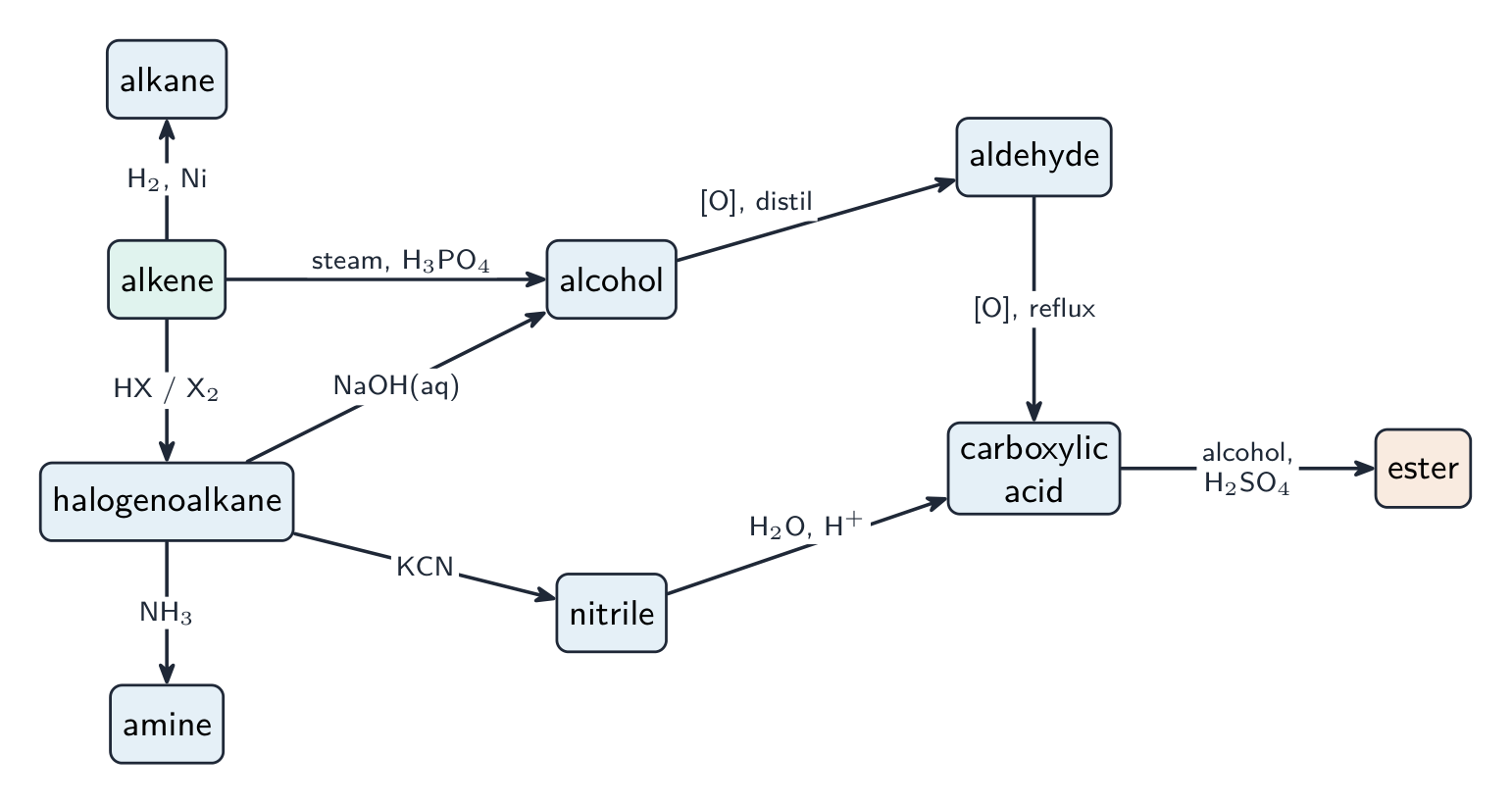
Une carte des réactions organiques AS pour planifier une synthèse
According to the reaction map, an alkene + steam (H₃PO₄) gives: · Selon la carte réactionnelle, un alcène + vapeur d'eau (H₃PO₄) donne :
Electrophilic addition of water across the C=C gives an alcohol. · L'addition électrophile d'eau sur la C=C donne un alcool.
Which step lengthens the carbon chain by one? · Quelle étape allonge la chaîne carbonée d'une unité ?
KCN adds a CN group (a carbon) — the only AS reaction that lengthens the chain. · KCN ajoute un groupe CN (un carbone) — la seule réaction AS qui allonge la chaîne.
Worked example: a two-step synthesis
- Plan by working backwards from the target, then check each step's reagents.
Make propanoic acid (3 C) from bromoethane (2 C). You need to add a carbon, so use KCN:
- Bromoethane + KCN (in ethanol) → propanenitrile (CH₃CH₂CN) — chain lengthened by one carbon.
- Propanenitrile + dilute acid (hydrolysis) → propanoic acid (CH₃CH₂COOH).
The KCN step is the key — it's the only one here that adds a carbon.
Exemple résolu : synthèse en deux étapes
- Planifier en travaillant à rebours depuis le produit cible, puis vérifier les réactifs de chaque étape.
Synthétiser l'acide propanoïque (3 C) à partir de bromoéthane (2 C). Vous devez ajouter un carbone, utilisez donc du KCN :
- Bromoéthane + KCN (dans l'éthanol) → propanenitrile (CH₃CH₂CN) — chaîne allongée d'un carbone.
- Propanenitrile + acide dilué (hydrolyse) → acide propanoïque (CH₃CH₂COOH).
L'étape au KCN est cruciale — c'est la seule ici qui ajoute un carbone.
You've got it
- synthesis joins known reactions to build a target — plan it backwards from the target
- tests: bromine water (alkene), AgNO₃ (halogenoalkane), dichromate (1°/2° alcohol), 2,4-DNPH (carbonyl), carbonate fizz (acid)
- the reaction map converts group to group; KCN is the only step that adds a carbon
- each arrow needs its reagents and conditions
Vous avez compris
- la synthèse associe des réactions connues pour construire un produit cible — planifiez-la à rebours depuis le produit cible
- tests : eau bromée (alcène), AgNO₃ (halogénure d'alcanes), dichromate (alcool 1°/2°), 2,4-DNPH (carbonyle), gazouillement de carbonate (acide)
- la carte des réactions convertit un groupe en un autre ; le KCN est la seule étape qui ajoute un carbone
- chaque flèche nécessite ses réactifs et conditions