Elimination and SN1/SN2 mechanisms
Introduit| English | Sens |
|---|---|
| elimination/ɪˌlɪmɪˈneɪʃn/ | élimination |
| transition state/trænˈsɪʃn steɪt/ | transition state : état de transition |
| carbocation/ˌkɑːbəˈkeɪʃn/ | carbocation : carbocation |
| steric hindrance | steric hindrance |
| inductive effect/ɪnˈdʌktɪv ɪˈfekt/ | The shift of electron density through sigma bonds caused by differences in electronegativity or charge. |
| bond energy/bɒnd ˈenədʒi/ | énergie de liaison |
Elimination 消去 and the SN1/SN2 mechanisms
- The same halogenoalkane can substitute or eliminate.
- Nucleophilic substitution follows one of two mechanisms.
- And the C–X bond strength sets the reactivity.
An SN2 mechanism goes via a carbocation intermediate.
Difficulté 1/5 · 100 pièces + un petit bonus lors de la première réussite aujourd'hui
False. SN2 is a one-step concerted mechanism. It is SN1 that goes via a carbocation intermediate.
Substitution vs elimination
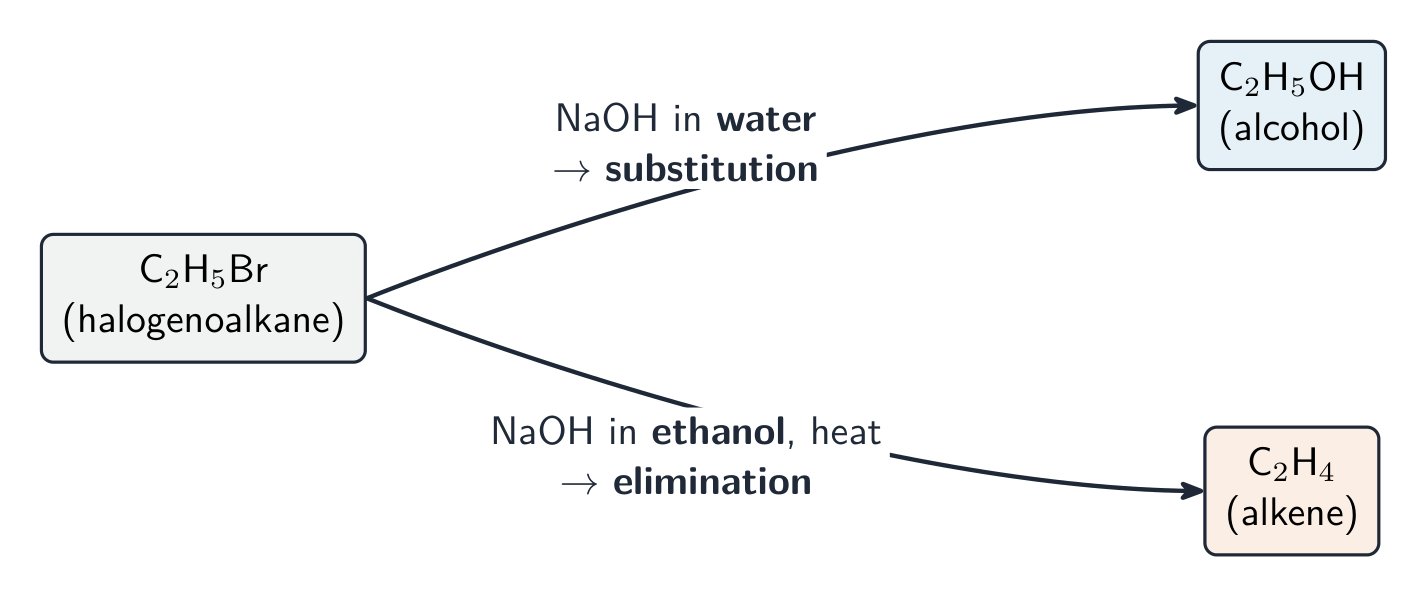
- $\text{NaOH}$ in water → nucleophilic substitution → an alcohol.
- $\text{NaOH}$ in ethanol, heated → elimination → an alkene:
$$\text{C}_2\text{H}_5\text{Br} + \text{NaOH} \rightarrow \text{C}_2\text{H}_4 + \text{NaBr} + \text{H}_2\text{O}$$
The SN2 mechanism, step by step
Step through nucleophilic substitution. The nucleophile attacks from behind as the halide leaves — all in one smooth step, flipping the molecule inside-out.
Heating a halogenoalkane with NaOH dissolved in ethanol gives:
Difficulté 1/5 · 100 pièces + un petit bonus lors de la première réussite aujourd'hui
NaOH in ethanol with heat favours elimination of HX to form an alkene; NaOH in water favours substitution.
Match each mechanism to its description.
Difficulté 2/5 · 140 pièces + un petit bonus lors de la première réussite aujourd'hui
Each item links the term to its correct meaning.
SN1 and SN2
- SN2: one step — the nucleophile attacks as the halogen leaves, through a crowded transition state. Rate depends on both reactants.
- SN1: two steps — the C–X bond breaks to a carbocation first, then the nucleophile attacks. Rate depends only on the halogenoalkane.
- Primary → mostly SN2; tertiary → mostly SN1 (its carbocation is well stabilised); secondary uses both.
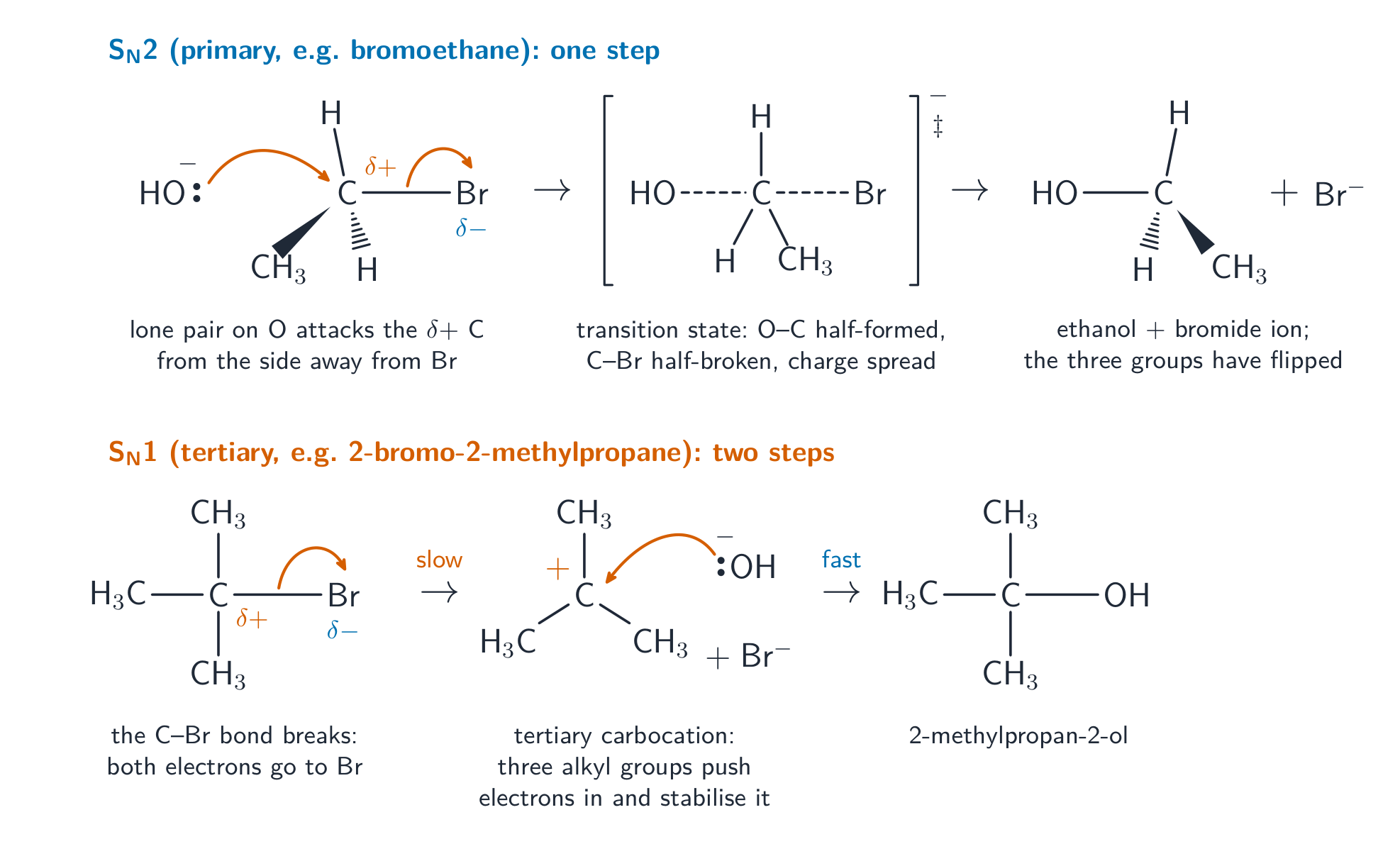
Curly arrows start at a lone pair or a bond: SN2 goes through a charged transition state 过渡态, SN1 through a carbocation 碳正离子
The SN1 mechanism:
Difficulté 1/5 · 100 pièces + un petit bonus lors de la première réussite aujourd'hui
SN1: C–X breaks first to a carbocation, then the nucleophile attacks; tertiary halogenoalkanes favour it.
The SN2 mechanism:
Difficulté 1/5 · 100 pièces + un petit bonus lors de la première réussite aujourd'hui
SN2 is a single concerted step; primary halogenoalkanes favour it and its rate depends on both species.
Why the class of halogenoalkane matters
- Steric hindrance 空间位阻: in a tertiary halogenoalkane, three bulky alkyl groups crowd the carbon, so the nucleophile cannot reach it from the back. SN2 is blocked.
- Carbocation stability: alkyl groups push electron density towards a positive carbon (the positive inductive effect 诱导效应). A tertiary carbocation has three such groups, so it is stable enough for SN1.
Why does 2-bromo-2-methylpropane react by SN1 rather than SN2?
Difficulté 1/5 · 100 pièces + un petit bonus lors de la première réussite aujourd'hui
Steric hindrance stops SN2, and the positive inductive effect of three alkyl groups stabilises the tertiary carbocation.
Put these carbocations in order of stability, most stable first.
Difficulté 3/5 · 200 pièces + un petit bonus lors de la première réussite aujourd'hui
More alkyl groups give more electron donation to the positive carbon.
Using rate data. A halogenoalkane RBr reacts with $\text{OH}^-$. Doubling $[\text{RBr}]$ doubles the rate; doubling $[\text{OH}^-]$ leaves the rate unchanged.
- Rate $=k[\text{RBr}]$: only RBr is in the slow step. This is SN1: the slow step is C–Br breaking to a carbocation.
- So RBr is most likely tertiary, e.g. 2-bromo-2-methylpropane. For 1-bromobutane you would expect rate $=k[\text{RBr}][\text{OH}^-]$ (SN2).
For the SN1 hydrolysis of 2-bromo-2-methylpropane, by what factor does the rate change if $[\text{OH}^-]$ is doubled?
Difficulté 2/5 · 140 pièces + un petit bonus lors de la première réussite aujourd'hui
In SN1 the slow step involves only the halogenoalkane, so rate $= k[\text{RBr}]$ and doubling $[\text{OH}^-]$ leaves it unchanged (factor 1).
Reactivity and the C–X bond
- Reactivity depends on the C–X bond strength (bond energy 键能).
- C–I is weakest → iodoalkanes react fastest; C–Cl is strongest → chloroalkanes slowest.
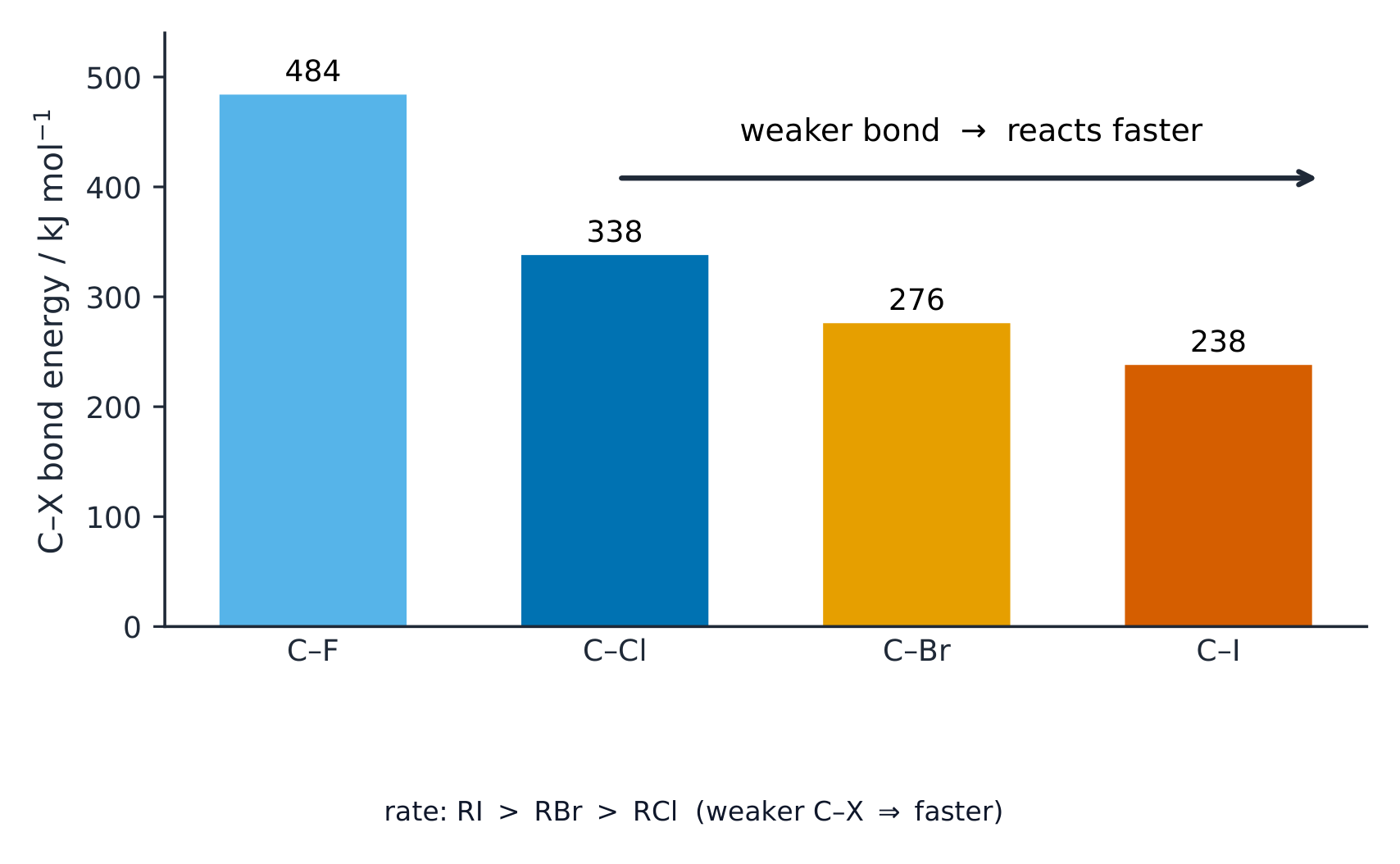
The weaker the C-X bond, the faster the halogenoalkane reacts
Which halogenoalkane reacts fastest?
Difficulté 1/5 · 100 pièces + un petit bonus lors de la première réussite aujourd'hui
The weaker the C–X bond, the faster the reaction, so C–I (weakest) reacts fastest and C–Cl slowest.
Worked example: one halogenoalkane, three outcomes
Predict the mechanism and product for (a) 1-bromobutane with warm NaOH(aq), (b) 2-bromo-2-methylpropane with warm NaOH(aq), (c) 2-bromopropane with NaOH in ethanol, heated.
- (a) Primary, so SN2: $\text{OH}^-$ attacks as $\text{Br}^-$ leaves, giving butan-1-ol; rate $= k[\text{RBr}][\text{OH}^-]$. (b) Tertiary: the C–Br breaks first to a stable carbocation, SN1, giving 2-methylpropan-2-ol; rate $= k[\text{RBr}]$.
- (c) Ethanol and heat favour elimination: $\text{OH}^-$ removes an H from a carbon next to the C–Br, giving propene + NaBr + $\text{H}_2\text{O}$.
2-bromobutane is heated with NaOH in ethanol. Which products can form?
Difficulté 1/5 · 100 pièces + un petit bonus lors de la première réussite aujourd'hui
The H can be removed from C1 or C3, so the C=C forms on either side of C2: but-1-ene or but-2-ene.
You've got it
- NaOH in water → substitution (alcohol); NaOH in ethanol + heat → elimination (alkene)
- SN2 = one step, rate depends on both; SN1 = two steps via a carbocation, rate depends on the halogenoalkane only
- primary → SN2, tertiary → SN1; iodoalkanes react fastest (weakest C–X bond)