Reactions of the halide ions
Introduit| English | Sens |
|---|---|
| halide/ˈhælaɪd/ | halogénure |
| reducing agent/rɪˈdjuːsɪŋ ˈeɪdʒənt/ | agent réducteur |
| precipitate/prɪˈsɪpɪteɪt/ | précipité |
| silver nitrate/ˈsɪlvə ˈnaɪtreɪt/ | nitrate d'argent |
Spotting a halide 卤离子
- Old camera film worked because silver bromide darkens in light. The same silver halides, white, cream and yellow, tell a chemist which halide 卤离子 is in a solution.
- Halide ions can also give away electrons: they are reducing agents 还原剂, and the power increases down the group. Two tests use these facts.
Halide ion test lab
Match halide ion evidence to the ion present.
The reducing power of the halide ions increases down the group because:
Difficulté 1/5 · 100 pièces + un petit bonus lors de la première réussite aujourd'hui
Reducing means losing an electron; bigger ions lose theirs more easily, so reducing power rises down the group.
Silver nitrate solution is used to test for ______ ions.
Difficulté 1/5 · 100 pièces + un petit bonus lors de la première réussite aujourd'hui
Different halides give different coloured precipitates.
Reducing power
- A halide ion ($\text{Cl}^{-}$, $\text{Br}^{-}$, $\text{I}^{-}$) acts as a reducing agent (it loses an electron).
- This power increases down the group, because a larger ion holds its outer electron less tightly.
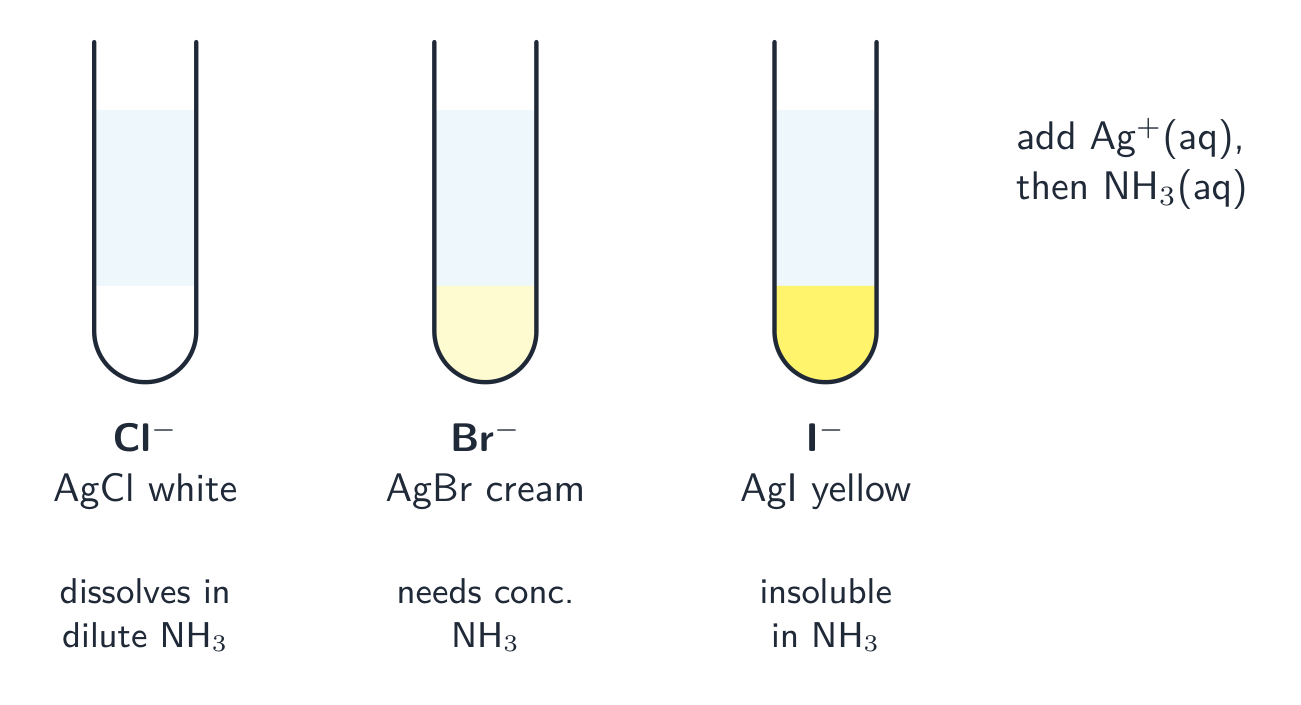
Silver halide precipitate 沉淀 colours and their solubility in ammonia identify the halide
Silver nitrate 硝酸银 test
Acidify with dilute nitric acid, add silver nitrate 硝酸银, then test the precipitate with ammonia. $\text{Ag}^+(\text{aq})+\text{X}^-(\text{aq})\rightarrow\text{AgX}(\text{s})$.
| Halide | Precipitate | In ammonia |
|---|---|---|
| $\text{Cl}^{-}$ | white | dissolves in dilute ammonia |
| $\text{Br}^{-}$ | cream | dissolves in concentrated ammonia |
| $\text{I}^{-}$ | yellow | insoluble |
Match each halide to its silver halide precipitate colour.
Difficulté 2/5 · 140 pièces + un petit bonus lors de la première réussite aujourd'hui
AgCl is white, AgBr cream, AgI yellow; ammonia solubility confirms (Cl dissolves in dilute, I insoluble).
Silver iodide (AgI) is:
Difficulté 1/5 · 100 pièces + un petit bonus lors de la première réussite aujourd'hui
AgI is yellow and does not dissolve in ammonia, distinguishing it from AgCl (white) and AgBr (cream).
With concentrated sulfuric acid
- All three first give steamy fumes of the hydrogen halide: $\text{NaX}+\text{H}_2\text{SO}_4\rightarrow\text{NaHSO}_4+\text{HX}$. Chloride stops there, because $\text{Cl}^-$ is too weak a reducing agent to go further.
- $\text{Br}^-$ and $\text{I}^-$ go on to reduce the sulfuric acid. Bromide gives brown $\text{Br}_2$ and $\text{SO}_2$; iodide gives purple-black $\text{I}_2$, $\text{SO}_2$ and $\text{H}_2\text{S}$ (rotten-egg smell), because $\text{I}^-$ is the strongest reducing agent.
With concentrated sulfuric acid, iodide gives I₂ plus H₂S because:
Difficulté 1/5 · 100 pièces + un petit bonus lors de la première réussite aujourd'hui
I⁻ is the strongest reducer, so it reduces the sulfuric acid all the way to H₂S (and forms I₂); Cl⁻ only gives HCl.
The redox equations
- Bromide: $2\text{HBr}+\text{H}_2\text{SO}_4\rightarrow\text{Br}_2+\text{SO}_2+2\text{H}_2\text{O}$. Sulfur goes from $+6$ to $+4$.
- Iodide: $8\text{HI}+\text{H}_2\text{SO}_4\rightarrow4\text{I}_2+\text{H}_2\text{S}+4\text{H}_2\text{O}$. Sulfur goes all the way from $+6$ to $-2$: iodide reduces it the furthest.
What is the oxidation state of sulfur in SO₂?
Difficulté 2/5 · 140 pièces + un petit bonus lors de la première réussite aujourd'hui
$x+2(-2)=0$, so $x=+4$. In H₂SO₄ it was +6, so bromide reduces sulfur by two.
Which halide ion reduces sulfuric acid all the way to H₂S?
Difficulté 1/5 · 100 pièces + un petit bonus lors de la première réussite aujourd'hui
I⁻ is the largest ion and the strongest reducing agent, reducing S from +6 to −2.
Worked example: identify the halide
A solution gives a cream precipitate with acidified silver nitrate. The precipitate dissolves in concentrated ammonia but not in dilute ammonia. The solid salt gives brown fumes with concentrated sulfuric acid.
- Cream, and soluble only in concentrated ammonia: the precipitate is AgBr, $\text{Ag}^+(\text{aq}) + \text{Br}^-(\text{aq}) \rightarrow \text{AgBr}(\text{s})$.
- The brown fumes confirm it: $\text{Br}^-$ is a strong enough reducing agent to reduce sulfuric acid to $\text{SO}_2$ and is oxidised to $\text{Br}_2$. A chloride would give only white fumes of HCl.
A halide gives a yellow precipitate with silver nitrate that does not dissolve in concentrated ammonia. What does the solid salt give with concentrated sulfuric acid?
Difficulté 1/5 · 100 pièces + un petit bonus lors de la première réussite aujourd'hui
Yellow and insoluble in ammonia means iodide. $\text{I}^-$ is the strongest reducing agent, reducing sulfuric acid as far as $\text{H}_2\text{S}$.
Oxidation states. In the reaction of iodide with concentrated sulfuric acid, how many electrons does each sulfur atom gain to form $\text{H}_2\text{S}$?
- S in $\text{H}_2\text{SO}_4$: $2(+1)+x+4(-2)=0$, so $x=+6$. S in $\text{H}_2\text{S}$: $-2$.
- Change $=8$, so each S gains 8 electrons. That is why 8 $\text{I}^-$ ions (each losing one electron) are needed per sulfur, as in the equation.
- Acidify with nitric acid, never hydrochloric acid: HCl adds $\text{Cl}^-$ and gives a white precipitate whatever the sample.
- The colours white, cream and yellow are hard to tell apart, so always confirm with ammonia.
- "Reducing power increases down the group" is about the ions. The halogen elements get weaker as oxidising agents down the group: the same trend seen from the other side.
Why is the sample acidified with nitric acid rather than hydrochloric acid before adding silver nitrate?
Difficulté 1/5 · 100 pièces + un petit bonus lors de la première réussite aujourd'hui
Nitric acid removes carbonate ions without adding halide ions. HCl would add Cl⁻ and give a false result.
You've got it
- halide ions are reducing agents; power increases down the group (larger ion, electron held loosely)
- silver nitrate test: AgCl white, AgBr cream, AgI yellow (confirm with ammonia solubility)
- conc. H₂SO₄: Cl⁻ → HCl only; Br⁻ → Br₂ + SO₂; I⁻ → I₂ + H₂S + SO₂ (strongest reducer)