Reactions across Period 3
Introduit| English | Sens |
|---|---|
| oxide/ˈɒksaɪd/ | oxyde |
| chloride/ˈklɔːraɪd/ | chlorure |
| oxidation number/ˌɒksɪˈdeɪʃn ˈnʌmbə/ | nombre d'oxydation |
Period 3 meets oxygen, chlorine and water
- Magnesium burns with one of the brightest flames in the lab; sulfur burns with a pale blue one. Exams ask for these observations and the equations.
- The products are oxides 氧化物 and chlorides 氯化物. Across the period, the element's oxidation number 氧化数 in them rises.
Period 3 reaction lab
Classify Period 3 reactions by what they reveal about bonding and acidity.
With oxygen
| Element | What you see | Equation |
|---|---|---|
| Na | bright yellow flame, white solid | $4\text{Na}+\text{O}_2\rightarrow2\text{Na}_2\text{O}$ |
| Mg | brilliant white flame, white solid | $2\text{Mg}+\text{O}_2\rightarrow2\text{MgO}$ |
| Al | white solid (powder burns brightly) | $4\text{Al}+3\text{O}_2\rightarrow2\text{Al}_2\text{O}_3$ |
| Si | heated strongly, white solid | $\text{Si}+\text{O}_2\rightarrow\text{SiO}_2$ |
| P | white flame, clouds of white smoke | $\text{P}_4+5\text{O}_2\rightarrow\text{P}_4\text{O}_{10}$ |
| S | blue flame, colourless choking gas | $\text{S}+\text{O}_2\rightarrow\text{SO}_2$ |
Sulfur is burned in air. What do you see, and what forms?
Difficulté 1/5 · 100 pièces + un petit bonus lors de la première réussite aujourd'hui
Sulfur burns with a pale blue flame to give sulfur dioxide. SO₃ needs a V₂O₅ catalyst (Contact process).
With chlorine
| Chloride | NaCl | MgCl₂ | AlCl₃ | SiCl₄ | PCl₅ |
|---|---|---|---|---|---|
| Oxidation number | +1 | +2 | +3 | +4 | +5 |
| Bonding | ionic | ionic | covalent (Al₂Cl₆ dimer) | covalent | covalent |
- Example: $2\text{Na}+\text{Cl}_2\rightarrow2\text{NaCl}$ (bright yellow flame, white solid); $2\text{Al}+3\text{Cl}_2\rightarrow2\text{AlCl}_3$.
The reaction of sodium with chlorine gives:
Difficulté 1/5 · 100 pièces + un petit bonus lors de la première réussite aujourd'hui
Sodium burns in chlorine to form sodium chloride: 2Na + Cl₂ → 2NaCl.
What is the oxidation number of silicon in SiCl₄? (Enter a signed number, e.g. 4 for +4.)
Difficulté 2/5 · 140 pièces + un petit bonus lors de la première réussite aujourd'hui
Cl is −1, so 4 × (−1) = −4; Si must be +4. Silicon uses all four outer electrons.
With water
- Sodium reacts fast with cold water: it fizzes and melts into a ball. $2\text{Na}+2\text{H}_2\text{O}\rightarrow2\text{NaOH}+\text{H}_2$, pH about 14.
- Magnesium reacts very slowly with cold water: $\text{Mg}+2\text{H}_2\text{O}\rightarrow\text{Mg(OH)}_2+\text{H}_2$. With steam it glows white: $\text{Mg}+\text{H}_2\text{O}\rightarrow\text{MgO}+\text{H}_2$.
Which Period 3 elements react with water?
Difficulté 1/5 · 100 pièces + un petit bonus lors de la première réussite aujourd'hui
Only Na and Mg react with water; sodium reacts fast, magnesium only very slowly with cold water.
Sodium reacts vigorously with water to form sodium hydroxide and ______.
Difficulté 1/5 · 100 pièces + un petit bonus lors de la première réussite aujourd'hui
2Na + 2H₂O → 2NaOH + H₂.
Match each Period 3 reaction to its result.
Difficulté 2/5 · 140 pièces + un petit bonus lors de la première réussite aujourd'hui
Each item links the term to its correct meaning.
Magnesium reacts with steam. What are the products?
Difficulté 1/5 · 100 pièces + un petit bonus lors de la première réussite aujourd'hui
Mg + H₂O(g) → MgO + H₂.
Oxidation numbers rise across the period
| Oxide | Na₂O | MgO | Al₂O₃ | SiO₂ | P₄O₁₀ | SO₃ |
|---|---|---|---|---|---|---|
| Oxidation number | +1 | +2 | +3 | +4 | +5 | +6 |
- The maximum oxidation number equals the number of outer electrons used in bonding.
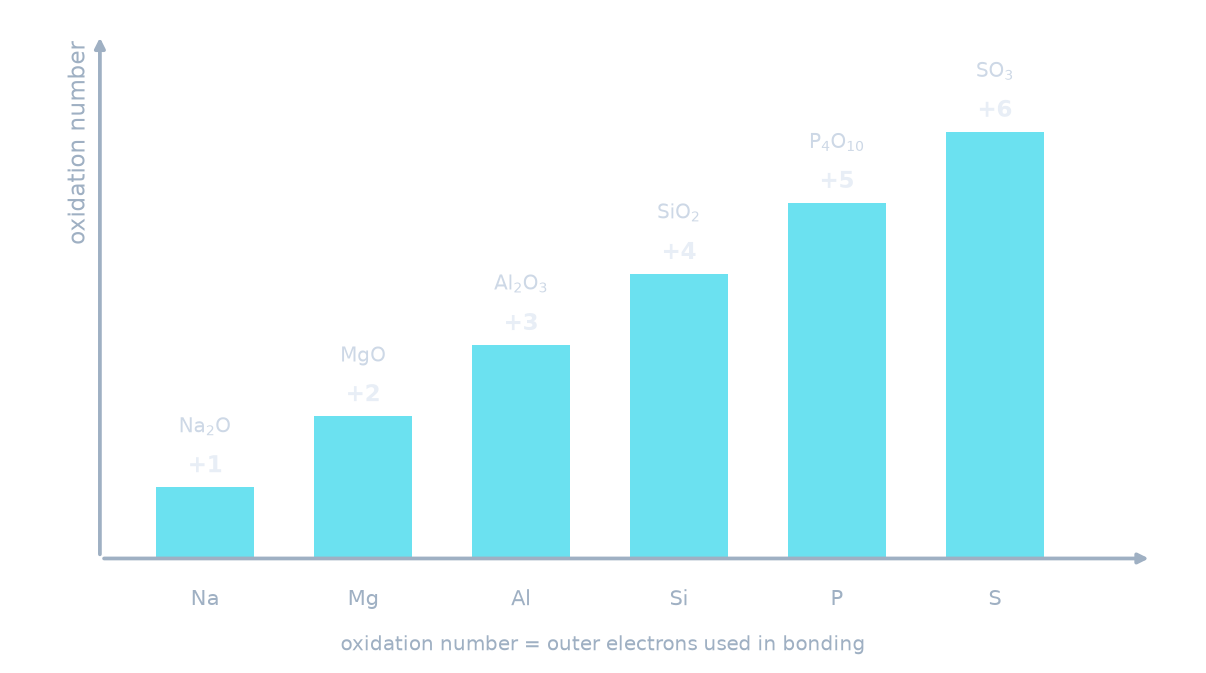
The oxidation number of the Period 3 element in its oxide rises across the period because it equals:
Difficulté 1/5 · 100 pièces + un petit bonus lors de la première réussite aujourd'hui
Going across, each element uses more valence electrons, so its oxidation number rises (+1 for Na up to +6 for S in SO₃).
In Al₂O₃, the oxidation number of aluminium is:
Difficulté 1/5 · 100 pièces + un petit bonus lors de la première réussite aujourd'hui
Na₂O is +1, MgO +2, Al₂O₃ +3 — the oxidation number rises across the period.
Write equations for aluminium burning in oxygen and phosphorus burning in excess oxygen. Give the oxidation number of the Period 3 element in each product, and link it to the outer electrons.
- $4\text{Al} + 3\text{O}_2 \rightarrow 2\text{Al}_2\text{O}_3$: Al is +3, matching its 3 outer electrons. $\text{P}_4 + 5\text{O}_2 \rightarrow \text{P}_4\text{O}_{10}$: P is +5, matching its 5 outer electrons.
- Check P: in $\text{P}_4\text{O}_{10}$, oxygen is −2, so $4x + 10(-2) = 0$ and $x = +5$. Across the period, more outer electrons can be used in bonding, so the maximum oxidation number rises.
What is the oxidation number of sulfur in SO₃?
Difficulté 2/5 · 140 pièces + un petit bonus lors de la première réussite aujourd'hui
x + 3(−2) = 0, so x = +6.
- Burning sulfur gives SO₂, not SO₃. SO₃ needs the Contact process (a catalyst).
- Magnesium with cold water gives Mg(OH)₂; with steam it gives MgO.
- In limited oxygen, phosphorus forms P₄O₆ (+3), not P₄O₁₀.
You've got it
- Learn the observations and equations for each element burning in oxygen and chlorine.
- Na reacts fast with cold water; Mg reacts slowly with cold water and fast with steam.
- The oxidation number rises across: +1 (Na) to +6 (S in SO₃) = outer electrons used.