Le Chatelier's principle
Introduit| English | Sens |
|---|---|
| equilibrium/ˌiːkwɪˈlɪbrɪəm/ | équilibre |
| Le Chatelier's principle/lə ˈtʃeɪtlɪəz ˈprɪnsɪpl/ | principe de Le Chatelier |
| position of equilibrium/pəˈzɪʃn ɒv ˌiːkwɪˈlɪbrɪəm/ | The relative amounts of reactants and products present when forward and reverse reaction rates are equal. |
| endothermic/ˌendəʊˈθɜːmɪk/ | endothermique |
| exothermic/eɡzəˈðɜːmɪk/ | Describing a process that transfers heat to its surroundings. |
| catalyst/ˈkætəlɪst/ | catalyseur |
Pushing a system at equilibrium
- Seal brown nitrogen dioxide in a syringe: $2\text{NO}_2(\text{g})\rightleftharpoons\text{N}_2\text{O}_4(\text{g})$. Push the plunger in and the brown colour first darkens, then fades a little. Put the syringe in ice water and the colour fades further.
- Le Chatelier's principle 勒夏特列原理 explains both: when a condition of a system at equilibrium 平衡 changes, the position of equilibrium 平衡位置 moves to oppose the change.
Changing a concentration
- Add more of a reactant and the position moves right, using some of it up. Remove a product and the position also moves right, making more of it.
- Adding a product, or removing a reactant, moves the position left.
In CH₃COOH + C₂H₅OH ⇌ CH₃COOC₂H₅ + H₂O, what happens to the position of equilibrium if water is removed?
Difficulté 1/5 · 100 pièces + un petit bonus lors de la première réussite aujourd'hui
Removing a product makes the system replace it, so the position moves right.
Changing the pressure (gases)
- Count the gas molecules on each side. Raising the pressure moves the position to the side with fewer gas molecules, which lowers the pressure.
- Lowering the pressure favours the side with more gas molecules. If both sides have the same number, pressure has no effect on the position.
For N₂(g) + 3H₂(g) ⇌ 2NH₃(g), what does raising the pressure do?
Difficulté 1/5 · 100 pièces + un petit bonus lors de la première réussite aujourd'hui
4 gas molecules on the left and 2 on the right. Higher pressure favours fewer molecules.
For CO(g) + H₂O(g) ⇌ CO₂(g) + H₂(g), raising the pressure moves the position of equilibrium to the right.
Difficulté 1/5 · 100 pièces + un petit bonus lors de la première réussite aujourd'hui
False. There are 2 gas molecules on each side, so pressure does not change the position.
Changing the temperature
- Raising the temperature moves the position in the endothermic 吸热 direction, which takes in the added heat. Lowering it favours the exothermic 放热 direction.
- Temperature is the only change that also alters the value of the equilibrium constant.
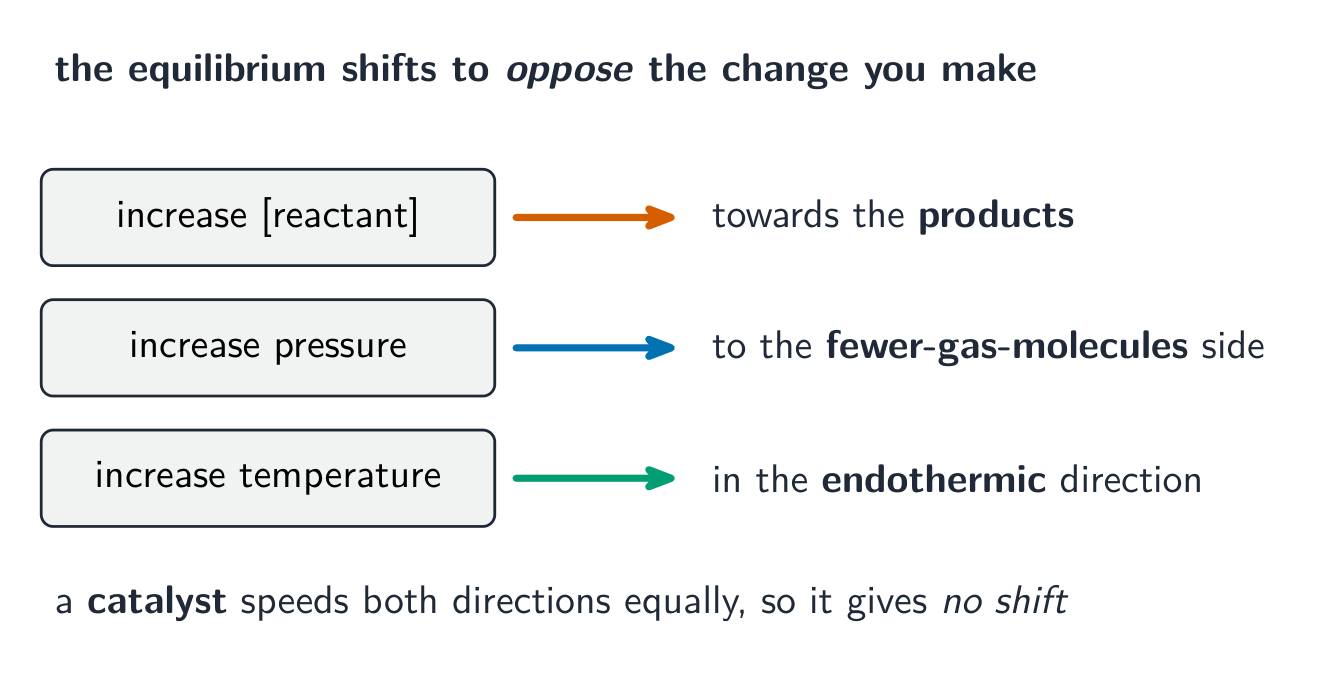
Principe de Le Chatelier
le système s'oppose au changement
Raise T, P or reactant and the equilibrium shifts to oppose your change.
For N₂O₄(g) ⇌ 2NO₂(g), ΔH = +57 kJ mol⁻¹, what does heating do?
Difficulté 1/5 · 100 pièces + un petit bonus lors de la première réussite aujourd'hui
Heating favours the endothermic direction, which here is the forward reaction. The mixture turns darker brown.
Catalysts do not move the position
- A catalyst 催化剂 speeds up the forward and reverse reactions by the same factor.
- Equilibrium is reached sooner, but the position and the yield at equilibrium stay the same.
What does adding a catalyst to a reaction at equilibrium do?
Difficulté 1/5 · 100 pièces + un petit bonus lors de la première réussite aujourd'hui
A catalyst speeds up both directions equally, so the position does not change.
The nitrogen dioxide syringe. $2\text{NO}_2(\text{g, brown})\rightleftharpoons\text{N}_2\text{O}_4(\text{g, colourless})$, $\Delta H=-57\ \text{kJ mol}^{-1}$.
- Push the plunger in: 2 gas molecules on the left, 1 on the right, so the position moves right. The colour darkens at first (the gas is squeezed), then fades as $\text{NO}_2$ becomes $\text{N}_2\text{O}_4$.
- Cool it: the forward reaction is exothermic, so cooling moves the position right. Less brown $\text{NO}_2$, paler colour.
The Contact equilibrium. $2\text{SO}_2(\text{g})+\text{O}_2(\text{g})\rightleftharpoons2\text{SO}_3(\text{g})$, $\Delta H=-197\ \text{kJ mol}^{-1}$.
- Raise the pressure: 3 gas molecules on the left, 2 on the right, so the position moves right and more $\text{SO}_3$ forms.
- Raise the temperature: the forward reaction is exothermic, so the position moves left and the yield falls.
- Add $\text{V}_2\text{O}_5$ (the catalyst): no shift; equilibrium is just reached sooner.
The forward reaction in the Haber process is exothermic. What happens to the yield of ammonia at equilibrium if the temperature is lowered?
Difficulté 1/5 · 100 pièces + un petit bonus lors de la première réussite aujourd'hui
Lowering the temperature favours the exothermic forward direction, so more ammonia. The reaction is slower, though.
When pressure does nothing. $\text{H}_2(\text{g})+\text{I}_2(\text{g})\rightleftharpoons2\text{HI(g)}$
- 2 gas molecules on each side, so raising the pressure does not move the position.
- The mixture does get darker purple, but only because the same $\text{I}_2$ is squeezed into a smaller volume.
- "Opposes" does not mean "cancels". After you add a reactant, its concentration settles above where it started, just not as high as right after you added it.
- Pressure only matters for gases. Count only (g) species, never solids or liquids.
- In answers, name the direction (right or left), then give the reason (fewer gas molecules, endothermic direction, uses up the added substance).
For CaCO₃(s) ⇌ CaO(s) + CO₂(g), what does raising the pressure do?
Difficulté 1/5 · 100 pièces + un petit bonus lors de la première réussite aujourd'hui
Count only gases. 0 gas molecules on the left and 1 on the right, so higher pressure moves the position left.
- Le Chatelier: the position of equilibrium moves to oppose a change.
- More reactant → right. Higher pressure → side with fewer gas molecules. Higher temperature → endothermic direction.
- A catalyst changes only how fast equilibrium is reached, not its position.
Match each change to its effect on 2SO₂ + O₂ ⇌ 2SO₃ (forward exothermic).
Difficulté 2/5 · 140 pièces + un petit bonus lors de la première réussite aujourd'hui
Pressure favours fewer gas molecules, heat favours the endothermic reverse reaction, and removing product makes more.