Polarity and van der Waals forces
Introduit| English | Sens |
|---|---|
| intermolecular force/ˌɪntəməˈlekjʊlə fɔːs/ | force intermoléculaire |
| dipole/ˈdaɪpəʊl/ | dipôle |
| polar/ˈpəʊlə/ | polaire |
| non-polar/nɒn ˈpəʊlə/ | non polaire |
| van der Waals' forces/ˈvændɜː wɑːlz ˈfɔːsɪz/ | forces de van der Waals |
| London dispersion/ˈlʌndn dɪˈspɜːʃn/ | dispersion de London |
Why some molecules stick
- Intermolecular forces 分子间力 act between molecules.
- They are much weaker than the bonds inside substances.
- They start with bond polarity.
Polarity and intermolecular forces lab
Classify molecules by the feature that controls attractions.
Compared with the bonds inside substances, intermolecular forces are:
Difficulté 1/5 · 100 pièces + un petit bonus lors de la première réussite aujourd'hui
Intermolecular forces (between molecules) are far weaker than ionic, covalent or metallic bonds within substances.
The weakest intermolecular forces, present between all molecules, are van der Waals (London) ______ forces.
Difficulté 1/5 · 100 pièces + un petit bonus lors de la première réussite aujourd'hui
Caused by temporary induced dipoles.
Polarity and dipoles 偶极
- When two atoms of different electronegativity bond, the electrons sit closer to the more electronegative one.
- This gives a dipole: one end slightly negative ($\delta-$), the other slightly positive ($\delta+$).
- If the dipoles don't cancel, the molecule is polar 极性; if they cancel by symmetry (like $\text{CO}_2$), it is non-polar 非极性.
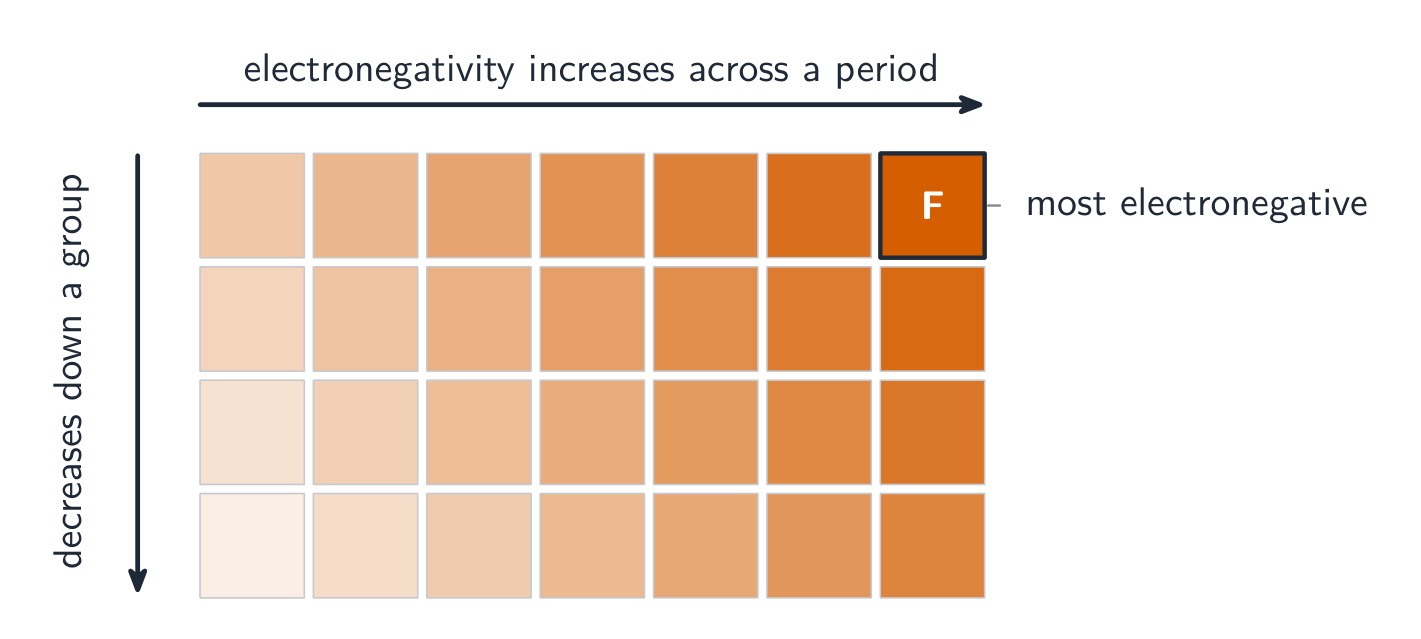
Electronegativity rises across a period and falls down a group; fluorine is highest
A polar bond has:
Difficulté 1/5 · 100 pièces + un petit bonus lors de la première réussite aujourd'hui
Unequal sharing of electrons gives a dipole: δ− at the more electronegative end, δ+ at the other.
CO₂ is non-polar even though its bonds are polar because:
Difficulté 1/5 · 100 pièces + un petit bonus lors de la première réussite aujourd'hui
CO₂ is linear and symmetric, so the two bond dipoles point opposite ways and cancel.
Match each force to what it is.
Difficulté 2/5 · 140 pièces + un petit bonus lors de la première réussite aujourd'hui
Intermolecular forces, weakest to strongest: van der Waals, permanent dipole, hydrogen bond.
Van der Waals' forces 范德华力
- Van der Waals' forces is the general name for intermolecular forces. Two types:
- London dispersion 伦敦色散 (instantaneous dipole–induced dipole): brief dipoles from moving electrons; act between all molecules and get stronger with more electrons.
- permanent dipole–permanent dipole: between molecules that are always polar.
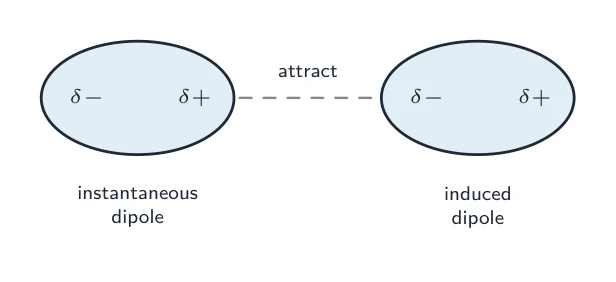
A momentary dipole induces one in a neighbour — the London dispersion force between all molecules
London dispersion forces get stronger when a molecule has:
Difficulté 1/5 · 100 pièces + un petit bonus lors de la première réussite aujourd'hui
More electrons give larger instantaneous dipoles, so London (dispersion) forces are stronger.
Worked example: explain three boiling points
Butane ($M_r$ 58) boils at −1 °C, propanone ($M_r$ 58) at 56 °C. Pentane boils at 36 °C, its isomer 2,2-dimethylpropane at 10 °C.
- Butane and propanone have about the same number of electrons, so similar London forces. Propanone's C=O makes it polar, adding permanent dipole–dipole forces, so it boils much higher.
- Pentane and 2,2-dimethylpropane have the same number of electrons. The long, thin pentane molecules touch over a larger area than the compact, near-spherical ones, so their London forces are stronger.
Which molecule has polar bonds but is non-polar overall?
Difficulté 1/5 · 100 pièces + un petit bonus lors de la première réussite aujourd'hui
In symmetrical $\text{CCl}_4$ the bond dipoles point equally outwards and cancel. The others are not symmetrical, so their dipoles add up.
You've got it
- intermolecular forces are weaker than the bonds inside substances
- a polar bond has $\delta-$ and $\delta+$ ends; a molecule is polar if its dipoles don't cancel ($\text{CO}_2$ cancels → non-polar)
- London dispersion acts between all molecules (stronger with more electrons); permanent dipole–dipole acts between polar molecules