Shapes of molecules
Introduit| English | Sens |
|---|---|
| VSEPR theory/ˈvespə ˈθɪəri/ | théorie VSEPR |
| lone pair/ləʊn peə/ | paire d'électrons non liante |
| tetrahedral/ˌtetrəˈhiːdrəl/ | tétraédrique |
| bonding pair/ˈbɒndɪŋ peə/ | paire liante |
| bond angle/bɒnd ˈæŋɡl/ | angle de liaison |
| octahedral/ˌɒktəˈhiːdrəl/ | octaédrique |
Why molecules have shape
- To predict a shape, use VSEPR theory 价层电子对互斥理论.
- Electron pairs around the central atom push apart as far as possible.
- Lone pairs 孤对电子 push hardest, squeezing the angles.
VSEPR theory says the shape of a molecule is set by:
Difficulté 1/5 · 100 pièces + un petit bonus lors de la première réussite aujourd'hui
Like charges repel, so the electron pairs push apart to minimise repulsion, fixing the shape.
A molecule with four bonding pairs and no lone pairs (e.g. methane) is:
Difficulté 1/5 · 100 pièces + un petit bonus lors de la première réussite aujourd'hui
Four pairs repel to ~109.5°.
Lone pairs push harder
- A lone pair (not in a bond) repels more strongly than a bonding pair 成键电子对.
- Each lone pair squeezes the bond angle 键角 by about $2.5°$.
- That's why $\text{NH}_3$ ($107°$) and $\text{H}_2\text{O}$ ($104.5°$) have smaller angles than $\text{CH}_4$ ($109.5°$).
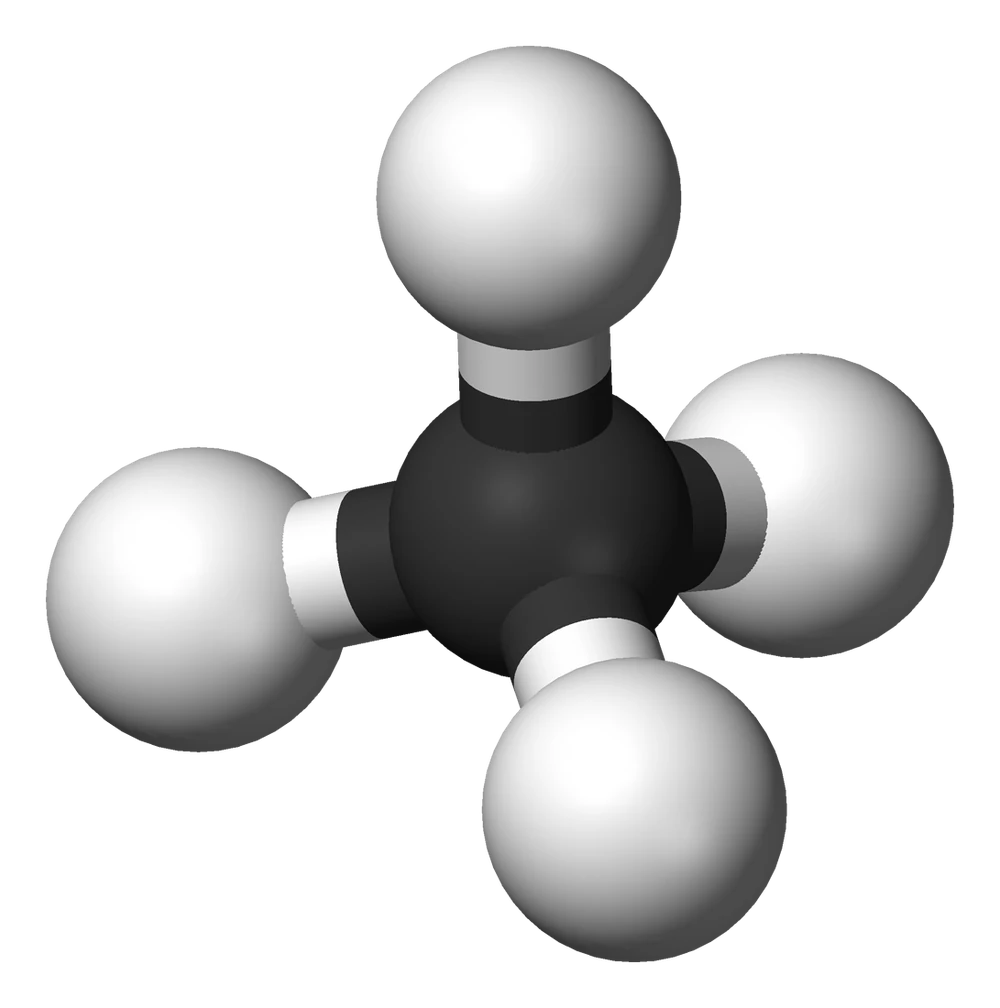
A molecular model shows the shape of a covalent molecule
Formes moléculaires
electron pairs repel (VSEPR)
Electron pairs spread out as far as possible; paires solitaires squeeze the bond angle.
Why is the bond angle in water (104.5°) smaller than in methane (109.5°)?
Difficulté 1/5 · 100 pièces + un petit bonus lors de la première réussite aujourd'hui
Lone pairs repel more than bonding pairs; water's two lone pairs squeeze the H–O–H angle below 109.5°.
The shapes
| Molecule | Shape | Angle |
|---|---|---|
| $\text{CO}_2$ | linear | $180°$ |
| $\text{BF}_3$ | trigonal planar | $120°$ |
| $\text{CH}_4$ | tetrahedral 四面体形 | $109.5°$ |
| $\text{NH}_3$ | pyramidal | $107°$ |
| $\text{H}_2\text{O}$ | bent | $104.5°$ |
| $\text{SF}_6$ | octahedral 八面体形 | $90°$ |
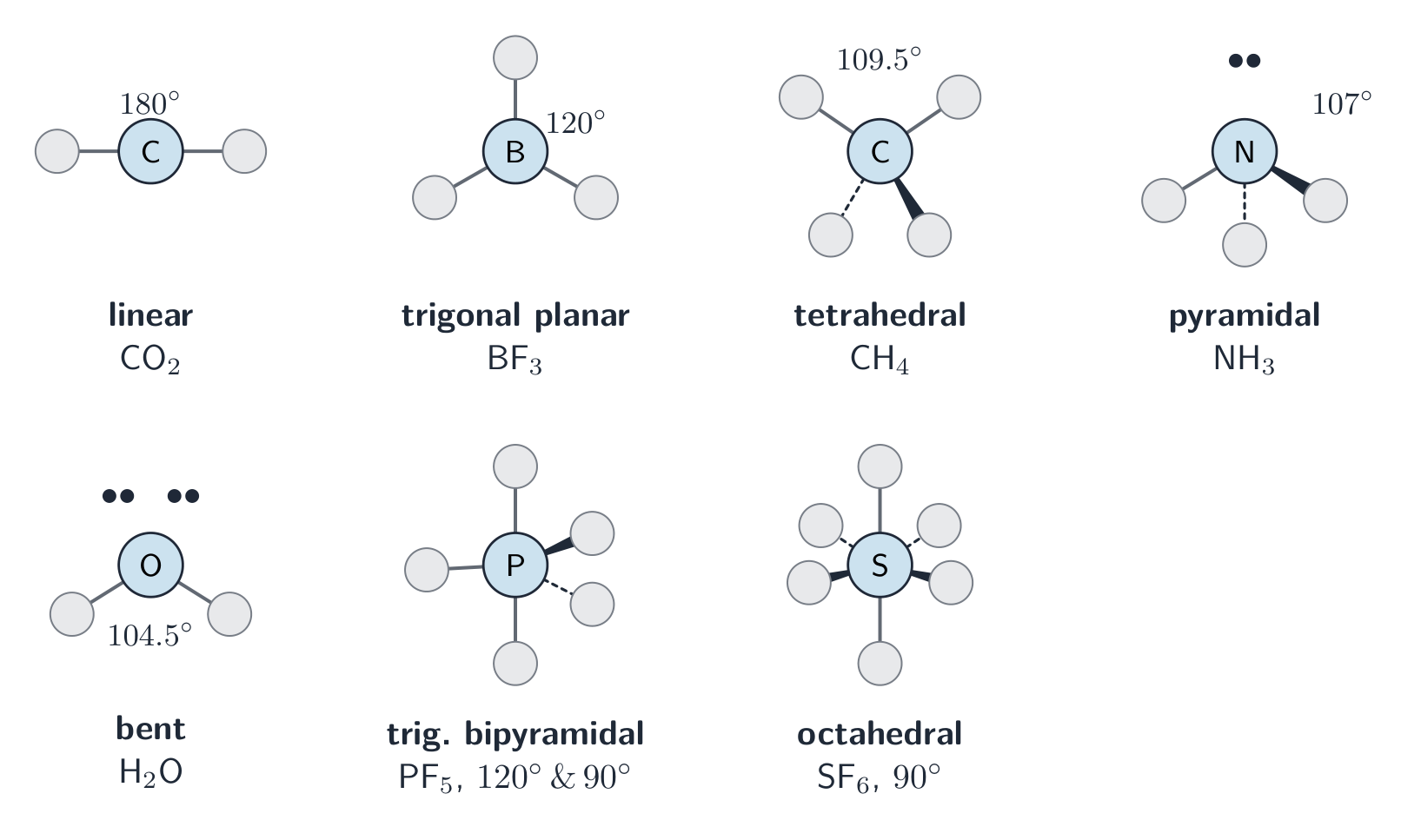
The common VSEPR shapes, from linear (180°) to octahedral (90°)
Methane (CH₄) is:
Difficulté 1/5 · 100 pièces + un petit bonus lors de la première réussite aujourd'hui
Four bonding pairs and no lone pairs give a tetrahedral shape at 109.5°.
Match each molecule to its shape.
Difficulté 2/5 · 140 pièces + un petit bonus lors de la première réussite aujourd'hui
CO₂ = linear (180°); BF₃ = trigonal planar (120°); NH₃ = pyramidal (107°).
Match each electron arrangement to its shape.
Difficulté 2/5 · 140 pièces + un petit bonus lors de la première réussite aujourd'hui
Electron pairs repel to spread out; lone pairs repel more, so they shrink the angle.
VSEPR predicts a molecule's shape from the number of electron pairs around the central atom, and lone pairs repel more strongly than bonding pairs.
Difficulté 1/5 · 100 pièces + un petit bonus lors de la première réussite aujourd'hui
That extra lone-pair repulsion is why water (104.5°) has a smaller angle than methane (109.5°).
Worked example: same formula, different shapes
Predict the shapes of $\text{BCl}_3$ and $\text{PCl}_3$.
- Count pairs on the central atom. B has 3 outer electrons, all used in 3 bonds: 3 bonding pairs, 0 lone pairs → trigonal planar, $120°$. P has 5: 3 go into bonds and 2 are left as 1 lone pair, so 4 pairs in all.
- Four pairs point to the corners of a tetrahedron, but only three hold atoms, so $\text{PCl}_3$ is pyramidal. The lone pair repels more, squeezing the angle to about $107°$, as in $\text{NH}_3$.
In $\text{NH}_4^{+}$, nitrogen has four bonding pairs and no lone pair. What are its shape and bond angle?
Difficulté 1/5 · 100 pièces + un petit bonus lors de la première réussite aujourd'hui
The lone pair of $\text{NH}_3$ became a bonding pair to $\text{H}^{+}$, so four equal bonding pairs repel equally: tetrahedral, like $\text{CH}_4$.
Silicon (Group 14) forms $\text{SiCl}_4$. Predict the Cl–Si–Cl bond angle in degrees.
Difficulté 2/5 · 140 pièces + un petit bonus lors de la première réussite aujourd'hui
Si uses all 4 outer electrons in 4 bonds: 4 bonding pairs, no lone pairs, so tetrahedral, $109.5°$.
You've got it
- VSEPR: electron pairs repel and spread out as far as possible
- lone pairs push harder than bonding pairs (≈ $2.5°$ each)
- linear $180°$, trigonal planar $120°$, tetrahedral $109.5°$, pyramidal $107°$, bent $104.5°$, octahedral $90°$