Metallic bonding
Introduit| English | Sens |
|---|---|
| metallic bonding/məˈtælɪk ˈbɒndɪŋ/ | liaison métallique |
| delocalised electron/dɪˈlɒkəlaɪzd ɪˈlektrɒn/ | électron délocalisé |
| malleable/ˈmæləbl/ | malléable |
| ductile/ˈdʌktaɪl/ | ductile |
A sea of shared electrons
- Metallic bonding 金属键 is the attraction between positive metal ions and a "sea" of delocalised electrons 离域电子.
- The outer electrons are free to move through the whole metal.
- This explains key properties of metals.
Metallic bonding is the attraction between:
Difficulté 1/5 · 100 pièces + un petit bonus lors de la première réussite aujourd'hui
In a metal, positive ions sit in a sea of delocalised electrons that hold the structure together.
Metals conduct electricity because of their ______ (delocalised) electrons.
Difficulté 1/5 · 100 pièces + un petit bonus lors de la première réussite aujourd'hui
A sea of delocalised electrons carries charge.
The sea of electrons
- The metal's outer electrons leave their atoms and are delocalised — free to move.
- This explains why metals conduct electricity and are strong.
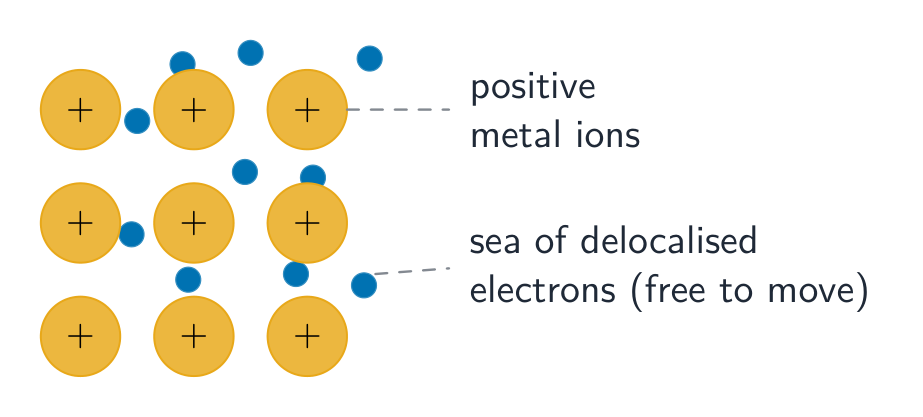
Metallic bonding: positive ions in a sea of delocalised electrons
À l'intérieur d'un métal — et pourquoi il se comporte ainsi
Step through it. Positive ions sit in a shared sea of delocalised electrons. That one picture explains conduction, malleability, and strength.
Metals conduct electricity because:
Difficulté 1/5 · 100 pièces + un petit bonus lors de la première réussite aujourd'hui
The delocalised electrons can move through the metal, carrying charge.
Match each property of a metal to the reason for it.
Difficulté 2/5 · 140 pièces + un petit bonus lors de la première réussite aujourd'hui
Every metallic property traces back to one picture: positive ions in a mobile sea of electrons.
Why metals conduct and bend
- Delocalised electrons carry charge and heat through the metal.
- Layers of cations slide over one another, so metals are malleable 可锻 and ductile 延展.
Metallic bonding helps explain why metals are strong.
Difficulté 1/5 · 100 pièces + un petit bonus lors de la première réussite aujourd'hui
The strong attraction between the positive ions and the electron sea makes metals strong.
Worked example: bend or shatter?
A sheet of aluminium can be hammered flat, but a crystal of sodium chloride shatters. Explain using their bonding.
- In the metal, the cations sit in a sea of delocalised electrons. When a force makes layers slide, the electrons move with them, so the attraction holding the layers together is kept: the metal bends (malleable).
- In the ionic lattice, sliding one layer by one ion brings like charges side by side ($\text{Na}^{+}$ next to $\text{Na}^{+}$). They repel and the crystal splits. Aluminium's bonding is also strong ($\text{Al}^{3+}$, 3 electrons each), so it melts at 660 °C, well above sodium's 98 °C.
Weaker metallic bonding (fewer delocalised electrons, larger ions) raises the melting point.
Difficulté 1/5 · 100 pièces + un petit bonus lors de la première réussite aujourd'hui
False. Stronger metallic bonding raises the melting point: more delocalised electrons and smaller ions give a stronger attraction, so more energy is needed to melt the metal.
How many delocalised electrons does each atom contribute in magnesium metal?
Difficulté 2/5 · 140 pièces + un petit bonus lors de la première réussite aujourd'hui
Mg is in Group 2: both outer electrons join the sea, leaving $\text{Mg}^{2+}$ ions.
Why does solid copper conduct electricity while solid copper(II) chloride does not?
Difficulté 1/5 · 100 pièces + un petit bonus lors de la première réussite aujourd'hui
Conduction needs mobile charged particles: electrons in a metal, ions in a melt or solution.
You've got it
- metallic bonding = attraction between positive metal ions and a sea of delocalised electrons
- the delocalised electrons are free to move → metals conduct electricity and are strong