The mole and Avogadro's constant
Introduit| English | Sens |
|---|---|
| mole/məʊl/ | mole |
| Avogadro constant/ˌævəˈɡædrəʊ ˈkɒnstənt/ | constante d'Avogadro |
| molar mass/ˈməʊlə mæs/ | masse molaire |
| amount of substance/əˈmaʊnt ɒv ˈsʌbstəns/ | amount of substance |
Counting by weighing
- A shop sells screws by weight: if 100 screws weigh 250 g, a 2.50 kg bag holds 1000 screws. Nobody counts them one by one.
- Chemists do the same with atoms. The counting unit is the mole 摩尔, and a balance does the counting.
The mole and Avogadro's constant
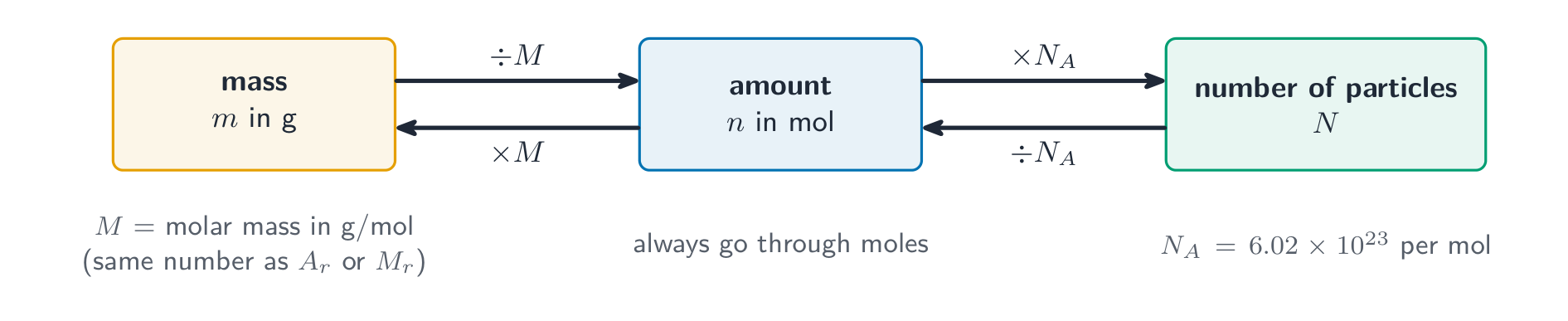
- One mole (mol) of a substance contains exactly $6.02\times10^{23}$ particles. This number is the Avogadro constant 阿伏伽德罗常量, $N_A=6.02\times10^{23}\ \text{mol}^{-1}$.
- The particles can be atoms, molecules, ions or electrons, so always say which: 1 mol of $\text{O}_2$ molecules contains 2 mol of O atoms.
One mole of any substance contains 6.02 × 10²³ particles. This number is called the ______ constant.
Difficulté 1/5 · 100 pièces + un petit bonus lors de la première réussite aujourd'hui
The Avogadro constant, NA = 6.02 × 10²³ per mol.
How many oxygen atoms are in 1.00 mol of O₂?
Difficulté 1/5 · 100 pièces + un petit bonus lors de la première réussite aujourd'hui
1.00 mol of O₂ molecules contains 2.00 mol of O atoms, which is 2.00 × 6.02 × 10²³ = 1.20 × 10²⁴ atoms.
Molar mass and $n=m/M$
- The molar mass 摩尔质量 $M$ is the mass of one mole. It has the same number as $A_r$ or $M_r$, with units g/mol: $M(\text{H}_2\text{O})=18.0\ \text{g/mol}$.
- The amount of substance 物质的量 in moles is $n=\dfrac{m}{M}$, with $m$ in grams. Rearrange it as $m=nM$ or $M=\dfrac{m}{n}$.
Mole mass lab
n = m / M
Change mass and see moles scale through molar mass.
How many moles are in 9.00 g of water? (Mr = 18.0)
Difficulté 2/5 · 140 pièces + un petit bonus lors de la première réussite aujourd'hui
n = m ÷ M = 9.00 ÷ 18.0 = 0.500 mol.
The molar mass of a substance in g/mol has the same number as its Mr.
Difficulté 1/5 · 100 pièces + un petit bonus lors de la première réussite aujourd'hui
True. Mr of CO₂ is 44.0, so its molar mass is 44.0 g/mol.
Mass → moles → particles. How many molecules, and how many oxygen atoms, are in 4.40 g of carbon dioxide? ($M_r(\text{CO}_2)=44.0$)
- $n=\dfrac{4.40}{44.0}=0.100$ mol of $\text{CO}_2$ molecules.
- Molecules $=0.100\times6.02\times10^{23}=6.02\times10^{22}$.
- Each molecule has two O atoms: O atoms $=2\times6.02\times10^{22}=1.20\times10^{23}$.
How many molecules are in 0.250 mol of methane? Give the answer × 10²³ (for 1.5 × 10²³ type 1.5).
Difficulté 2/5 · 140 pièces + un petit bonus lors de la première réussite aujourd'hui
0.250 × 6.02 × 10²³ = 1.505 × 10²³ molecules (1.51 × 10²³ to 3 s.f.).
Moles → mass. What mass of sodium hydroxide, NaOH, is 0.250 mol? ($A_r$: Na 23.0, O 16.0, H 1.0)
- $M(\text{NaOH})=23.0+16.0+1.0=40.0$ g/mol.
- $m=nM=0.250\times40.0=10.0$ g.
What is the mass of 0.500 mol of sodium chloride, NaCl? (Ar: Na = 23.0, Cl = 35.5)
Difficulté 2/5 · 140 pièces + un petit bonus lors de la première réussite aujourd'hui
M = 58.5 g/mol, so m = 0.500 × 58.5 = 29.25 g (29.3 g to 3 s.f.).
Find the molar mass, then name the element. 0.0500 mol of a Group 2 metal has a mass of 2.00 g. Which metal is it?
- $M=\dfrac{m}{n}=\dfrac{2.00}{0.0500}=40.0$ g/mol.
- The Group 2 metal with $A_r=40.1$ is calcium.
0.200 mol of a gas has a mass of 6.40 g. What is its molar mass?
Difficulté 2/5 · 140 pièces + un petit bonus lors de la première réussite aujourd'hui
M = m ÷ n = 6.40 ÷ 0.200 = 32.0 g/mol. This fits O₂.
Counting ions in a compound
- Use the formula to count the particles inside. One mole of $\text{CaCl}_2$ contains 1 mol of $\text{Ca}^{2+}$ ions and 2 mol of $\text{Cl}^-$ ions: 3 mol of ions in all.
- So 0.10 mol of $\text{CaCl}_2$ contains 0.20 mol of $\text{Cl}^-$, which is $0.20\times6.02\times10^{23}=1.2\times10^{23}$ chloride ions.
How many moles of ions in total are in 0.20 mol of aluminium sulfate, Al₂(SO₄)₃?
Difficulté 2/5 · 140 pièces + un petit bonus lors de la première réussite aujourd'hui
Each Al₂(SO₄)₃ gives 2 Al³⁺ and 3 SO₄²⁻, so 5 ions. 0.20 × 5 = 1.0 mol of ions.
The mass of one atom
- Divide the molar mass by the Avogadro constant. One carbon-12 atom: $\dfrac{12.0\ \text{g}}{6.02\times10^{23}}=1.99\times10^{-23}$ g.
- This tiny number is why chemists weigh moles, not atoms.
What is the mass of one atom of gold? (Ar = 197)
Difficulté 1/5 · 100 pièces + un petit bonus lors de la première réussite aujourd'hui
197 ÷ 6.02 × 10²³ = 3.27 × 10⁻²² g. One atom must be tiny, so the answer needs a negative power of ten.
- Mass must be in grams. Convert first: 2.5 kg = 2500 g; 350 mg = 0.350 g.
- Always ask "moles of what?". 1 mol of $\text{H}_2\text{O}$ has 3 mol of atoms; 1 mol of $\text{Cl}_2$ has 2 mol of Cl atoms.
- Multiply by $N_A$ to get particles; do not divide. More moles must give more particles.
A tablet contains 500 mg of aspirin (Mr = 180). How many moles is that? Give 3 significant figures.
Difficulté 2/5 · 140 pièces + un petit bonus lors de la première réussite aujourd'hui
500 mg = 0.500 g. n = 0.500 ÷ 180 = 0.00278 mol (2.78 × 10⁻³ mol).
- 1 mol = $6.02\times10^{23}$ particles ($N_A$); say which particles.
- $n=\dfrac{m}{M}$ with $m$ in g and $M$ in g/mol; rearrange to $m=nM$ or $M=m/n$.
- Particles $=n\times N_A$. Use the formula to count atoms or ions inside each unit.
Match each quantity to its unit.
Difficulté 2/5 · 140 pièces + un petit bonus lors de la première réussite aujourd'hui
n = m ÷ M, so g ÷ (g/mol) = mol. NA is particles per mole.