Atomic and ionic radius
Introduit| English | Sens |
|---|---|
| atomic radius/əˈtɒmɪk ˈreɪdɪəs/ | rayon atomique |
| nuclear charge/ˈnjuːklɪə tʃɑːdʒ/ | charge nucléaire |
| shielding/ˈʃiːldɪŋ/ | effet d'écran |
| cation/ˈkætaɪən/ | cation |
| anion/ˈænaɪən/ | anion |
| isoelectronic/ˌaɪsəʊlɪkˈtrɒnɪk/ | isoelectronique |
How big is an atom?
- Atomic radius 原子半径 is about $10^{-10}$ m, so we measure it in picometres (1 pm $=10^{-12}$ m). A sodium atom is 186 pm across its radius; a chlorine atom only 99 pm.
- Every size comparison comes down to three things: the number of shells, the nuclear charge 核电荷, and the shielding 屏蔽 by inner electrons.
Trends for atoms
- Across a period, the radius decreases. Protons are added but the electrons go into the same shell, and shielding hardly changes. The stronger pull draws the shell in.
- Down a group, the radius increases. Each step adds a shell: the outer electrons are further away and more shielded, which outweighs the extra protons.
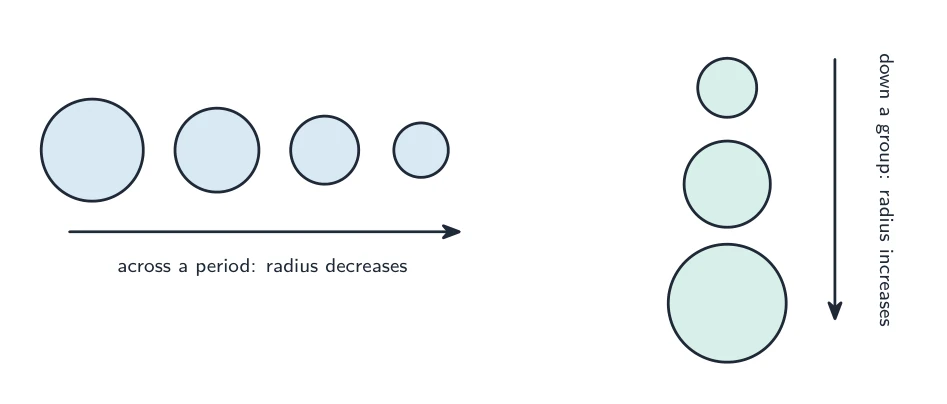
Atomic and ionic radius trends
Atomic radius falls across a period (rising nuclear charge pulls the same shell in) and rises down a group (an extra shell each time). Step across Period 3 to see it.
Across a period, the atomic radius decreases because:
Difficulté 1/5 · 100 pièces + un petit bonus lors de la première réussite aujourd'hui
Electrons go into the same outer shell, so rising nuclear charge with similar shielding pulls them closer.
Down a group, the atomic radius increases because:
Difficulté 1/5 · 100 pièces + un petit bonus lors de la première réussite aujourd'hui
Adding shells increases distance and shielding, so the radius grows down a group.
Match each change to its effect on radius.
Difficulté 2/5 · 140 pièces + un petit bonus lors de la première réussite aujourd'hui
Pulling power vs number of shells sets the size; ions differ from their atoms by the electrons gained or lost.
An atom and its ion
- A cation 阳离子 is smaller than its atom. Na (2,8,1) → Na⁺ (2,8) loses its whole outer shell: 186 pm → 102 pm.
- An anion 阴离子 is larger than its atom. Cl (2,8,7) → Cl⁻ (2,8,8) gains an electron in the same shell, so repulsion rises: 99 pm → 181 pm. The number of protons does not change in either case.
A positive ion (cation) is larger than its parent atom.
Difficulté 1/5 · 100 pièces + un petit bonus lors de la première réussite aujourd'hui
False. A cation is smaller: losing the outer-shell electrons removes a shell or reduces repulsion, so the remaining electrons are pulled closer.
Compared with its atom, a cation (positive ion) is:
Difficulté 1/5 · 100 pièces + un petit bonus lors de la première réussite aujourd'hui
Proton number stays unchanged. Electron loss can remove an outer occupied shell, but does not always do so; reduced repulsion and greater attraction for remaining electrons explain contraction.
A student says that forming any positive ion changes the proton number and always removes an entire shell. Correct both claims and explain why a typical cation is smaller than its atom.
Ion formation removes electrons, not protons, so the element and nuclear charge stay the same. A whole outer occupied shell may be emptied, but losing one electron does not always empty a shell. Fewer electrons reduce repulsion and allow the remaining electrons to be attracted more strongly; losing an outer shell can make the contraction especially large.
Which is larger, Fe²⁺ or Fe³⁺?
Difficulté 1/5 · 100 pièces + un petit bonus lors de la première réussite aujourd'hui
Both have 26 protons. Fe³⁺ has one electron fewer, so there is less repulsion and the same nucleus pulls the electrons in more.
Isoelectronic ions
- Isoelectronic 等电子 ions have the same number of electrons and the same arrangement. More protons pull the same electrons in more tightly, so the radius is smaller.
| Ion | S²⁻ | Cl⁻ | K⁺ | Ca²⁺ |
|---|---|---|---|---|
| Protons | 16 | 17 | 19 | 20 |
| Electrons | 18 | 18 | 18 | 18 |
| Radius / pm | 184 | 181 | 138 | 100 |
Among ions with the same number of electrons, the smallest is the one with the most ______.
Difficulté 1/5 · 100 pièces + un petit bonus lors de la première réussite aujourd'hui
More protons pull the same number of electrons in more tightly, giving a smaller ion.
N³⁻, O²⁻, F⁻ and Na⁺ all have 10 electrons. Which has the largest radius?
Difficulté 1/5 · 100 pièces + un petit bonus lors de la première réussite aujourd'hui
Same electrons, arranged 2,8. N³⁻ has the fewest protons (7), so it holds the electrons least tightly.
Exam explanation. Explain why Mg²⁺ (72 pm) is smaller than Na⁺ (102 pm).
- Both ions have 10 electrons, arranged 2,8. They are isoelectronic.
- Mg²⁺ has 12 protons and Na⁺ has 11, so Mg²⁺ has the greater nuclear charge. It attracts the same electrons more strongly, so its radius is smaller.
Arrange O²⁻, F⁻, Na⁺ and Mg²⁺ in order of increasing radius. State the electron count and compare the nuclear charges before explaining the order.
Each has 10 electrons. Proton numbers are 8, 9, 11 and 12, respectively. With the same electron arrangement, greater nuclear charge gives stronger attraction and a smaller radius: Mg²⁺ < Na⁺ < F⁻ < O²⁻.
- "More protons means smaller" only works when the ions have the same electron arrangement. K⁺ (19 protons) is larger than Na⁺ (11 protons) because it has an extra shell.
- Never explain an ion's size by a change in proton number: forming an ion only changes the electrons.
- Atoms and ions follow separate series. In Period 3, the radius jumps up from Al³⁺ (53 pm) to P³⁻ (212 pm), because the anions keep the third shell.
K⁺ has more protons than Na⁺. A student therefore predicts that K⁺ is smaller. Evaluate this argument using their occupied shells and shielding.
Na⁺ has the shell arrangement 2,8; K⁺ has 2,8,8. The extra occupied shell in K⁺ increases distance from the nucleus and inner shielding. These effects outweigh the increased nuclear charge, so K⁺ is larger. The more-protons rule cannot be used alone when the electron arrangements differ.
You've got it
- Across a period: same shell, more protons → smaller. Down a group: more shells → larger.
- Cations are smaller than their atoms; anions are larger.
- Isoelectronic ions: more protons → smaller. Check that the electron arrangements match first.