Demand, supply and elasticity
Introduit| English | Sens |
|---|---|
| demand/dɪˈmænd/ | demande |
| supply/səˈplaɪ/ | offre |
| quantity demanded/ˈkwɒntɪti dɪˈmændɪd/ | quantité demandée |
| substitute/ˈsʌbstɪtjuːt/ | Goods or services that can be used in place of each other. |
| complement/ˈkɒmplɪmənt/ | Goods or services typically used together, so demand for one is linked to the use of the other. |
| equilibrium/ˌiːkwɪˈlɪbrɪəm/ | équilibre |
| price elasticity of demand/praɪs ɪlæˈstɪsɪti ɒv dɪˈmænd/ | élasticité prix de la demande |
| elastic/ɪˈlæstɪk/ | élastique |
| inelastic/ɪnɪˈlæstɪk/ | inélastique |
| revenue/ˈrevənjuː/ | chiffre d'affaires |
Why does bubble tea cost more in summer?
- On hot days a bubble-tea shop sells many more cups. Tapioca and milk cost the same, yet shops can charge more and still sell out. In winter they offer discounts.
- Prices are set by the market: the buyers' demand 需求 and the sellers' supply 供给. A firm that understands both can forecast sales and set prices with fewer mistakes.
Demand: what changes it?
- Demand is the amount customers are willing and able to buy at each price. When the price rises, the quantity demanded 需求量 falls: a movement along the demand curve.
- Anything else that changes demand shifts the whole curve: right means more is bought at every price.
| Factor | Shifts demand right when… |
|---|---|
| Income | incomes rise (for most goods) |
| Price of a substitute 替代品 | a rival product gets dearer |
| Price of a complement 互补品 | something used with it gets cheaper |
| Tastes and fashion | the product becomes popular |
| Advertising | promotion works |
| Population, season, weather | more buyers, or the right season |
A coffee chain cuts the price of its lattes. What happens to the demand for its lattes?
Difficulté 1/5 · 100 pièces + un petit bonus lors de la première réussite aujourd'hui
A change in the product's own price moves along its demand curve. Only other factors shift the curve.
Supply: what changes it?
- Supply is the amount firms are willing and able to sell at each price. A higher price makes selling more worthwhile, so the quantity supplied rises.
- The supply curve shifts right (more supplied at every price) when costs of production fall, new technology arrives, more firms enter the market, a subsidy is paid or the harvest is good. Higher costs, new taxes or a poor harvest shift it left.
Which of these shifts the supply of bread to the left?
Difficulté 1/5 · 100 pièces + un petit bonus lors de la première réussite aujourd'hui
Higher costs mean less is supplied at every price. Better technology and subsidies shift supply right; more buyers shifts demand, not supply.
Equilibrium 均衡 and how it moves
- The equilibrium price is where quantity demanded = quantity supplied. Above it there is a surplus, so sellers cut prices. Below it there is a shortage, so prices rise.
- When a curve shifts, the market moves to a new equilibrium.
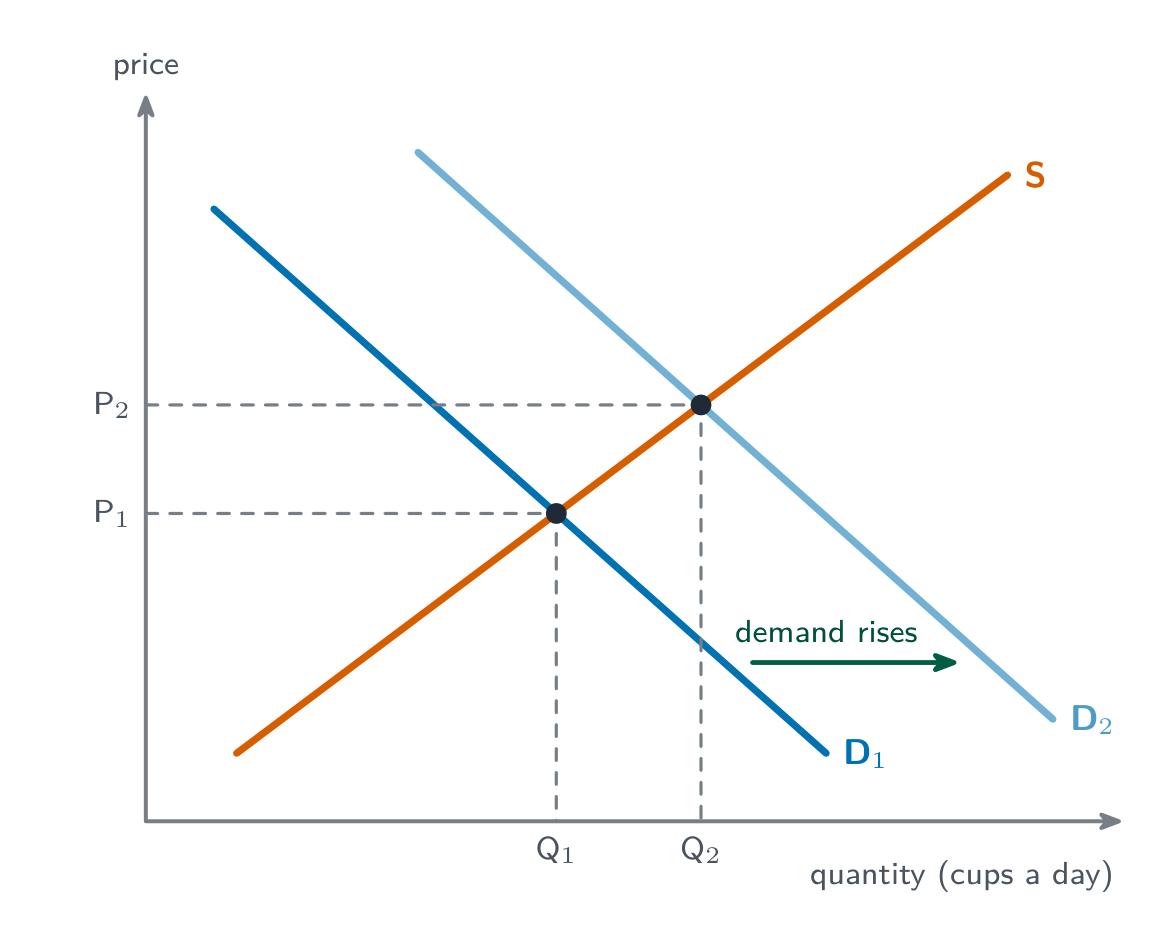
In summer demand shifts right: both price and quantity rise.
| Event | Shift | Price | Qty |
|---|---|---|---|
| Hot summer | D right | up | up |
| Dearer milk | S left | up | down |
| Faster machines | S right | down | up |
| Sugar health scare | D left | down | down |
- D = demand, S = supply, Qty = quantity sold.
Demand, supply & elasticity
Price is set where demande rencontre alimentation.
The equilibrium price is where:
Difficulté 1/5 · 100 pièces + un petit bonus lors de la première réussite aujourd'hui
Equilibrium clears the market.
Wages in the hotel industry rise sharply. What happens to the equilibrium price and number of hotel rooms sold?
Difficulté 1/5 · 100 pièces + un petit bonus lors de la première réussite aujourd'hui
Higher costs shift supply left. Along the same demand curve, price rises and quantity falls.
Price elasticity of demand 需求价格弹性 (PED)
- PED measures how strongly quantity demanded reacts to a change in price:
- % change = (new − old) ÷ old × 100. Work out each % change first, then divide.
A shop raises a large tea from 20 to 22 yuan. Daily sales fall from 400 to 380 cups.
- % change in price = (22 − 20) ÷ 20 × 100 = +10%
- % change in quantity = (380 − 400) ÷ 400 × 100 = −5%
- PED = −5 ÷ 10 = −0.5
PED is negative for almost all goods, because price and quantity move in opposite directions. We judge the size (0.5).
Price rises 10% and quantity demanded falls 25%. What is the size of PED?
Difficulté 2/5 · 140 pièces + un petit bonus lors de la première réussite aujourd'hui
PED = 25% / 10% = 2.5 (elastic).
When quantity demanded responds strongly to price, demand is said to be ______.
Difficulté 1/5 · 100 pièces + un petit bonus lors de la première réussite aujourd'hui
Elastic demand has PED greater than 1.
Elastic or inelastic?
| Size of PED | Name | Meaning |
|---|---|---|
| more than 1 | elastic 富有弹性 | quantity changes by a larger % than price |
| less than 1 | inelastic 缺乏弹性 | quantity changes by a smaller % than price |
| exactly 1 | unitary | the same % change |
- Demand is more elastic when there are many close substitutes, the product is a luxury, it takes a large share of income, or buyers have time to look for other options.
- Demand is more inelastic for necessities, habits, strong brands, and products with few substitutes, such as petrol or a popular phone brand.
A product with many close substitutes tends to have inelastic demand.
Difficulté 1/5 · 100 pièces + un petit bonus lors de la première réussite aujourd'hui
False. Close substitutes let customers switch easily when the price rises, so demand is price elastic.
PED and sales revenue 营业收入
- Revenue = price × quantity. PED tells a firm what a price change will do to it.
The tea shop (PED = −0.5, inelastic)
- Before: 20 × 400 = 8,000 yuan a day.
- After the rise: 22 × 380 = 8,360 yuan a day. Revenue rises by 360.
A shop with elastic demand (PED = −2) raises its price by 10%, so sales fall by 2 × 10% = 20%: from 400 to 320 cups.
- Before: 20 × 400 = 8,000. After: 22 × 320 = 7,040. Revenue falls by 960.
| Demand is… | Raise price | Cut price |
|---|---|---|
| inelastic | revenue rises | revenue falls |
| elastic | revenue falls | revenue rises |
If demand for a product is inelastic, raising its price will:
Difficulté 1/5 · 100 pièces + un petit bonus lors de la première réussite aujourd'hui
With inelastic demand, quantity falls little, so revenue rises.
A cinema sells 500 tickets at 40 each. PED is −1.5. It cuts the price by 10% to 36. What is its new revenue?
Difficulté 2/5 · 140 pièces + un petit bonus lors de la première réussite aujourd'hui
Quantity rises by 1.5 × 10% = 15%: 500 × 1.15 = 575 tickets. Revenue = 36 × 575 = 20,700, up from 20,000.
Using PED, and its limits
- Uses: setting prices, forecasting sales after a price change, deciding how much of a cost rise can be passed on to customers.
- Limits: PED is an estimate from past data and soon goes out of date. It assumes nothing else changes, but rivals may react and tastes change. It also changes over time, and a firm with many products has many PEDs.
- Revenue is not profit: a price cut may raise revenue but also raise costs, because more must be made.
Worked exam answer
The tea shop's PED is estimated at −0.5. Its manager wants to raise prices by 10% to cover higher milk costs. Evaluate this decision. [8]
Analysis: with PED −0.5, a 10% price rise cuts quantity by about 5%. Revenue rises from 8,000 to 8,360 yuan a day. Selling fewer cups also saves milk and tapioca, so profit should rise by more than revenue.
Evaluation: the PED is only an estimate, perhaps based on a few weeks of data. If a rival shop nearby keeps its price low, customers can switch easily and demand may be much more elastic than −0.5. Demand also changes with the season: in winter, when fewer people want cold drinks, a price rise could cost more sales.
Judgement: the rise is likely to help in summer, when demand is high and inelastic. The manager should watch sales and rivals' prices for a few weeks, and be ready to offer winter discounts if sales fall by more than expected.
- Why it scores: it uses the PED to calculate the effect on revenue, then questions the estimate (rivals, season) and gives a judgement that depends on these conditions.
Common mistakes. Putting price on top of the formula: PED = % change in quantity ÷ % change in price. Using the change itself instead of the % change. Confusing a movement along a curve (the product's own price changed) with a shift (anything else changed).
You've got it
- the product's own price moves you along a curve; other factors shift it
- price settles at equilibrium, where quantity demanded = quantity supplied
- PED = % change in quantity demanded ÷ % change in price; size above 1 = elastic, below 1 = inelastic
- inelastic: a price rise raises revenue; elastic: a price cut raises revenue
- PED is an estimate that changes with rivals, seasons and time
Write from the data: find the PED
- Price rises by 8 percent and quantity demanded falls by 12 percent.
- Find the size of PED and say what that means for a further price rise.
Price rises by 8 percent and quantity demanded falls by 12 percent. What is the size of PED, and should the firm expect revenue to rise if it raises price again?
12 divided by 8 is 1.5, which is elastic.
What is the size of PED?
Difficulté 1/5 · 100 pièces + un petit bonus lors de la première réussite aujourd'hui
The percentage quantity change over the percentage price change is 1.5. Other options — 2.5 (the lesson example's PED); 0.67 (the price change divided by the quantity change).