The Calvin cycle
Introduit| English | Sens |
|---|---|
| fixation/fɪkˈseɪʃn/ | fixation |
| rubisco/ruːˈbɪskəʊ/ | rubisco |
| RuBP/ruː ˌbiːˈpiː/ | RuBP |
| regeneration/riːˌdʒenəˈreɪʃn/ | régénération |
| triose phosphate/ˈtraɪəʊs ˈfɒsfeɪt/ | triose phosphate |
Building sugar from air
- The light-independent stage builds sugars in the stroma.
- It uses the ATP and reduced NADP made by the light stage.
- It runs as a cycle, in three main steps.
Step 1: Fixation 固定
- The enzyme rubisco 核酮糖二磷酸羧化酶 joins carbon dioxide to a 5-carbon molecule, RuBP 核酮糖二磷酸 (ribulose bisphosphate).
- This makes two molecules of a 3-carbon compound, GP (glycerate 3-phosphate).
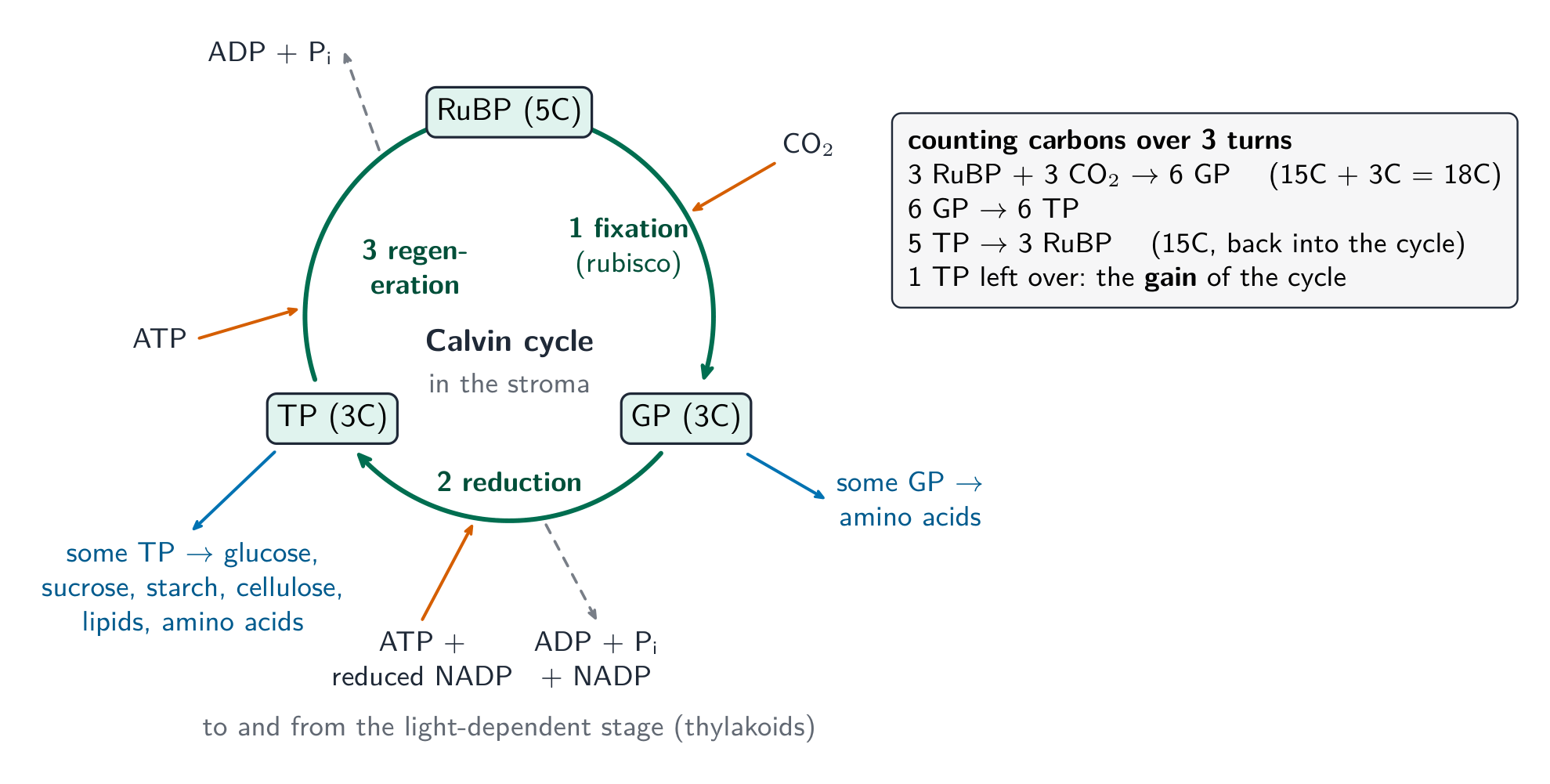
The Calvin cycle: fixation, reduction and regeneration 再生
Le cycle de Calvin
Step around the cycle. CO₂ is fixed onto RuBP, reduced to sugar using the light-stage's ATP and NADP, and RuBP is regenerated.
In fixation, the enzyme rubisco:
Difficulté 1/5 · 100 pièces + un petit bonus lors de la première réussite aujourd'hui
Rubisco catalyses carbon fixation: CO₂ + RuBP → 2 GP.
The enzyme that joins CO₂ to RuBP in the fixation step is ______.
Difficulté 1/5 · 100 pièces + un petit bonus lors de la première réussite aujourd'hui
Rubisco is the most abundant enzyme on Earth — it fixes nearly all the carbon in the living world.
The Calvin cycle is the light-independent stage; it uses the ATP and reduced NADP made by the light-dependent stage.
Difficulté 1/5 · 100 pièces + un petit bonus lors de la première réussite aujourd'hui
It does not need light directly, but it cannot run without the ATP and reduced NADP from the light reactions.
Steps 2 & 3: Reduction and regeneration
- Reduction: GP is reduced to TP (triose phosphate 丙糖磷酸), using reduced NADP and ATP.
- Regeneration: most TP is used (with more ATP) to regenerate RuBP, so the cycle keeps running.
GP is reduced to TP using:
Difficulté 1/5 · 100 pièces + un petit bonus lors de la première réussite aujourd'hui
The reduction step uses the reduced NADP and ATP made in the light-dependent stage.
Put the steps of the Calvin cycle in order.
Difficulté 3/5 · 200 pièces + un petit bonus lors de la première réussite aujourd'hui
CO₂ is fixed onto RuBP (fixation) → GP reduced to TP (reduction) → RuBP regenerated (regeneration).
Match each step or molecule to its role.
Difficulté 2/5 · 140 pièces + un petit bonus lors de la première réussite aujourd'hui
Fix the carbon, reduce GP to sugar, then regenerate the RuBP acceptor so the cycle keeps turning.
Making useful molecules
- Some TP leaves the cycle to make carbohydrates, lipids and amino acids.
- GP can also be used to make some amino acids.
What happens to the TP that leaves the cycle?
Difficulté 1/5 · 100 pièces + un petit bonus lors de la première réussite aujourd'hui
TP that leaves the cycle builds useful molecules: carbohydrates, lipids and amino acids.
Worked example: switching off the light
Algae are photosynthesising in bright light; then the light is switched off. The amount of GP rises and RuBP falls. Explain.
- In the dark, the light-dependent stage stops, so there is no new ATP or reduced NADP. Without them, GP cannot be reduced to TP, so GP builds up.
- Rubisco still fixes CO₂ with the RuBP that is left, making more GP, but RuBP cannot be regenerated from TP (which also needs ATP). So RuBP falls. If CO₂ were removed instead, the opposite would happen: RuBP would rise and GP would fall.
If the CO₂ concentration falls suddenly in bright light, what happens to RuBP?
Difficulté 1/5 · 100 pièces + un petit bonus lors de la première réussite aujourd'hui
Regeneration continues but fixation slows.
When rubisco fixes one CO₂ to one RuBP (5C), how many molecules of GP (3C) are made?
Difficulté 2/5 · 140 pièces + un petit bonus lors de la première réussite aujourd'hui
6 carbon atoms make two 3-carbon molecules.
You've got it
- fixation: rubisco + CO₂ + RuBP (5C) → 2 GP (3C)
- reduction: GP → TP using reduced NADP + ATP
- regeneration: TP → RuBP (more ATP) to keep the cycle going
- some TP leaves → carbohydrates, lipids, amino acids
Write from two triose phosphates making a hexose
- Six carbon dioxide molecules enter the Calvin cycle.
- Rubisco fixes each one onto RuBP. ATP and reduced NADP are used.
How many triose phosphates are used to make one hexose?
A six-carbon sugar is built from two three-carbon sugars.
How is the hexose made?
Difficulté 1/5 · 100 pièces + un petit bonus lors de la première réussite aujourd'hui
Two three-carbon molecules join to make the sugar.