Glycolysis and the link reaction · Glycolyse et réaction de liaison
| English | Français |
|---|---|
| glycolysis/ɡlaɪˈkɒləsɪs/ | glycolyse |
| link reaction/lɪŋk rɪˈækʃn/ | réaction de liaison |
| Krebs cycle/krebz ˈsaɪkl/ | Cycle de Krebs |
| oxidative phosphorylation/ˈɒksɪdətɪv ˌfɒsfɔːrɪˈleɪʃn/ | phosphorylation oxydative |
| pyruvate/ˈpaɪruːveɪt/ | pyruvate |
| coenzyme/ˌkəʊˈenzaɪm/ | coenzyme |
| acetyl coenzyme A/ˈæsɪtaɪl ˌkəʊˈenzaɪm eɪ/ | acétyl-coenzyme A |
Aerobic respiration: the first stages
- Aerobic respiration (with oxygen) runs in four stages.
- Each happens in a set place in the cell.
- We start with glycolysis 糖酵解 and the link reaction 连接反应.
Respiration aérobie : les premières étapes
- La respiration aérobie (avec oxygène) se déroule en quatre étapes.
- Chacune a lieu dans un endroit précis de la cellule.
- Nous commençons par la glycolyse 糖酵解 et la réaction de liaison 连接反应.
Glycolysis takes place in the cytoplasm, and needs no oxygen. · La glycolyse a lieu dans le cytoplasme et ne nécessite pas d'oxygène.
Glycolysis is in the cytoplasm and is anaerobic; the later stages (Krebs, oxidative phosphorylation) are in the mitochondria. · La glycolyse a lieu dans le cytoplasme et est anaérobie ; les étapes ultérieures (Krebs, phosphorylation oxydative) ont lieu dans les mitochondries.
Where each stage happens
| Stage | Location |
|---|---|
| glycolysis | the cytoplasm |
| link reaction | the matrix of the mitochondria |
| Krebs cycle 克雷布斯循环 | the matrix of the mitochondria |
| oxidative phosphorylation 氧化磷酸化 | the inner membrane of the mitochondria |
The four stages of aerobic respiration and where each one happens
Lieu de chaque étape
| Étape | Emplacement |
|---|---|
| glycolyse | le cytoplasme |
| réaction de liaison | la matrice des mitochondries |
| cycle de Krebs 克雷布斯循环 | la matrice des mitochondries |
| phosphorylation oxydative 氧化磷酸化 | la membrane interne des mitochondries |

Les quatre étapes de la respiration aérobie et le lieu de chacune
Match each stage of aerobic respiration to where it happens. · Associez chaque étape de la respiration aérobie à son lieu de réalisation.
Glycolysis = cytoplasm; link reaction & Krebs = matrix; oxidative phosphorylation = inner membrane. · Glycolyse = cytoplasme ; réaction de liaison & Krebs = matrice ; phosphorylation oxydative = membrane interne.
Glycolysis
- In the cytoplasm, glucose (6C) is phosphorylated using 2 ATP, then split into two triose phosphate (3C) molecules.
- These are oxidised to two pyruvate 丙酮酸 (3C).
- Net result: a gain of 2 ATP and some reduced NAD (NAD is a coenzyme 辅酶, a helper molecule).
Glycolysis splits one glucose into two pyruvate, for a net gain of 2 ATP and reduced NAD
Glycolyse
- Dans le cytoplasme, le glucose (6C) est phosphorylé en utilisant 2 ATP, puis scindé en deux trioses phosphates (3C).
- Ceux-ci sont oxydés en deux pyruvates 丙酮酸 (3C).
- Résultat net : un gain de 2 ATP et une certaine quantité de NAD réduit (le NAD est une coenzyme 辅酶, une molécule assistante).
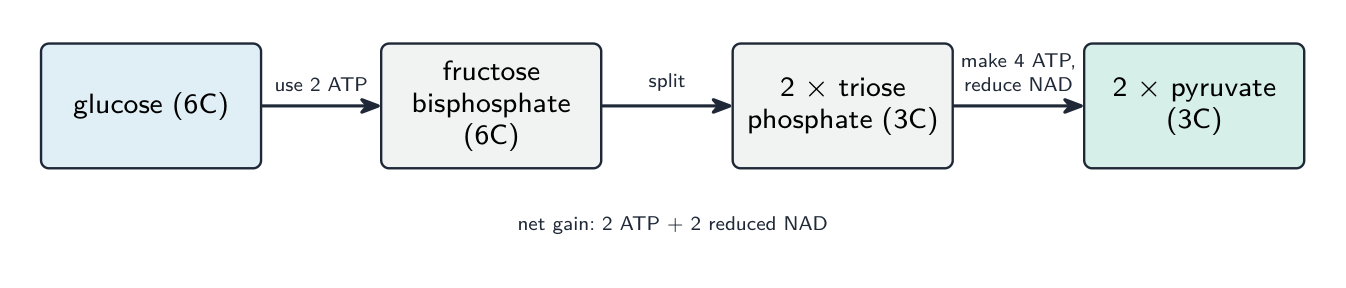
La glycolyse scinde un glucose en deux pyruvates, pour un gain net de 2 ATP et de NAD réduit
Glycolysis · Glycolyse
Step through it. Glucose is split in the cytoplasm into two pyruvate, for a small net gain of ATP and reduced NAD. · Étape par étape. Le glucose se scinde dans le cytoplasme en deux pyruvate, pour un petit gain net d'ATP et de NAD réduit.
The net yield of glycolysis is: · Le rendement net de la glycolyse est :
Glycolysis uses 2 ATP and makes 4, a net gain of 2 ATP, plus reduced NAD. · La glycolyse utilise 2 ATP et en produit 4, soit un gain net de 2 ATP, plus du NAD réduit.
Glycolysis ends by splitting glucose into: · La glycolyse se termine par la scission du glucose en :
Glucose (6C) → 2 triose phosphate (3C) → 2 pyruvate (3C).
Glycolysis gives a net gain of ______ ATP per glucose molecule. · La glycolyse donne un gain net de ______ ATP par molécule de glucose.
2 ATP are used and 4 are made — a net gain of 2 ATP (plus 2 reduced NAD). · 2 ATP sont utilisés et 4 sont produits — un gain net de 2 ATP (plus 2 NAD réduits).
Put the steps of glycolysis in order. · Mettez les étapes de la glycolyse dans l'ordre.
Phosphorylate → split → oxidise to pyruvate, for a net 2 ATP and 2 reduced NAD. · Phosphoryler → scinder → oxyder en pyruvate, pour un gain net de 2 ATP et 2 NAD réduits.
The link reaction
- When oxygen is available, pyruvate enters the mitochondrial matrix.
- Each pyruvate loses a CO₂ and becomes a 2-carbon acetyl group.
- Carried by coenzyme A, it forms acetyl coenzyme A 乙酰辅酶A; NAD is reduced.
Réaction de liaison
- En présence d'oxygène, le pyruvate pénètre dans la matrice mitochondriale.
- Chaque pyruvate perd un CO₂ et devient un groupe acétylique à 2 carbones.
- Porté par la coenzyme A, il forme l'acétyl-CoA 乙酰辅酶A ; le NAD est réduit.
In the link reaction, each pyruvate: · Dans la réaction de liaison, chaque pyruvate :
Pyruvate is decarboxylated (loses CO₂) to a 2C acetyl group, carried by coenzyme A as acetyl CoA. · Le pyruvate est décarboxylé (perd du CO₂) en un groupe acétyle 2C, transporté par la coenzyme A sous forme d'acétyl CoA.
You've got it
- aerobic respiration = 4 stages: glycolysis (cytoplasm), link + Krebs (matrix), oxidative phosphorylation (inner membrane)
- glycolysis: glucose → 2 pyruvate; net 2 ATP + reduced NAD
- link reaction: pyruvate → acetyl CoA (loses CO₂, reduces NAD)
Vous avez compris
- respiration aérobie = 4 étapes : glycolyse (cytoplasme), liaison + Krebs (matrice), phosphorylation oxydative (membrane interne)
- glycolyse : glucose → 2 pyruvates ; bilan net 2 ATP + NAD réduit
- réaction de liaison : pyruvate → acétyl-CoA (perte de CO₂, réduction du NAD)