Le cœur
Introduit| English | Sens |
|---|---|
| atria/ˈeɪtrɪə/ | oreillettes |
| ventricle/ˈventrɪkl/ | ventricule |
| cardiac cycle/ˈkɑːdiæk ˈsaɪkl/ | cycle cardiaque |
| systole/ˈsɪstəʊl/ | systole |
| diastole/ˈdaɪəstəʊl/ | diastole |
| sinoatrial node/sɪˈnəʊtrɪəl nəʊd/ | nœud sino-auriculaire |
| pacemaker/ˈpeɪsmeɪkə/ | pacemaker |
| atrioventricular node/ˌeɪtrɪˌəʊvənˈtrɪkjʊlə nəʊd/ | nœud auriculo-ventriculaire |
| Purkyne tissue/ˈpɜːkaɪn ˈtɪʃuː/ | tissu de Purkinje |
The pump that never rests
- The heart is a double pump with four chambers.
- Its walls are thicker where it must push blood further.
- And it sets its own rhythm — no outside command needed.
Structure
- The two upper chambers are the atria 心房 — thin walls, because they only push blood down into the chambers below.
- The two lower chambers are the ventricles 心室 — thick muscular walls, because they pump blood out of the heart.
- The left ventricle wall is the thickest: it pumps blood all the way round the body (the right side only reaches the nearby lungs).
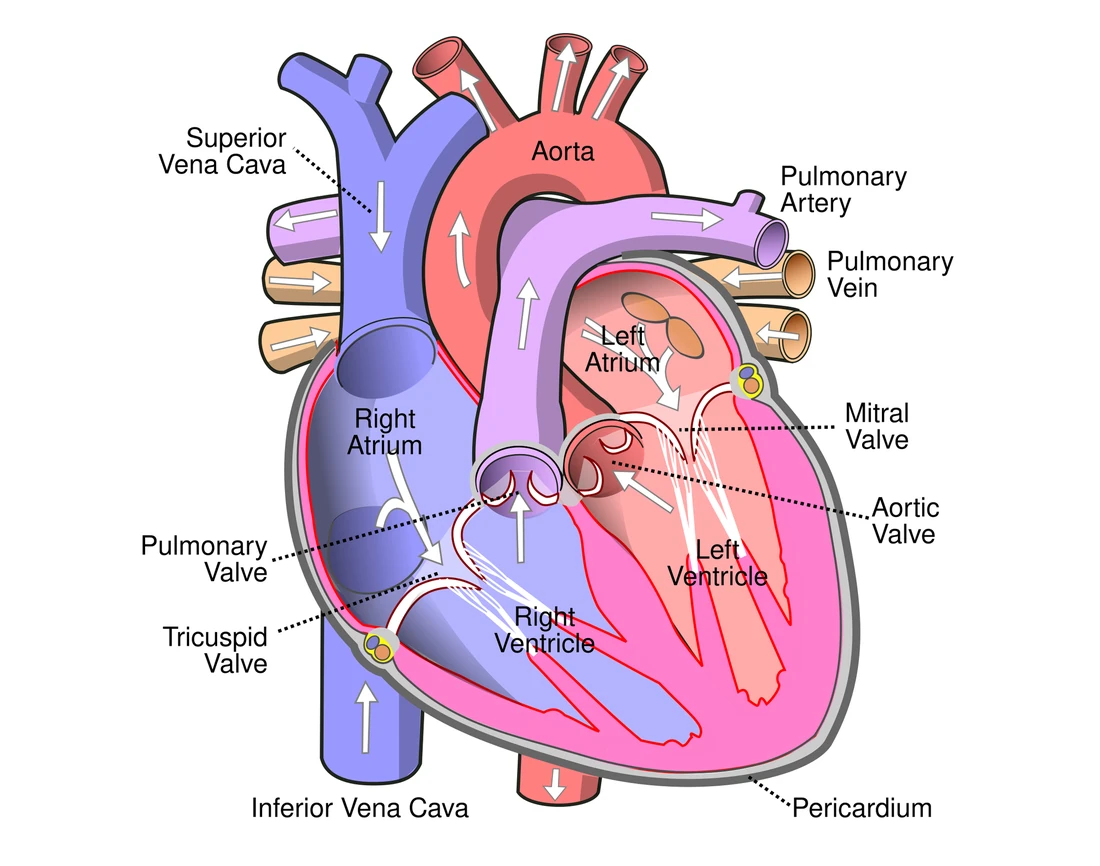
The internal structure of the human heart
Explore the heart
Tap each part. The right side pumps blood to the lungs; the thicker-walled left side pumps it round the whole body.
Ventricles have thicker walls than atria because they:
Difficulté 1/5 · 100 pièces + un petit bonus lors de la première réussite aujourd'hui
Atria only push blood into the ventricles below; ventricles pump blood out, so need thick muscular walls.
The thickest, most muscular chamber, which pumps blood around the whole body, is the left ______.
Difficulté 1/5 · 100 pièces + un petit bonus lors de la première réussite aujourd'hui
The left ventricle drives the systemic circulation (whole body), so it needs the most muscle.
The cardiac cycle 心动周期
- One heartbeat is the cardiac cycle: systole 收缩期 (muscle contracts) and diastole 舒张期 (relaxes and fills).
- When a chamber contracts, the pressure inside rises.
- These pressure changes open and close the valves, so blood flows one way only.
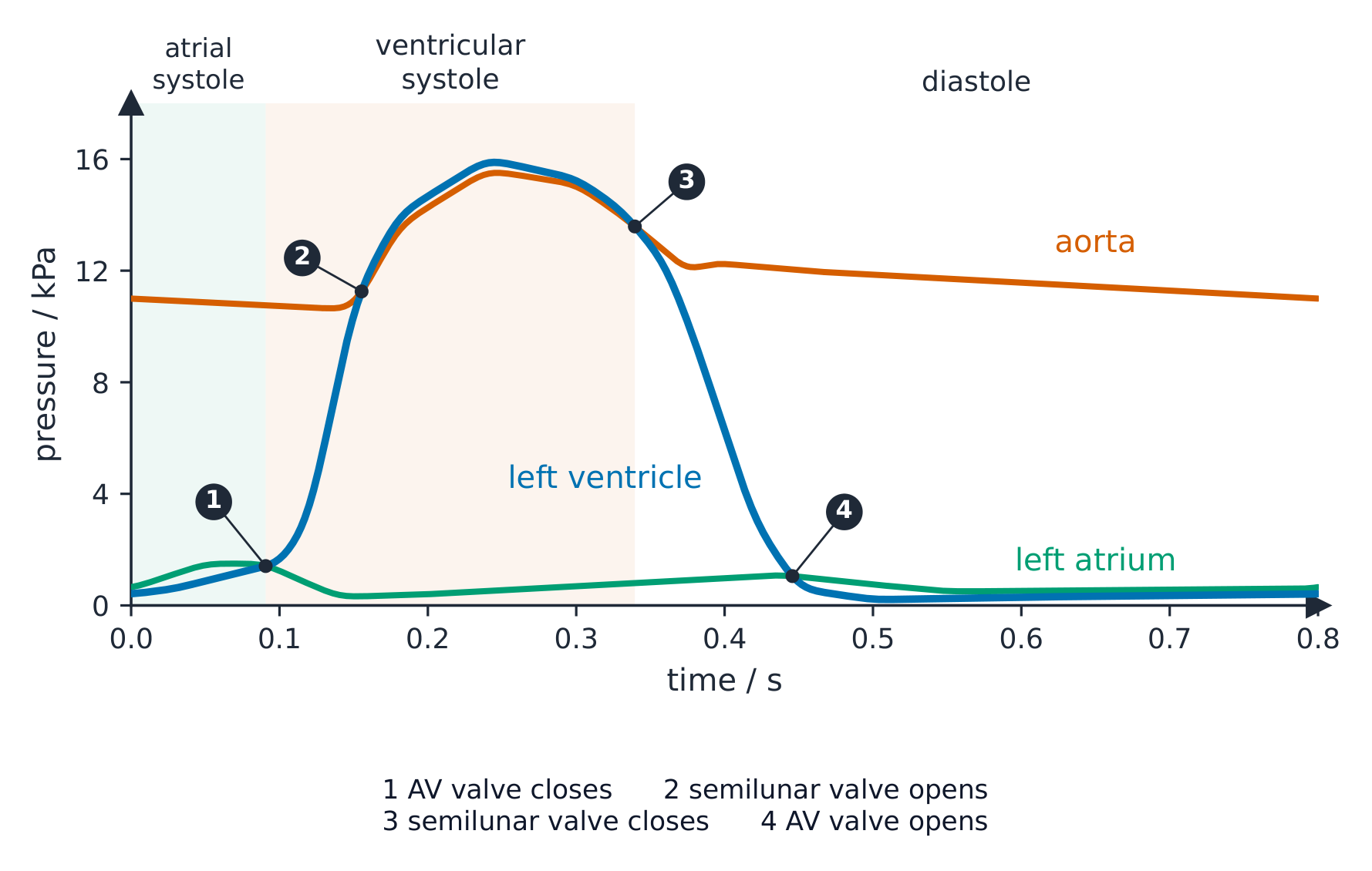
Pressure rises and falls in the atria, ventricles and aorta through one cardiac cycle, working the valves
The cardiac cycle
Step through one heartbeat — atria contract, then ventricles contract, then everything relaxes and refills.
In the cardiac cycle, systole is when the heart muscle:
Difficulté 1/5 · 100 pièces + un petit bonus lors de la première réussite aujourd'hui
Systole = contraction (pressure rises); diastole = relaxation and filling.
Match each stage of the cardiac cycle.
Difficulté 2/5 · 140 pièces + un petit bonus lors de la première réussite aujourd'hui
Atria contract first, then ventricles, then everything relaxes; the valves keep blood moving one way.
The semilunar valves stop blood flowing back into the ventricles from the arteries.
Difficulté 1/5 · 100 pièces + un petit bonus lors de la première réussite aujourd'hui
When the ventricles relax, the semilunar valves (in the aorta and pulmonary artery) shut to stop backflow.
Controlling the heartbeat
- The sinoatrial node 窦房结 (SAN) in the right atrium is the pacemaker 起搏点 — its wave of excitation makes the atria contract.
- The atrioventricular node 房室结 (AVN) picks up the wave and delays it (so the atria empty first).
- The Purkyne tissue 浦肯野组织 carries the wave down and up the ventricle walls, so the ventricles contract from the bottom up.
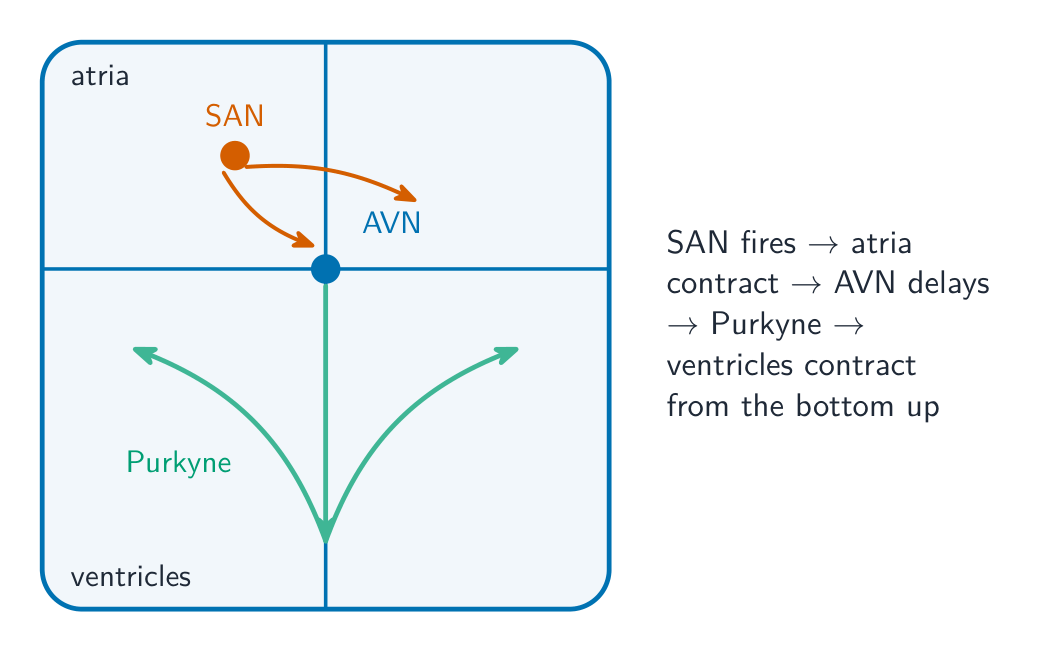
The heart's electrical conduction system
The pacemaker that sets the heart's rhythm is the:
Difficulté 1/5 · 100 pièces + un petit bonus lors de la première réussite aujourd'hui
The SAN in the right atrium generates the wave of excitation that triggers each heartbeat.
Put the electrical conduction pathway in the correct order.
Difficulté 3/5 · 200 pièces + un petit bonus lors de la première réussite aujourd'hui
SAN (pacemaker) → AVN (delay) → Purkyne tissue (ventricles contract from the bottom up).
Worked example: reading pressure in the cardiac cycle
Pressure in the left ventricle rises from 1 kPa to 16 kPa, while aortic pressure stays near 10 kPa until the ventricle pressure passes it. Explain when each valve opens and closes, and calculate the heart rate if one cycle lasts 0.8 s.
- When ventricle pressure rises above atrial pressure, the atrioventricular valve closes. When it passes aortic pressure (about 10 kPa), the semilunar valve opens and blood flows into the aorta. When the ventricle relaxes and its pressure falls below aortic pressure, the semilunar valve closes.
- Heart rate = 60 ÷ 0.8 = 75 beats per minute.
One cardiac cycle lasts 0.6 s. What is the heart rate, in beats per minute?
Difficulté 2/5 · 140 pièces + un petit bonus lors de la première réussite aujourd'hui
60 ÷ 0.6 = 100 beats per minute.
Why does the AVN delay the impulse?
Difficulté 1/5 · 100 pièces + un petit bonus lors de la première réussite aujourd'hui
The ventricles must fill before they contract.
You've got it
- atria = thin walls (push blood down); ventricles = thick walls (pump out)
- left ventricle is thickest — it pumps to the whole body
- cardiac cycle = systole (contract) + diastole (relax/fill); pressure works the valves (one-way flow)
- rhythm: SAN (pacemaker) → atria; AVN (delay) → Purkyne → ventricles contract bottom-up
Write from the thicker left ventricle
- The right ventricle pumps blood to the lungs.
- The left ventricle pumps blood around the body.
Which ventricle has the thicker wall, and why?
The systemic circuit needs the higher pressure.
Which ventricle has the thicker wall?
Difficulté 1/5 · 100 pièces + un petit bonus lors de la première réussite aujourd'hui
The left side supplies the whole body.