Transport of oxygen
Introduit| English | Sens |
|---|---|
| haemoglobin/ˌhiːməˈɡləʊbɪn/ | hémoglobine |
| oxygen dissociation curve/ˈɒksɪdʒn dɪˌsəʊsɪˈeɪʃn kɜːv/ | courbe de dissociation de l'oxygène |
| saturation/ˌsætʃəˈreɪʃn/ | saturation |
| partial pressure/ˈpɑːʃl ˈpreʃə/ | pression partielle |
| Bohr shift/ˈbəʊə ʃɪft/ | déplacement de Bohr |
| fetal haemoglobin/ˈfiːtl ˌhiːməˈɡləʊbɪn/ | hémoglobine fœtale |
| affinity/əˈfɪnɪti/ | affinité |
One blood supply, very different needs
- In a sprint, your leg muscles may use oxygen ten times faster than at rest, yet the same blood flows past them.
- The answer is haemoglobin 血红蛋白: it holds oxygen tightly in the lungs and lets go of more of it in the tissues that need it most.
- One graph, the oxygen dissociation curve 氧解离曲线, explains how.
Haemoglobin and partial pressure
- A haemoglobin molecule has four polypeptide chains, each with a haem group containing one iron ion (Fe²⁺). Each haem binds one O₂, so one haemoglobin carries up to four O₂ molecules.
- The binding is reversible: $\text{Hb} + 4\text{O}_2 \rightleftharpoons \text{HbO}_8$ (oxyhaemoglobin 氧合血红蛋白).
- Partial pressure 分压 of oxygen (pO₂, in kPa) measures how much oxygen is present. It is about 12 kPa in the alveoli, about 5 kPa in resting tissue, and can fall to 2–3 kPa in hard-working muscle.
How blood carries oxygen
Haemoglobin picks up oxygen where there is lots of it (the lungs) and releases it where there is little (the tissues).
What is the largest number of oxygen molecules that one haemoglobin molecule can carry?
Difficulté 2/5 · 140 pièces + un petit bonus lors de la première réussite aujourd'hui
Four polypeptide chains, each with one haem group, and each haem binds one O₂.
Reading the curve
- The curve plots % saturation 饱和度 of haemoglobin (how full of oxygen it is) against pO₂.
- In the lungs (12 kPa) haemoglobin is about 96% saturated: it loads 装载 almost fully.
- In resting muscle (5 kPa) it is still 71% saturated, so it unloads 卸载 only 96 − 71 = 25% of its oxygen. In exercising muscle (2.5 kPa) it falls to 27%, so it unloads 96 − 27 = 69%.
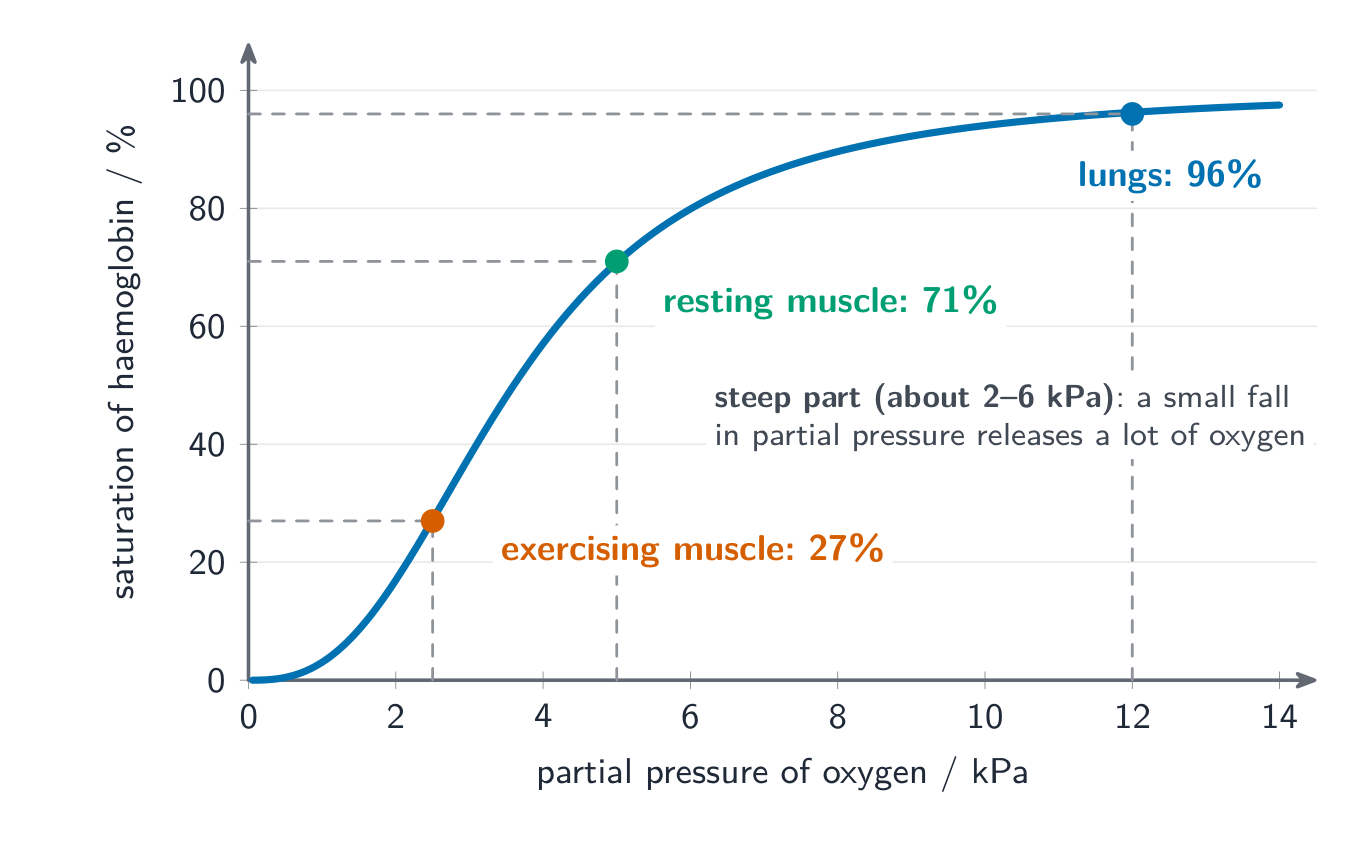
Respiring muscle lowers pO₂, and haemoglobin gives up more oxygen without any signal from the brain.
Where the partial pressure of oxygen is high (the lungs), haemoglobin:
Difficulté 1/5 · 100 pièces + un petit bonus lors de la première réussite aujourd'hui
At high oxygen partial pressure (lungs), haemoglobin loads up and becomes nearly fully saturated.
In respiring tissues, where oxygen is low, haemoglobin:
Difficulté 1/5 · 100 pièces + un petit bonus lors de la première réussite aujourd'hui
At low oxygen partial pressure (tissues), haemoglobin releases oxygen to the cells.
Haemoglobin is 96% saturated in the lungs and 30% saturated in active muscle. What percentage of its maximum oxygen load is released?
Difficulté 2/5 · 140 pièces + un petit bonus lors de la première réussite aujourd'hui
96 − 30 = 66%.
Why the curve is S-shaped
- Low pO₂ (flat start): the first O₂ binds with difficulty, because the haem groups are buried inside the molecule.
- Middle (steep): once one O₂ binds, the shape of the haemoglobin changes. The other haem groups become easier to reach, so the second and third O₂ bind much more easily. This is cooperative binding 协同结合.
- High pO₂ (plateau): the fourth O₂ is harder to add, as there are few free sites left, so the curve levels off near 100%.
- Why it matters: in the lungs, the plateau means haemoglobin stays almost full even if pO₂ falls a little. In the tissues, pO₂ sits on the steep part, so a small fall in pO₂ releases a lot of oxygen.
The oxygen dissociation curve is S-shaped (sigmoid).
Difficulté 1/5 · 100 pièces + un petit bonus lors de la première réussite aujourd'hui
It is S-shaped: binding one oxygen makes the next bind more easily, giving the characteristic sigmoid curve.
Haemoglobin moves from low to high pO₂. Put the events in order.
Difficulté 3/5 · 200 pièces + un petit bonus lors de la première réussite aujourd'hui
This is cooperative binding, and it gives the S-shaped curve.
Why is it useful that tissue pO₂ lies on the steep part of the curve?
Difficulté 1/5 · 100 pièces + un petit bonus lors de la première réussite aujourd'hui
On the steep part, saturation changes a lot for a small change in pO₂, so working tissue gets much more oxygen.
The Bohr shift 波尔位移
- Respiring cells produce CO₂. In red blood cells, carbonic anhydrase 碳酸酐酶 turns it into carbonic acid, which releases H⁺ ions.
- The H⁺ ions bind to haemoglobin (forming haemoglobinic acid) and change its shape, which lowers its affinity 亲和力 for oxygen. Oxyhaemoglobin releases more O₂.
- So at high CO₂ the curve moves to the right. At the same pO₂, haemoglobin is less saturated: it unloads more oxygen to the tissue that is respiring fastest.
- In the lungs CO₂ is low, so the curve shifts back: loading is not affected.
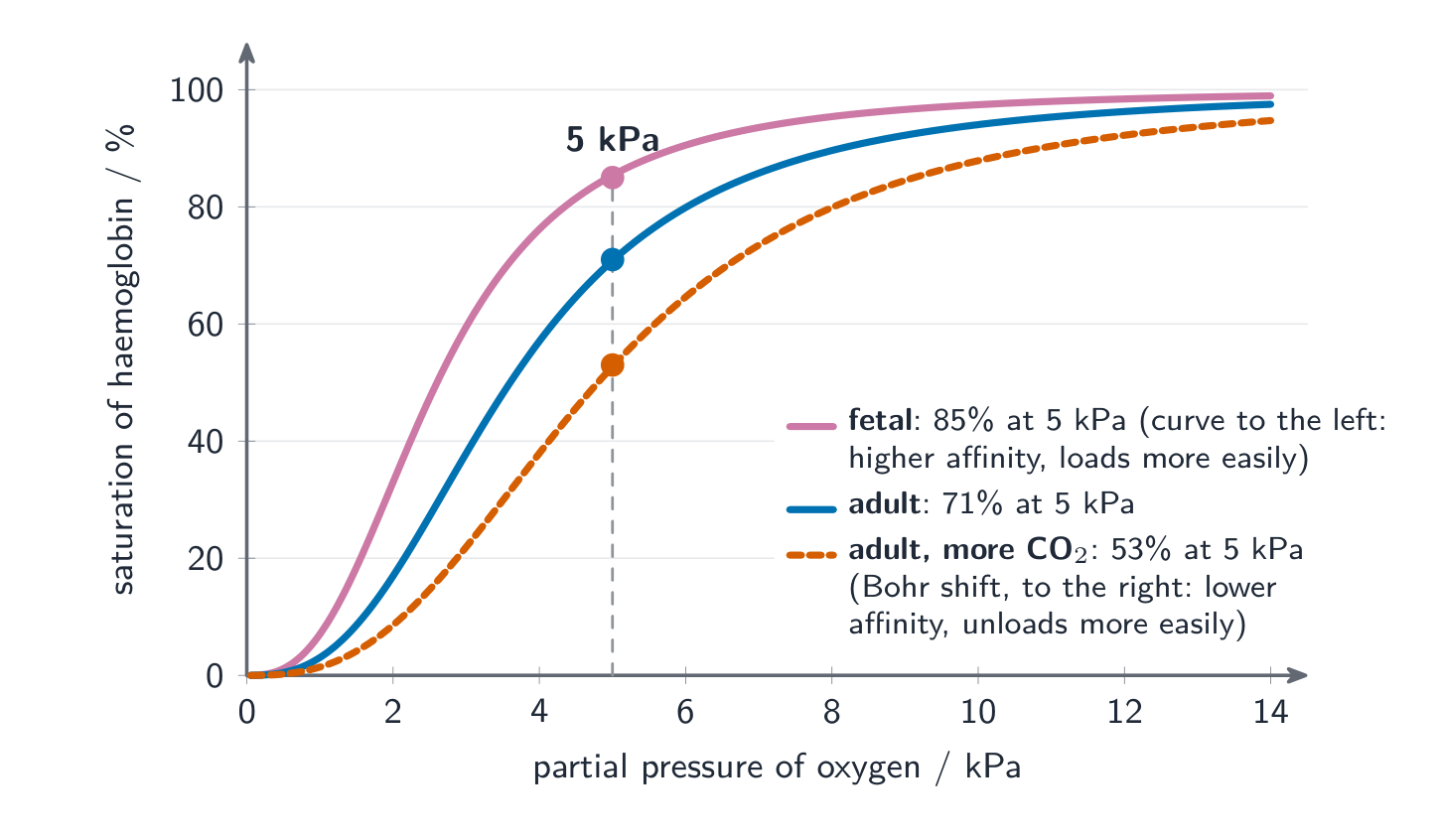
The Bohr shift describes how:
Difficulté 1/5 · 100 pièces + un petit bonus lors de la première réussite aujourd'hui
More CO₂ lowers pH, shifting the curve right so haemoglobin releases more oxygen where tissues need it.
The rightward shift of the curve when CO₂ rises, releasing more oxygen to active tissues, is the ______ shift.
Difficulté 1/5 · 100 pièces + un petit bonus lors de la première réussite aujourd'hui
The Bohr shift means active tissues (high CO₂, low pH) get more oxygen unloaded to them.
What directly lowers the affinity of haemoglobin for oxygen in the Bohr shift?
Difficulté 1/5 · 100 pièces + un petit bonus lors de la première réussite aujourd'hui
CO₂ forms carbonic acid, which releases H⁺. The H⁺ binds to haemoglobin (haemoglobinic acid) and changes its shape.
Fetal haemoglobin 胎儿血红蛋白
- A fetus gets its oxygen from the mother's blood in the placenta, where pO₂ is low.
- Fetal haemoglobin has a higher affinity for oxygen, so its curve lies to the left of the adult curve (85% saturated at 5 kPa, against 71% for the adult).
- At the placenta the mother's haemoglobin unloads oxygen, and the fetal haemoglobin loads it.
Match each situation to what haemoglobin does.
Difficulté 2/5 · 140 pièces + un petit bonus lors de la première réussite aujourd'hui
Hb loads in the lungs, unloads in tissues; high CO₂ shifts the curve right; fetal Hb grabs oxygen from the mother.
At the same partial pressure of oxygen, fetal haemoglobin is more saturated than adult haemoglobin.
Difficulté 1/5 · 100 pièces + un petit bonus lors de la première réussite aujourd'hui
Its curve lies to the left, so it has a higher affinity for oxygen.
Worked exam question: explain the shape
Question (4 marks). Explain why the oxygen dissociation curve of adult haemoglobin is S-shaped.
Model answer, with one mark for each point:
- At low pO₂, it is difficult for the first oxygen molecule to bind to haemoglobin.
- When one oxygen binds, the haemoglobin changes shape (its tertiary/quaternary structure).
- This makes it easier for the second and third oxygen molecules to bind, so saturation rises steeply. This is cooperative binding.
- It is harder for the fourth oxygen to bind, so the curve levels off.
Why answers lose marks: "haemoglobin likes oxygen more" gains nothing. Name the shape change, and link each part of the curve to how easily the next O₂ binds.
Without looking back: explain why the oxygen dissociation curve is S-shaped (4 marks).
Each mark links a part of the curve to how easily the next O₂ binds.
Worked exam question: the Bohr shift in numbers
Question (3 marks). Use the second graph. Blood leaves the lungs 96% saturated. It reaches a tissue where pO₂ is 5 kPa. Calculate how much more of its oxygen it unloads when the tissue has a high CO₂ concentration, and explain why this is useful.
- At normal CO₂: saturation at 5 kPa is 71%, so 96 − 71 = 25% is unloaded.
- At high CO₂: saturation at 5 kPa is 53%, so 96 − 53 = 43% is unloaded: 18 percentage points more (1 mark for the working, 1 for the answer).
- Explanation (1 mark): high CO₂ means the tissue is respiring fast, so it needs more oxygen for aerobic respiration. The Bohr shift delivers it there.
Mark-scheme trap: read the saturations off the graph at the same pO₂. Give your answer as a difference in percentage points, not a percentage change.
What does the extra carbon dioxide do to unloading?
More carbon dioxide makes haemoglobin give up oxygen.
Blood leaves the lungs 95% saturated. In a tissue at 4 kPa it is 60% saturated at normal CO₂, and 40% saturated at high CO₂. How many more percentage points of oxygen are unloaded at high CO₂?
Difficulté 2/5 · 140 pièces + un petit bonus lors de la première réussite aujourd'hui
Normal: 95 − 60 = 35. High CO₂: 95 − 40 = 55. 55 − 35 = 20 percentage points more.
You've got it
- haemoglobin: 4 chains, 4 haem groups with Fe²⁺, so up to 4 O₂; binding is reversible
- lungs (≈12 kPa): ≈96% saturated, loads; tissues (≈5 kPa or lower): unloads
- S-shape = cooperative binding: first O₂ hard, then a shape change makes the next ones easier; the fourth is hard again
- tissue pO₂ lies on the steep part: a small fall in pO₂ releases a lot of O₂
- Bohr shift: CO₂ → H⁺ → haemoglobinic acid → lower affinity → curve moves right → more O₂ to active tissues
- fetal haemoglobin: higher affinity, curve to the left, takes O₂ from the mother at the placenta
What is the Bohr shift?
Difficulté 1/5 · 100 pièces + un petit bonus lors de la première réussite aujourd'hui
The curve shifts right and oxygen is released.