Movement into and out of cells
Introduit| English | Sens |
|---|---|
| concentration gradient/ˌkɒnsənˈtreɪʃn ˈɡreɪdɪənt/ | gradient de concentration |
| diffusion/dɪˈfjuːʒn/ | diffusion |
| facilitated diffusion/fəˈsɪlɪteɪtɪd dɪˈfjuːʒn/ | diffusion facilitée |
| osmosis/ɒzˈməʊsɪs/ | osmose |
| water potential/ˈwɔːtə pəˈtenʃl/ | potentiel hydrique |
| active transport/ˈæktɪv ˈtrænspɔːt/ | transport actif |
| endocytosis/ˌendəʊsɪˈtəʊsɪs/ | endocytose |
| exocytosis/eɡˌzɒsɪˈtəʊsɪs/ | exocytose |
Getting across the membrane
- Every second, oxygen slips into your cells, glucose is let in, and ions are pumped out, all through the same thin membrane.
- Substances cross in six ways. Some are passive 被动的 (no ATP used); some are active (they use ATP from respiration).
- For each one, ask two questions: which way is the concentration gradient 浓度梯度*?* and is a protein needed?

Simple diffusion 扩散
- Diffusion is the net movement of molecules or ions from a region of higher concentration to a region of lower concentration, down a concentration gradient. It is passive: the molecules' own kinetic energy drives it.
- In simple diffusion, small or non-polar molecules pass straight through the phospholipid bilayer: for example O₂, CO₂ and steroid hormones.
- What makes it faster: a steeper concentration gradient, a larger surface area, a shorter distance (a thinner surface), a higher temperature (more kinetic energy), and smaller or more lipid-soluble molecules.
Movement into & out of cells
net movement: high → low
Drag the concentrations. Particles diffuse down their concentration gradient until both sides are equal.
Which molecules cross the membrane by simple diffusion through the bilayer?
Difficulté 1/5 · 100 pièces + un petit bonus lors de la première réussite aujourd'hui
Only small or non-polar molecules can pass straight through the oily bilayer, down the gradient.
Which change would make oxygen diffuse into a cell more slowly?
Difficulté 1/5 · 100 pièces + un petit bonus lors de la première réussite aujourd'hui
A thicker surface means a longer diffusion distance, so the rate falls. The other three all speed diffusion up.
Facilitated diffusion 易化扩散
- Ions and large polar molecules (like glucose) cannot pass through the hydrophobic core of the bilayer. They cross through transport proteins, still down the gradient, so this is still passive.
- Channel proteins 通道蛋白 are water-filled pores; many can open or close (e.g. Na⁺ channels). Carrier proteins 载体蛋白 bind one specific molecule and change shape to move it across (e.g. glucose carriers).
- The rate depends on the number of proteins. When every protein is in use, adding more solute outside cannot speed it up: the rate levels off.
Facilitated diffusion uses channel or carrier proteins but needs no energy — it is still passive.
Difficulté 1/5 · 100 pièces + un petit bonus lors de la première réussite aujourd'hui
Ions and large polar molecules cross via proteins, but movement is still down the gradient, so no ATP is used.
Facilitated diffusion uses ATP to move glucose through a carrier protein.
Difficulté 1/5 · 100 pièces + un petit bonus lors de la première réussite aujourd'hui
It is passive: glucose moves down its gradient.
Match each transport protein to how it works.
Difficulté 2/5 · 140 pièces + un petit bonus lors de la première réussite aujourd'hui
Channels are pores; carriers change shape. Aquaporins are channels for water.
Osmosis 渗透
- Osmosis is the net movement of water molecules from a region of higher water potential 水势 to a region of lower water potential, through a partially permeable membrane.
- Water is small enough to cross the bilayer, but most of it passes through channel proteins called aquaporins 水通道蛋白. It is passive.
- Lesson 4.4 shows how to use water potential to predict what happens to plant and animal cells.
Osmosis is the movement of water from:
Difficulté 1/5 · 100 pièces + un petit bonus lors de la première réussite aujourd'hui
Water moves by osmosis down a water-potential gradient (higher → lower) across a partially permeable membrane.
A plant cell is placed in pure water. Which way does water move?
Difficulté 1/5 · 100 pièces + un petit bonus lors de la première réussite aujourd'hui
Pure water has the highest water potential.
Active transport 主动运输
- Active transport moves ions or molecules against their concentration gradient (from lower to higher concentration). It uses carrier proteins and ATP from respiration.
- The ATP is used to change the shape of the carrier, so the substance is released on the other side.
- Example: the sodium–potassium pump. For each ATP it uses, it pumps 3 Na⁺ out of the cell and 2 K⁺ in. Root hair cells also use active transport to take in mineral ions, such as nitrate, from soil water that is more dilute than the cell.
Moving a substance against its gradient using carrier proteins and ATP is called ______ transport.
Difficulté 1/5 · 100 pièces + un petit bonus lors de la première réussite aujourd'hui
Active transport pumps a substance from low to high concentration, so it needs carrier proteins and ATP.
A cell uses 50 ATP molecules on its sodium–potassium pumps. How many K⁺ ions are pumped into the cell?
Difficulté 2/5 · 140 pièces + un petit bonus lors de la première réussite aujourd'hui
Each ATP moves 3 Na⁺ out and 2 K⁺ in, so 50 × 2 = 100 K⁺ in (and 150 Na⁺ out).
Bulk transport: endocytosis and exocytosis
- Some materials are too large for any protein. The cell moves them in vesicles 囊泡, and this also needs ATP.
- Endocytosis 胞吞作用: the membrane folds in around the material and pinches off a vesicle, bringing it in. Example: a phagocyte engulfs a bacterium.
- Exocytosis 胞吐作用: a vesicle moves to the cell surface membrane and fuses with it, releasing its contents out. Example: a pancreas cell secretes insulin or digestive enzymes.

In exocytosis, a cell:
Difficulté 1/5 · 100 pièces + un petit bonus lors de la première réussite aujourd'hui
Exocytosis releases material out (vesicle fuses with the membrane); endocytosis brings material in.
All six compared
| Process | ATP? | Protein? |
|---|---|---|
| simple diffusion | no | no |
| facilitated diffusion | no | channel or carrier |
| osmosis | no | often aquaporins |
| active transport | yes | carrier |
| endocytosis | yes | no: a vesicle forms |
| exocytosis | yes | no: a vesicle fuses |
- The three passive processes all go down a gradient. Active transport goes against it. Endocytosis and exocytosis move whole vesicles in or out.
Match each way of crossing the membrane to its key feature.
Difficulté 2/5 · 140 pièces + un petit bonus lors de la première réussite aujourd'hui
Diffusion and osmosis are passive (down the gradient); active transport pumps against the gradient using ATP.
Worked exam question: reading uptake graphs
Question (3 marks). Graph A shows the rate of uptake of two substances into cells at different outside concentrations. One crosses by simple diffusion, the other by facilitated diffusion. Identify each, and explain the shape of the green curve.
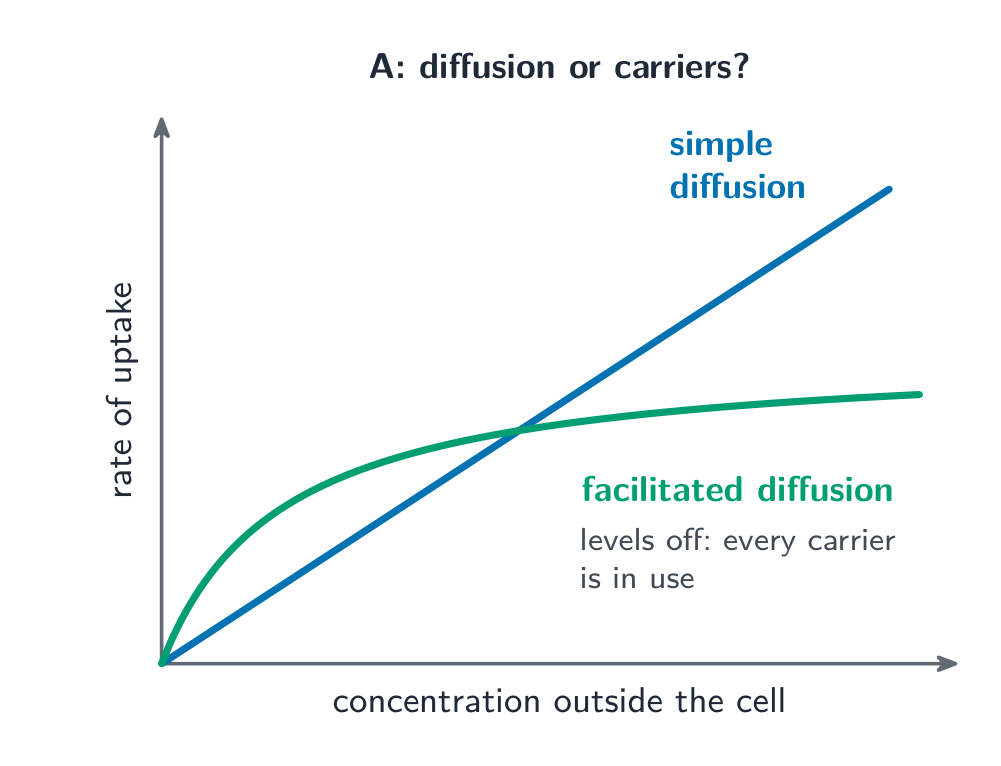
- Blue = simple diffusion: the rate rises in proportion to the concentration, because a steeper gradient means faster net movement and nothing limits it (1 mark).
- Green = facilitated diffusion: at first the rate rises with concentration (1 mark). It then levels off because all the channel or carrier proteins are in use: the number of proteins now limits the rate (1 mark).
Mark-scheme trap: "the membrane is full" or "the cell is full" gains nothing. Name the proteins as the limiting factor.
Glucose uptake by red blood cells levels off at high glucose concentrations. What is the best explanation?
Difficulté 1/5 · 100 pièces + un petit bonus lors de la première réussite aujourd'hui
Glucose enters red blood cells by facilitated diffusion, so the number of carriers limits the rate. No ATP is used.
Worked exam question: is it active transport?
Question (4 marks). Barley roots were kept in a potassium solution at 25 °C. With air bubbled through, they took up K⁺ at 12 units per hour. With nitrogen bubbled through (no oxygen), they took up K⁺ at only 2 units per hour. Graph B shows a similar experiment with cyanide, which stops respiration. Explain what these results show about how K⁺ enters the roots.

- Most K⁺ enters by active transport (1 mark).
- Without oxygen (or with cyanide), the root cells cannot carry out aerobic respiration, so they make little ATP (1 mark).
- Without ATP, the carrier proteins cannot change shape to move K⁺ against its concentration gradient, so uptake falls from 12 to 2 units per hour (1 mark).
- The small uptake that remains (2 units per hour) is probably by diffusion, which needs no ATP (1 mark).
Why this design works: only oxygen changes, and the temperature stays the same. So the fall must come from the loss of ATP, not from slower diffusion.
A substance moves from a low concentration to a high concentration, and the cell spends ATP and uses a carrier protein. Name the process and explain how you know.
Uphill movement that spends ATP is active transport.
Cyanide stops respiration. Explain why adding cyanide to roots stops nitrate uptake but not oxygen uptake (4 marks).
Link the inhibitor to ATP, and ATP to the carrier proteins.
You've got it
- passive (no ATP), all down the gradient: simple diffusion (through the bilayer), facilitated diffusion (channel or carrier proteins), osmosis (water)
- diffusion is faster with a steeper gradient, more surface area, a shorter distance, a higher temperature and smaller or lipid-soluble molecules
- facilitated diffusion levels off when all the proteins are in use
- active transport: against the gradient, carrier proteins + ATP (e.g. Na⁺/K⁺ pump: 3 Na⁺ out, 2 K⁺ in)
- endocytosis brings material in; exocytosis sends it out; both use ATP
- a respiratory inhibitor or a lack of oxygen stops active transport but not diffusion
What moves a substance uphill using ATP?
Difficulté 1/5 · 100 pièces + un petit bonus lors de la première réussite aujourd'hui
The carrier spends ATP to pump against the gradient.