Regardez de près. Ce sont de vraies cellules, photographiées en plein milieu de leur division. À l'intérieur de votre corps, des millions de nouvelles cellules sont produites chaque seconde — peau, sang, intestin…
Narration en anglais · sous-titres en anglais et en 中文 au choix
4.1
Communication cellulaire
Programme
Grande Idée 3 — Stockage et Transmission d'Informations : Les systèmes vivants stockent, récupèrent, transmettent et répondent aux informations essentielles aux processus vitaux.
Objectif d'apprentissage 4.1.A : Décrire les moyens par lesquels les cellules peuvent communiquer entre elles.
4.1.A.1 Les cellules communiquent entre elles par contact direct avec d'autres cellules ou à distance via un signal chimique.
*Exemples illustratifs pour 4.1.A.1 :
Les cellules immunitaires interagissent par contact cellule-à-cellule, notamment les cellules présentatrices d'antigènes (CPA), les lymphocytes T auxiliaires et les lymphocytes T tueurs.
Objectif d'apprentissage 4.1.B : Expliquer comment les cellules communiquent entre elles sur de courtes et longues distances.
4.1.B.1 Les cellules communiquent sur de courtes distances en utilisant des régulateurs locaux qui ciblent les cellules situées à proximité de la cellule émettrice du signal.
*Exemples illustratifs pour 4.1.B.1 :
Neurotransmetteurs
Réponse immunitaire des plantes
Quorum sensing chez les bactéries
Morphogènes dans le développement embryonnaire
4.1.B.2 Les signaux libérés par un type cellulaire peuvent parcourir de longues distances pour atteindre des cellules cibles d'un autre type.
*Exemples illustratifs pour 4.1.B.2 :
Insuline
Hormone de croissance humaine
Hormones thyroïdiennes
Testostérone
Œstrogène
Source : Description du cours et de l'examen AP College Board
English
A single molecule of adrenaline 肾上腺素 arriving at a liver cell can release millions of glucose 葡萄糖 molecules within seconds. A single faulty switch in the same kind of pathway can make a cell divide without stopping. This unit follows a signal from the outside of a cell to its response, and shows where the control can fail.
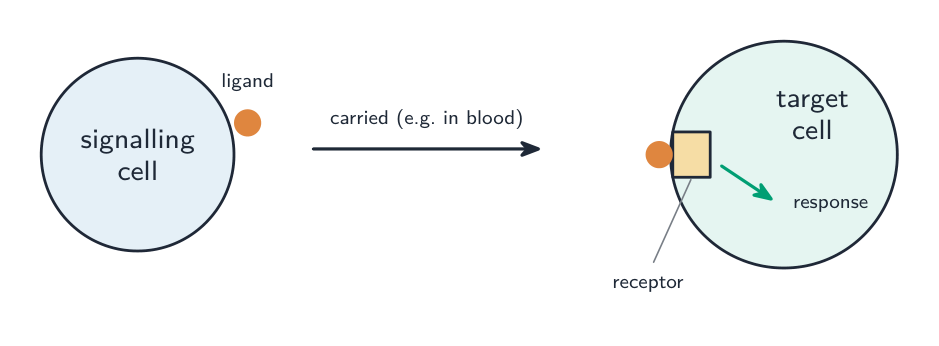
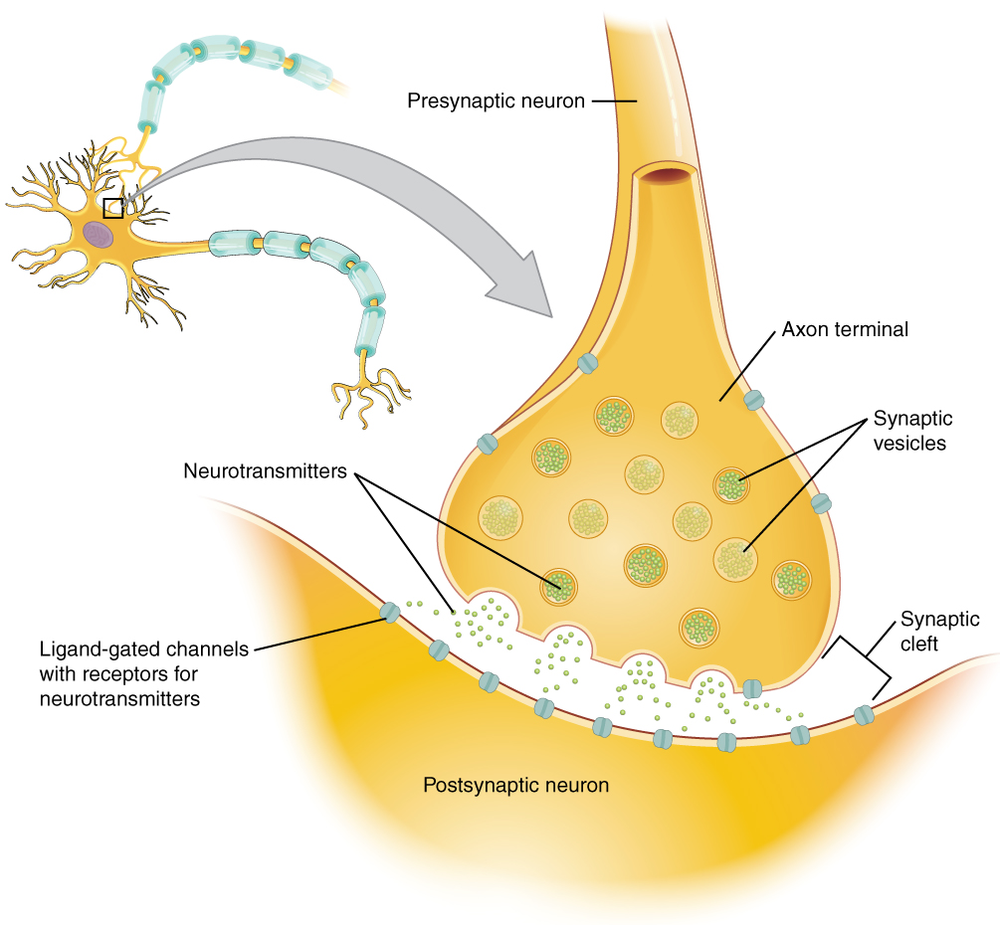
Cells coordinate by sending and receiving chemical signals 信号. In chemical signaling, a ligand 配体 binds a receptor 受体 on a target cell 靶细胞. The ligand may be released or held on a cell surface. Signals travel over different ranges: direct contact (cell junctions 细胞连接), local signaling (nearby cells, like neurotransmitters 神经递质), and long-distance signaling (hormones 激素 carried through the blood in animals; plants use other transport routes).
Each range has classic examples. In direct contact, an immune cell that has engulfed a pathogen shows pieces of it on its surface, and a helper T cell must touch it to read them. Local signals include neurotransmitters, morphogens that tell embryo cells where they are, and quorum sensing, in which bacteria release a chemical and switch on new genes (such as those for glowing or for forming a biofilm) only when enough of them are nearby. Long-distance signals include insulin, human growth hormone, thyroid hormones, testosterone and oestrogen.
A signal molecule (ligand) binds a matching receptor on the target cell
Explorer
Sur quelle distance le signal voyage-t-il ?
Classez chaque type de signalisation cellulaire selon la distance parcourue par le message.
Grande Idée 3 — Stockage et Transmission d'Informations : Les systèmes vivants stockent, récupèrent, transmettent et répondent aux informations essentielles aux processus vitaux.
Objectif d'apprentissage 4.2.A : Décrire les composants d'une voie de transduction du signal.
4.2.A.1 Les voies de transduction du signal relient la réception du signal aux réponses cellulaires.
4.2.A.2 De nombreuses voies de transduction du signal comprennent des modifications protéiques et impliquent des cascades de phosphorylation.
Objectif d'apprentissage 4.2.B : Décrire le rôle des composants d'une voie de transduction du signal dans la production d'une réponse cellulaire.
4.2.B.1 La signalisation commence par la reconnaissance d'un messager chimique — un ligand — par une protéine réceptrice dans une cellule cible.
i. Le domaine de liaison au ligand d'un récepteur reconnaît un messager chimique spécifique, qui peut être un peptide (protéine) ou une petite molécule.
ii. Les récepteurs couplés aux protéines G sont un exemple de protéine réceptrice chez les eucaryotes.
iii. Les récepteurs peuvent être situés à la surface d'une cellule cible ou dans le cytoplasme ou le noyau de cette dernière.
4.2.B.2 Les cascades de signalisation relaient les signaux des récepteurs vers les cibles cellulaires, amplifiant souvent les signaux entrants, ce qui aboutit aux réponses appropriées de la cellule. Ces réponses peuvent inclure la croissance cellulaire, la sécrétion de molécules ou l'expression génique.
i. Après la liaison du ligand, le domaine intracellulaire d'une protéine réceptrice change de forme, initiant la transduction du signal.
ii. Les enzymes et les seconds messagers tels que l'AMP cyclique (AMPc) relaient et amplifient le signal intracellulaire.
iii. Les hormones constituent un exemple de messager de signalisation pouvant parcourir de longues distances dans le sang.
iv. La liaison de ligands à des canaux dépendants de ligands peut provoquer l'ouverture ou la fermeture du canal.
Source : Description du cours et de l'examen AP College Board
English
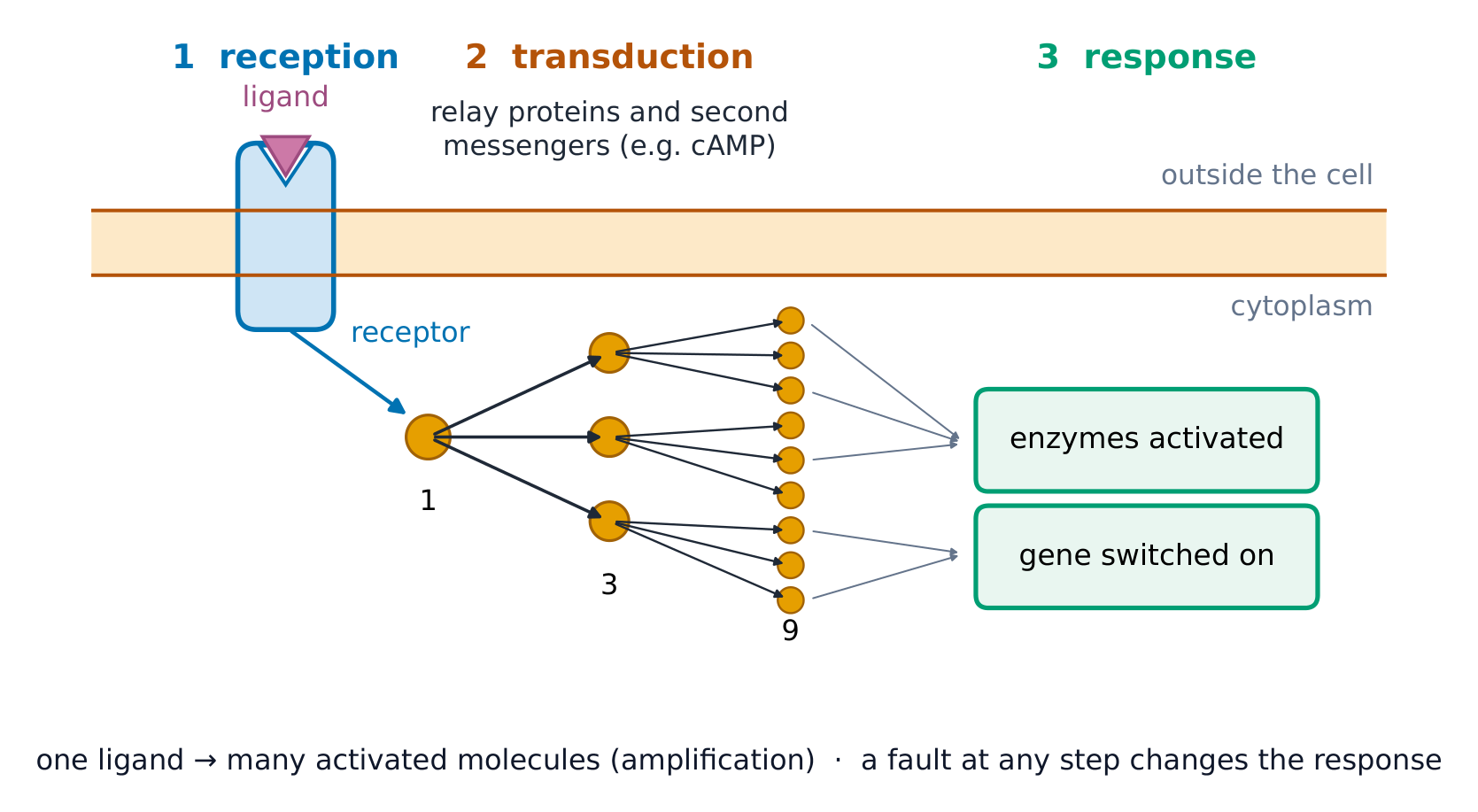
Signal transduction 信号转导 converts an outside signal into a cellular response in three stages: reception 接收 (ligand binds receptor), transduction 转导 (a relay of molecules inside the cell), and response 响应 (a change in the cell's activity, such as switching on a gene). Receptors are specific, so a cell only responds to signals it can receive.
Where the receptor sits depends on the ligand. Large or polar ligands, such as peptide hormones and neurotransmitters, cannot cross the membrane, so they bind receptors on the cell surface. Small nonpolar ligands, such as steroid hormones (oestrogen, testosterone), cross the membrane and bind receptors in the cytoplasm or nucleus; the receptor–hormone complex often acts directly on genes. A receptor has a ligand-binding part that fits only its ligand; when the ligand binds, the receptor's part inside the cell changes shape, and that change starts transduction.
Two kinds of surface receptor appear often on the exam:
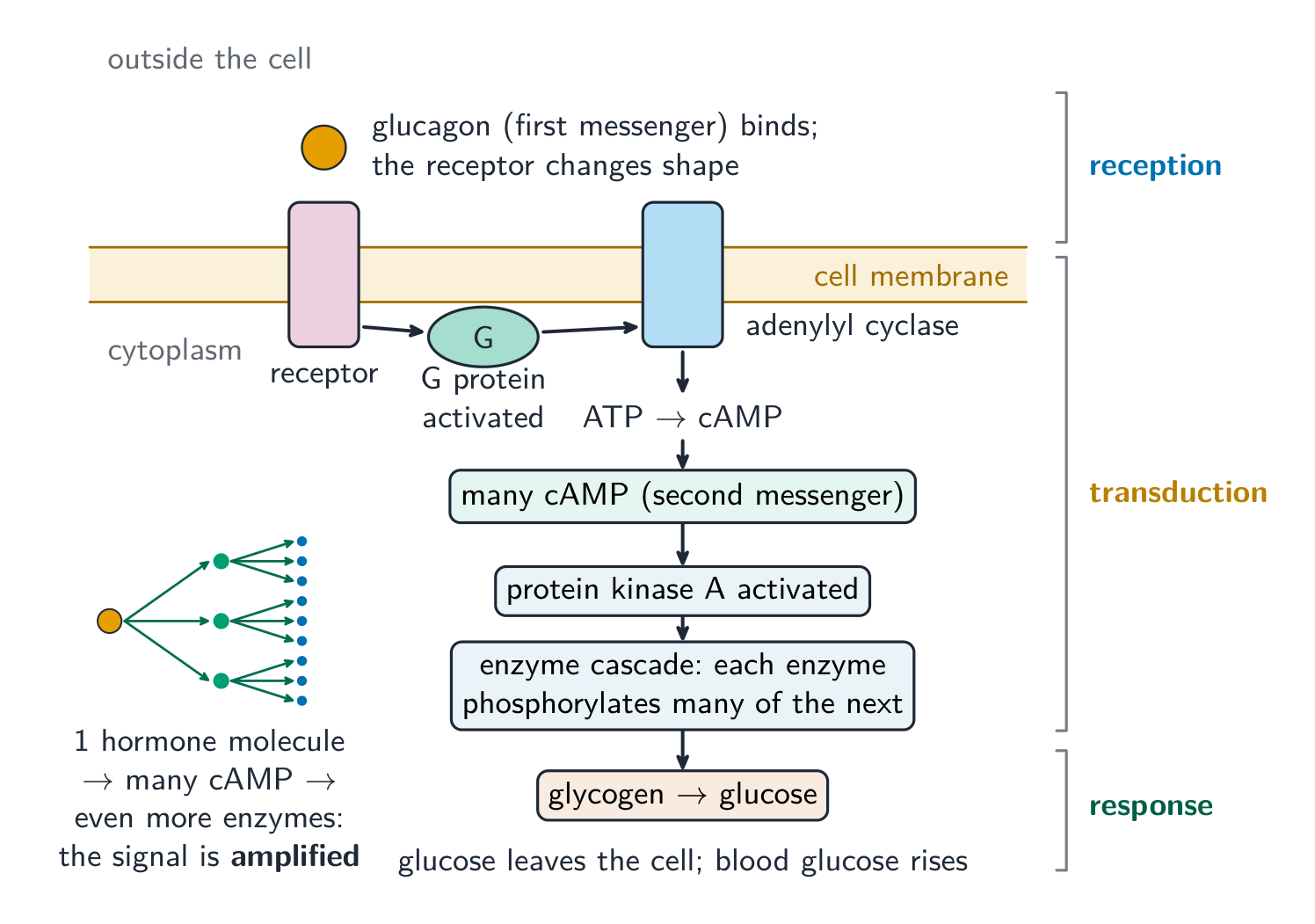
G protein-coupled receptors (GPCRs). The ligand changes the receptor's shape, so it activates a G protein inside the membrane. An inactive G protein holds GDP; the active receptor makes it swap GDP for GTP, and the GTP-bound G protein switches on an enzyme, such as the one that makes cyclic AMP. The G protein then breaks GTP down to GDP and turns itself off.
Ligand-gated ion channels. The ligand opens (or closes) a channel. Acetylcholine binding to receptors on a muscle cell opens channels that let $\text{Na}^+$ in, which starts the muscle contracting.
A chemical synapse: signal transduction passes a message across a gap with a ligand and receptorThe three stages of cell signalling: reception at the membrane, transduction by a relay cascade that amplifies the signal at each step, and the response
Grande Idée 3 — Stockage et Transmission d'Informations : Les systèmes vivants stockent, récupèrent, transmettent et répondent aux informations essentielles aux processus vitaux.
Objectif d'apprentissage 4.3.A : Décrire les différents types de réponses cellulaires déclenchées par une voie de transduction du signal.
4.3.A.1 La transduction du signal peut entraîner des changements dans l'expression des gènes et la fonction cellulaire, modifiant le phénotype ou entraînant la mort cellulaire programmée (apoptose).
*Exemples illustratifs pour 4.3.A.1 :
Utilisation de messagers chimiques par les microorganismes pour communiquer avec d'autres cellules voisines et réguler des voies spécifiques en réponse à la densité de population (quorum sensing)
Stimulation de la dégradation du glycogène par l'épinéphrine chez les mammifères
Objectif d'apprentissage 4.3.B : Expliquer comment un changement de structure d'une molécule de signalisation affecte l'activité de la voie de signalisation.
4.3.B.1 Les changements dans les voies de transduction du signal peuvent modifier les réponses cellulaires. Des mutations dans n'importe quel domaine de la protéine réceptrice ou dans n'importe quel composant de la voie de signalisation peuvent affecter les composants en aval en altérant la transduction ultérieure du signal.
*Exemples illustratifs pour 4.3.B.1 :
Les cytokines régulent l'expression des gènes pour permettre la réplication et la division cellulaires.
Les phéromones de accouplement chez la levure déclenchent l'expression des gènes liés à l'accouplement.
Les niveaux d'éthylène provoquent des changements dans la production de différentes enzymes permettant la maturation des fruits.
Les gènes HOX régulent les plans corporels animaux pendant le développement embryonnaire.
4.3.B.2 Les substances chimiques qui interagissent avec n'importe quel composant de la voie de signalisation peuvent activer ou inhiber cette voie.
Source : Description du cours et de l'examen AP College Board
English
In the transduction stage, the signal passes through a pathway 通路 – often a cascade 级联 of proteins that activate one another, frequently amplifying 放大 the signal so a few ligands trigger a large response. Second messengers 第二信使 (like cyclic AMP 环磷酸腺苷 or calcium ions) spread the signal quickly through the cell. A change in one step can alter the whole outcome.
Many cascades work by phosphorylation. Enzymes called kinases add a phosphate group, taken from ATP, to the next protein in the relay. The phosphate is charged, so it changes the protein's shape, which switches it on (or, for some proteins, off). Each kinase activates many copies of the next one, so the signal is amplified. Enzymes called phosphatases remove the phosphates, which switches the pathway off again when the signal stops.
The response can be a change in which genes are expressed, a change in an enzyme's activity (adrenaline switches on the breakdown of glycogen to glucose in liver cells), cell division, or even apoptosis 细胞凋亡, programmed cell death.
Worked example (toxins and drugs). Chemicals that act on any step can switch a pathway on or off.
Cholera toxin changes the G protein in gut cells so that it cannot break down its GTP. The G protein stays on, the cell makes cyclic AMP nonstop, and chloride ions and water pour out of the cells into the gut: severe diarrhoea.
A mutation that stops GTP from replacing GDP does the opposite: the G protein can never be switched on, so the ligand binds but there is no response.
Acetylcholinesterase normally breaks down acetylcholine in the gap between nerve and muscle. Inhibit it, and acetylcholine stays bound to the receptors, the channels keep opening, and the muscle keeps being stimulated, leading to spasms.
A signalling cascade amplifies the message inside the cell
Worked example (amplification: epinephrine and glycogen). Epinephrine (adrenaline) binds a G protein-coupled receptor on a liver cell. Suppose one activated receptor switches on 10 G proteins, each G protein activates one adenylyl cyclase that makes 100 cAMP molecules, and the cascade of kinases after that multiplies the signal 1000 times more. How many active enzymes of the final step (glycogen phosphorylase) result from one epinephrine molecule? $10 \times 100 \times 1000 = 10^{6}$: one hormone molecule leads to about a million active enzymes, each of which breaks off many glucose units from glycogen. This is why tiny concentrations of a hormone give a large, fast response. Because epinephrine never enters the cell, the response depends entirely on the receptor and the relay; a drug that blocks the receptor, or an inhibitor of adenylyl cyclase, stops glycogen breakdown even when the hormone is present.
Worked example (yeast mating pheromones). Haploid yeast cells come in two mating types, a and α. Each type releases a pheromone 信息素 that binds a receptor on cells of the other type. The receptor activates a G protein and a kinase cascade, which switches on transcription factors; these turn on the mating genes, so the cells stop dividing, grow towards each other and fuse into a diploid cell. Predict the effect of a mutation that removes the α-pheromone receptor from type a cells. The a cells can no longer detect α-pheromone, so no transduction happens, the mating genes stay off, and the cells cannot mate, although they still make their own a-pheromone and divide normally. This example shows signaling between single-celled organisms, and a response that is a change in gene expression.
Morphogens. In an embryo, a morphogen 形态发生素 is released from one region and diffuses away, so its concentration falls with distance. Cells read the local concentration: a high concentration switches on one set of genes, a lower one another set. In the fruit fly, the protein Bicoid, high at the head end of the egg, determines which end develops as the head; an embryo with no Bicoid develops without a head and thorax.
Reading error bars
Experimental results are often shown as means with error bars, usually $\pm 2$ standard errors of the mean ($\pm 2\,\text{SE}_{\bar{x}}$), which gives roughly a 95% confidence interval.
Worked example. Liver cells were treated three ways, and the cAMP made was measured (mean $\pm 2\,\text{SE}$, arbitrary units): no hormone $5 \pm 2$; epinephrine $48 \pm 6$; epinephrine plus a receptor-blocking drug $9 \pm 4$.
Epinephrine vs no hormone: the error bars ($3$–$7$ and $42$–$54$) do not overlap, so the increase is very likely a real (statistically significant) difference.
No hormone vs epinephrine plus drug: the bars ($3$–$7$ and $5$–$13$) overlap, so overlap alone cannot establish whether the difference is significant. The mean with the drug is much nearer the untreated mean, consistent with strong inhibition.
A claim to support: epinephrine increases cAMP production through its receptor, because blocking the receptor greatly reduces the increase.
Overlapping 95% confidence intervals can still accompany a statistically significant difference; use an appropriate statistical test to decide. Bars that do not overlap suggest a real difference. Error bars do not tell you the cause; that comes from the controls in the design.
Grande Idée 2 — Énergétique : Les systèmes biologiques utilisent l'énergie et les blocs de construction moléculaires pour croître, se reproduire et maintenir une homéostasie dynamique.
Objectif d'apprentissage 4.4.A : Expliquer comment la rétroaction positive et négative aide à maintenir l'homéostasie.
4.4.A.1 Les organismes utilisent des mécanismes de rétroaction pour maintenir leurs environnements internes face aux changements internes et externes.
i. Les mécanismes de rétroaction négative maintiennent l'homéostasie en réduisant le stimulus initial pour réguler les processus physiologiques. Si un système est perturbé ou déséquilibré, les mécanismes de rétroaction négative ramènent le système à son point consigne. Ces processus opèrent aux niveaux moléculaire, cellulaire et organismal.
*Exemples illustratifs pour 4.4.A.1.i :
Régulation de la glycémie par l'insuline/glucagon
ii. Les mécanismes de rétroaction positive amplifient les réponses et les processus chez les organismes biologiques. La variable initiant la réponse s'éloigne davantage du point consigne initial. L'amplification se produit lorsque le stimulus est intensifié, ce qui déclenche à son tour une réponse supplémentaire produisant un changement du système.
*Exemples illustratifs pour 4.4.A.1.ii :
Lactation chez les mammifères
Accouchement
Maturation des fruits
Source : Description du cours et de l'examen AP College Board
English
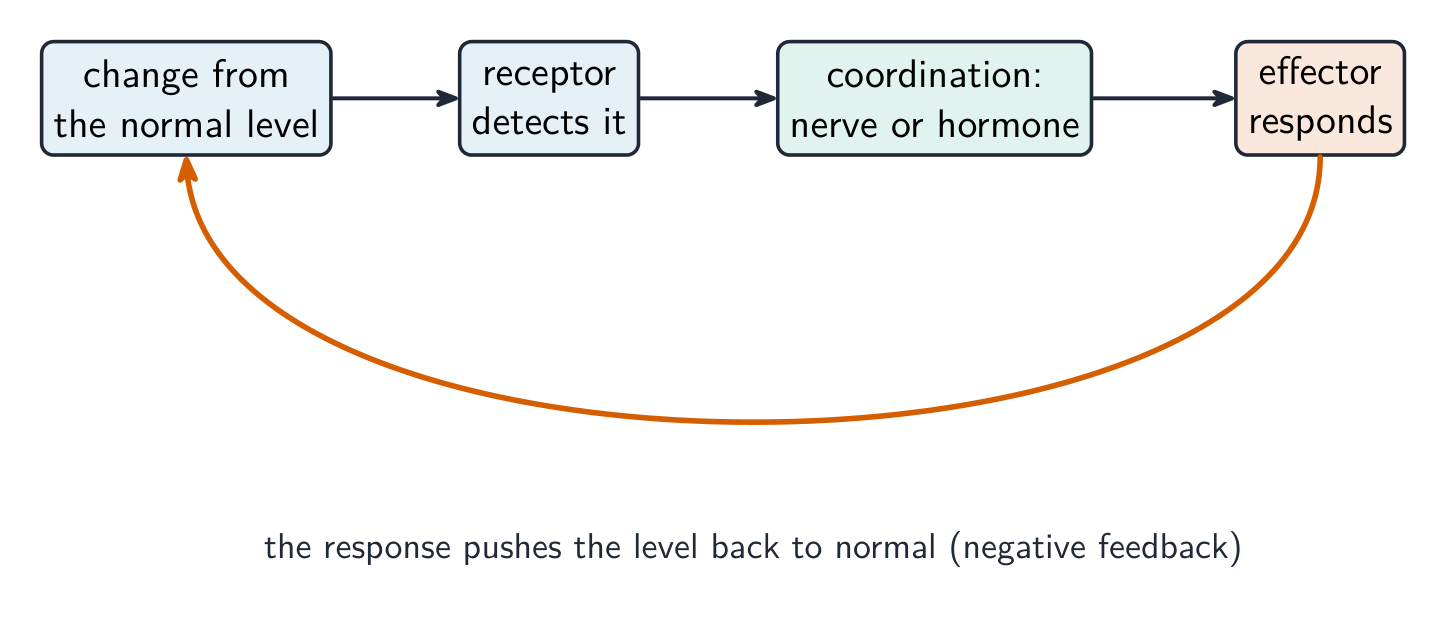
Feedback 反馈 keeps systems balanced:
Negative feedback 负反馈 counteracts a change to restore a set point 设定点 (like a thermostat 恒温器) – it maintains homeostasis 稳态.
Positive feedback 正反馈 amplifies a change to push a process to completion (like childbirth contractions 宫缩 or blood clotting 血液凝固).
Negative feedback detects and corrects a change
Worked example (blood sugar). After a meal, blood glucose rises. The pancreas releases insulin 胰岛素, which makes body cells take up glucose and the liver store it as glycogen, so blood glucose falls back to its set point. Between meals, glucose falls; the pancreas releases glucagon, which makes the liver break glycogen down and release glucose. Each hormone reverses the change that triggered it, so both are negative feedback. Positive feedback examples include milk release while a baby feeds (suckling causes more milk release, which encourages more suckling) and fruit ripening: ripening fruit releases the gas ethylene, which makes nearby fruit ripen and release more ethylene.
Explorer
La rétroaction négative maintient la stabilité
La rétroaction négative détecte un changement et l'inverse, maintenant une variable (comme la glycémie) près d'un point de consigne. Éloignez-la et observez le système se corriger.
Grande Idée 3 — Stockage et Transmission d'Informations : Les systèmes vivants stockent, récupèrent, transmettent et répondent aux informations essentielles aux processus vitaux.
Objectif d'apprentissage 4.5.A : Décrire les événements qui se déroulent dans le cycle cellulaire.
4.5.A.1 Le cycle cellulaire est une série hautement régulée d'événements qui contrôle la croissance et la reproduction des cellules eucaryotes.
i. Le cycle cellulaire consiste en des étapes séquentielles d'interphase (G1, S, G2), de mitose et de cytokinèse.
ii. Phase G1 : La cellule est métaboliquement active, dupliquant les organites et les composants cytosoliques.
iii. Phase S : L'ADN est sous forme de chromatine et se réplique pour former deux chromatides sœurs reliées par un centromère.
iv. Phase G2 : La synthèse de protéines a lieu, l'ATP est produit en grande quantité et les centrosomes se dupliquent.
v. Une cellule peut entrer dans une phase (G0) où elle ne se divise plus, mais elle peut réintégrer le cycle cellulaire en réponse à des stimuli appropriés.
vi. Les cellules non divisantes peuvent sortir du cycle cellulaire ou être maintenues à une étape particulière du cycle cellulaire.
Objectif d'apprentissage 4.5.B : Expliquer comment la mitose assure la transmission des chromosomes d'une génération de cellules à la suivante.
4.5.B.1 La mitose est un processus qui garantit le transfert d'un génome complet d'une cellule parent à deux cellules filles génétiquement identiques chez les eucaryotes.
i. La mitose joue un rôle dans la croissance, la réparation des tissus et la reproduction asexuée.
ii. La mitose se déroule en étapes séquentielles (prophase, métaphase, anaphase, télophase) et alterne avec l'interphase dans le cycle cellulaire.
iii. Prophase : Les chromatides sœurs se condensent, le fuseau mitotique commence à se former et les centrosomes migrent vers les pôles opposés de la cellule.
iv. Métaphase : Les fibres du fuseau alignent les chromosomes le long de l'équateur de la cellule.
v. Anaphase : Les chromatides sœurs appariées se séparent alors que les fibres du fuseau tirent les chromatides vers les pôles.
vi. Télophase : Le fuseau mitotique se désagrège, une nouvelle enveloppe nucléaire se développe, puis le cytoplasme se divise.
vii. Cytokinèse : Un sillon de clivage se forme chez les cellules animales ou une plaque cellulaire se forme chez les plantes, résultant en deux nouvelles cellules filles.
Source : Description du cours et de l'examen AP College Board
English
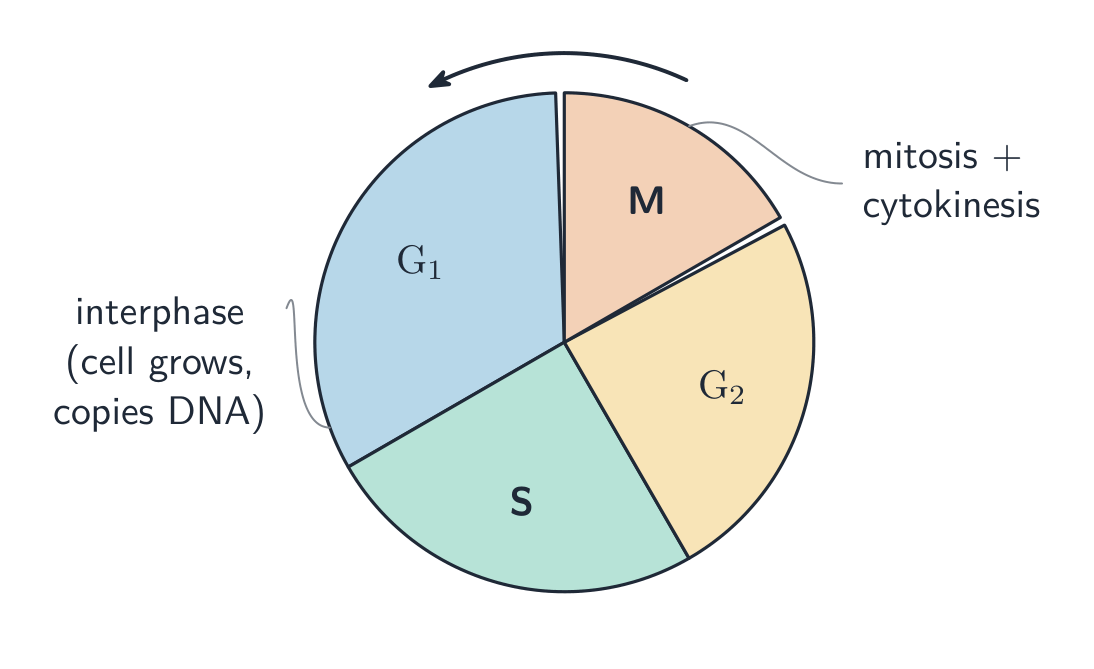
The cell cycle 细胞周期 is the life of a cell from one division to the next: interphase 间期 (G1 growth, S DNA replication DNA复制, G2 preparation) followed by M phase, including mitosis 有丝分裂 and cytokinesis 胞质分裂, which normally produce daughter cells 子细胞 with the same chromosome 染色体 number and very similar genetic information. Interphase takes most of the time; DNA is copied only in S phase.
G1: the cell grows and is metabolically active, copying its organelles.
S: each chromosome (spread out as chromatin) is copied, giving two sister chromatids joined at a centromere. In animal cells the centrosome also duplicates during S phase.
G2: the cell makes proteins and replenishes ATP stores in preparation for division.
G0: many cells, such as most nerve cells, leave the cycle and stop dividing. Some can return to the cycle when the right signal arrives.
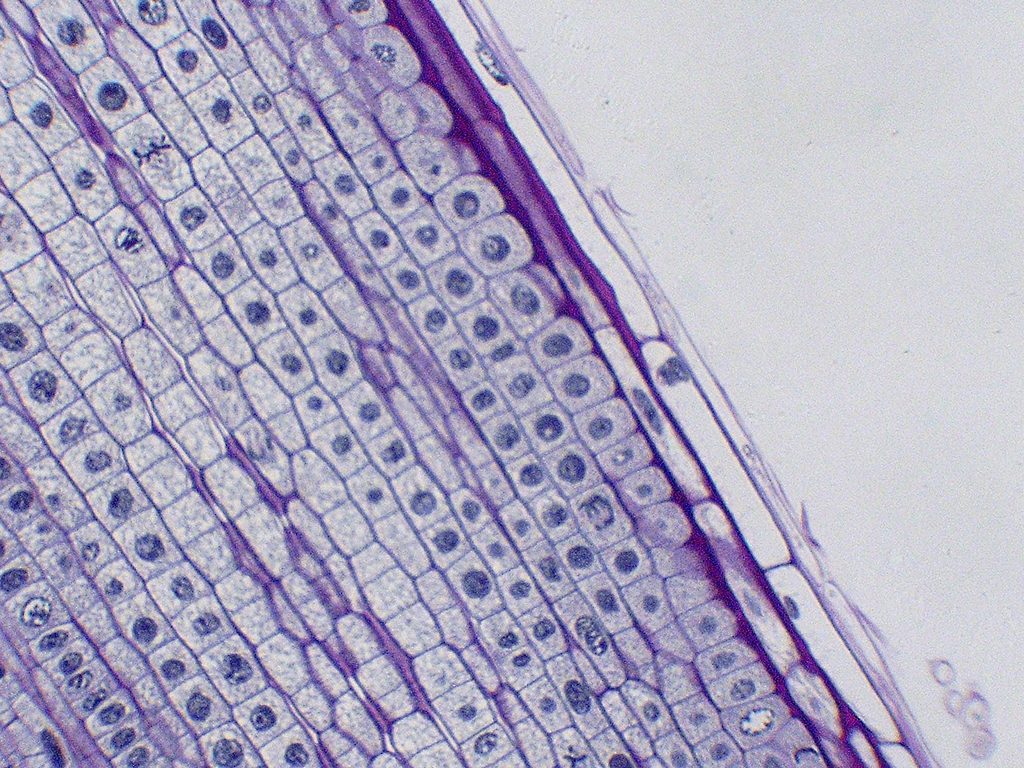
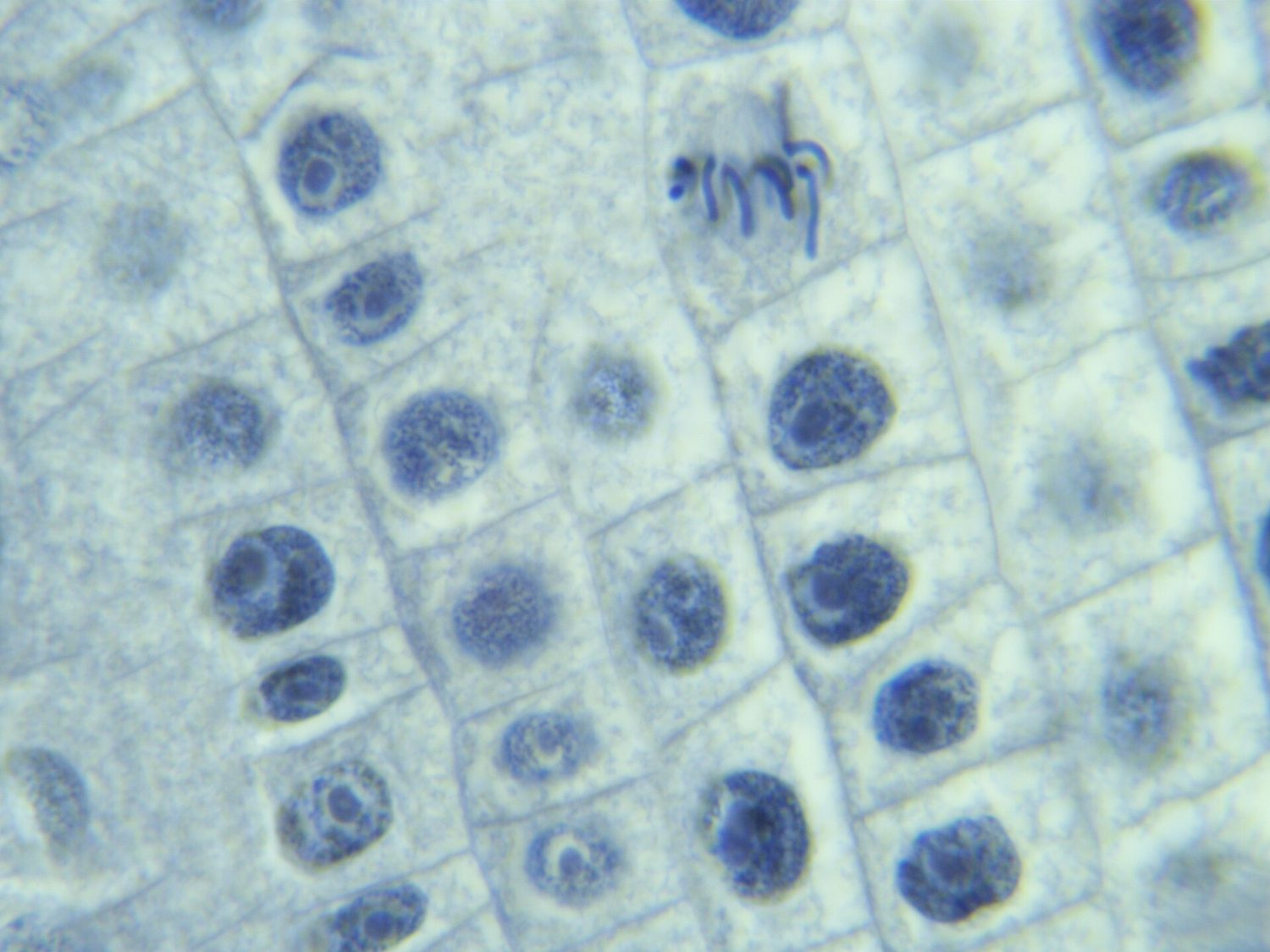
Onion root-tip cells at different stages of mitosis (light micrograph)
Mitosis passes a complete, identical genome to two daughter cells. It is used for growth, repair of tissues, and asexual reproduction, in four steps:
Prophase 前期: the chromatids condense into thick, visible chromosomes, the spindle starts to form, and the centrosomes move to opposite poles.
Metaphase: spindle fibres line the chromosomes up across the middle of the cell.
Anaphase 后期: the sister chromatids separate and are pulled to opposite poles.
Telophase 末期: the spindle breaks down and a new nuclear envelope forms around each set of chromosomes.
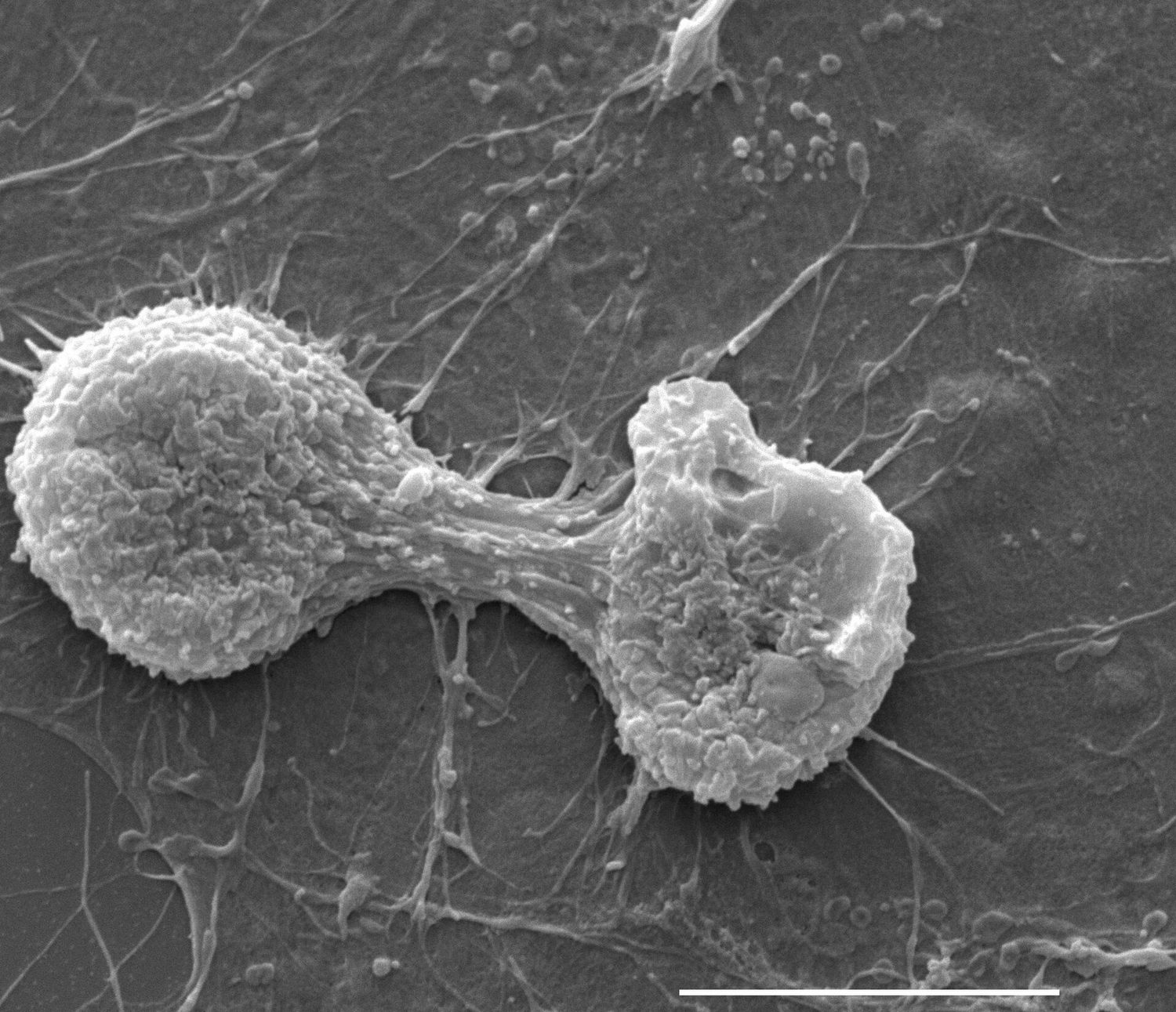
Cytokinesis then divides the cytoplasm: a cleavage furrow pinches an animal cell in two, while a plant cell, held in by its wall, builds a new cell plate across the middle. Chromosomes are visible under a microscope only during division because only then are they tightly condensed; in interphase the DNA is spread out as chromatin.
The cell cycle: interphase, then mitosis and cytokinesisA fibroblast dividing: cytokinesis splits one cell into two as mitosis endsOnion root tip at metaphase: chromosomes line up before sister chromatids separate
Explorer
Parcourir le cycle cellulaire
Le cycle cellulaire copie l'ADN (phase S) puis le divise équitablement lors de la mitose, produisant deux cellules identiques. Parcourez les étapes.
Grande Idée 3 — Stockage et Transmission d'Informations : Les systèmes vivants stockent, récupèrent, transmettent et répondent aux informations essentielles aux processus vitaux.
Objectif d'apprentissage 4.6.A : Décrire le rôle des points de contrôle dans la régulation du cycle cellulaire.
4.6.A.1 Un certain nombre de contrôles internes ou de points de vigilance régulent la progression dans le cycle cellulaire.
4.6.A.2 Les interactions entre les cyclines et les kinases dépendantes des cyclines régulent le cycle cellulaire.
Énoncé d'exclusion : La connaissance des paires spécifiques cycline-CdK ou des facteurs de croissance dépasse le cadre de l'examen AP.
Objectif d'apprentissage 4.6.B : Décrire les effets des perturbations du cycle cellulaire sur la cellule ou l'organisme.
4.6.B.1 Les perturbations du cycle cellulaire peuvent entraîner un cancer ou l'apoptose (mort cellulaire programmée).
Source : Description du cours et de l'examen AP College Board
English
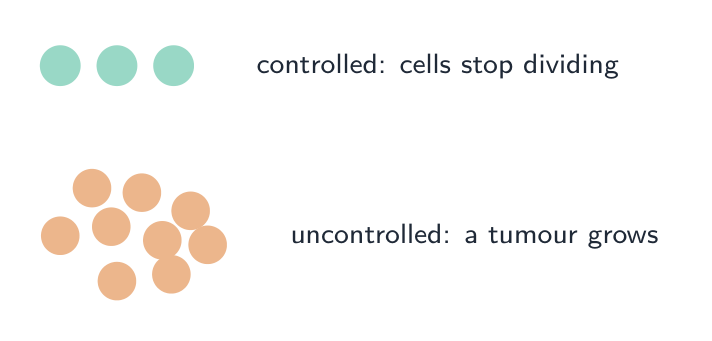
The cycle is controlled at checkpoints 检查点 that verify conditions before proceeding (Is the DNA intact? Are chromosomes attached?). Internal signals (cyclins 周期蛋白 and their kinases 激酶) and external signals drive the cycle forward. When this control fails – for example, a mutation 突变 that ignores a checkpoint – cells divide uncontrollably, which underlies cancer 癌症.
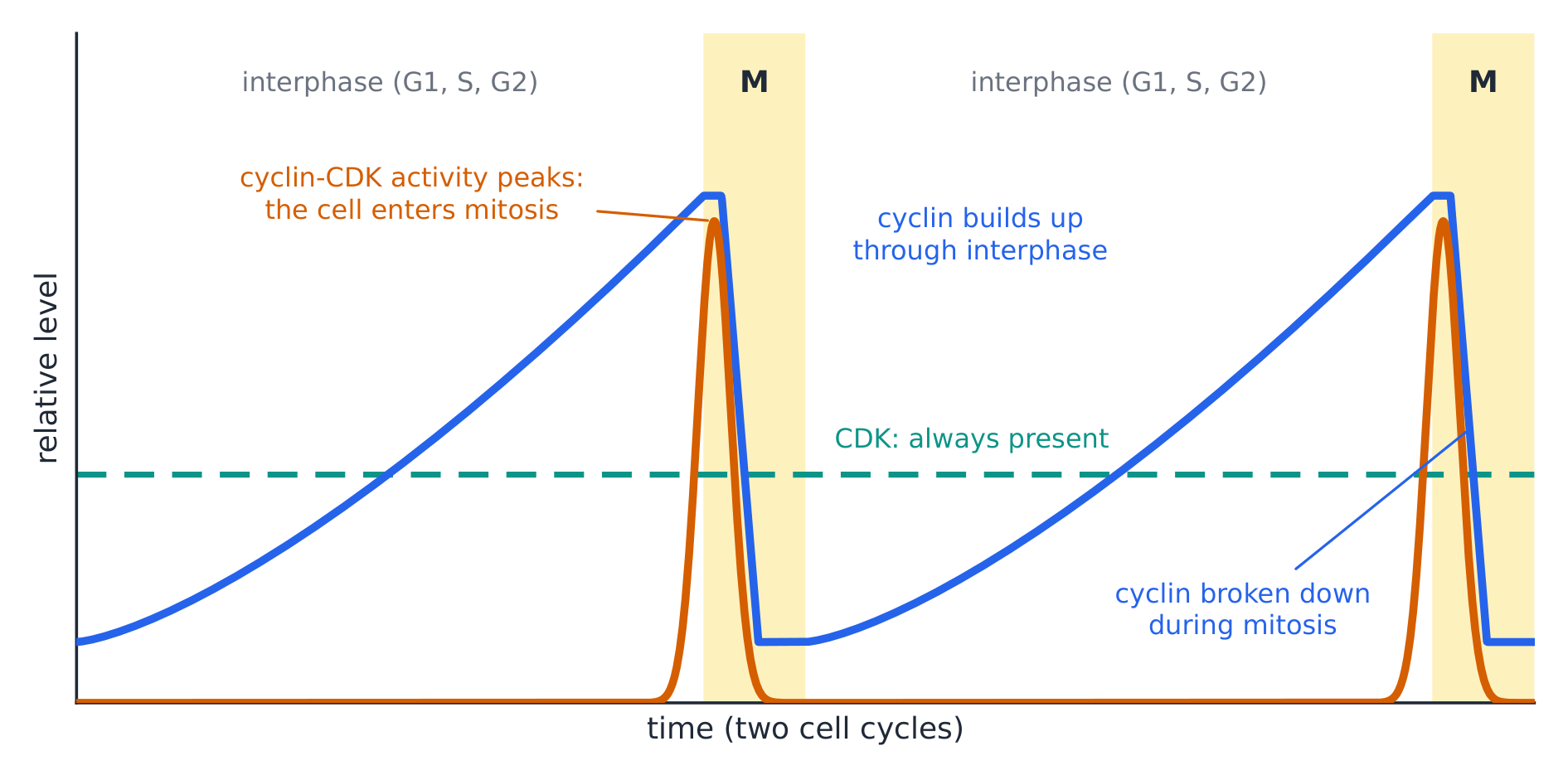
The main checkpoints are at the end of G1 (is the cell big enough, and is the DNA undamaged?), at the end of G2 (has all the DNA been copied correctly?), and in metaphase (is every chromosome attached to the spindle?). The driving force is a pair of proteins: a cyclin-dependent kinase (CDK) is always present, but it is active only when bound to a cyclin. Cyclin builds up through interphase; when enough cyclin–CDK complex has formed, it phosphorylates target proteins that push the cell into mitosis. Then the cyclin is destroyed and the cycle resets. A cell with damaged DNA that cannot be repaired is normally sent into apoptosis instead of dividing.
Cyclin builds up through interphase; cyclin-CDK activity peaks to start mitosis, then the cyclin is broken downUncontrolled division from failed checkpoints forms a tumour
Worked example. Signal amplification in a cascade: one hormone activates one receptor, which switches on about 100 relay proteins, and each of those makes about 1,000 second-messenger molecules — so a single signal produces roughly $100 \times 1000 = 10^{5}$ product molecules. This is why a hormone concentration as low as $10^{-9}\,\text{M}$ can trigger a large cellular response.
Worked example (predict the effect of a mutation). In a pathway, a ligand activates a G protein, which switches on an enzyme that makes a second messenger. A mutation leaves the G protein permanently active, even with no ligand. Predict the result: the enzyme keeps making second messenger and the response continues without the signal. The cell can no longer switch the response off. In growth-signal pathways, this kind of always-on mutation is a step toward cancer.
Worked example (timing the cell cycle). In an onion root tip, 200 cells are counted: 160 in interphase, 20 in prophase, 8 in metaphase, 6 in anaphase and 6 in telophase. The cycle takes about 24 hours.
The mitotic index 有丝分裂指数 is the fraction of cells in mitosis: $\dfrac{20+8+6+6}{200}=20\%$.
For this rough phase-duration estimate, assume an asynchronously dividing sample and use phase fractions as approximate time fractions; growth and sampling biases can affect the estimate. Interphase: $\dfrac{160}{200}\times24=19.2$ hours. Metaphase 中期: $\dfrac{8}{200}\times24\approx1.0$ hour.
DNA content through the cycle. A cell starts G1 with an amount $x$ of DNA. It doubles to $2x$ during S phase and stays at $2x$ through G2 and mitosis. At cytokinesis each daughter cell returns to $x$. A graph of DNA per cell against time rises gradually during S, then drops at division.
Name the three stages of cell signalling, in order.
A drug blocks the receptor for a hormone. Predict the effect on the target cell's response, and explain.
In a root-tip count, 25 of 250 cells are in mitosis and the cycle lasts 20 hours. Find the mitotic index and the time spent in mitosis.
Classify each as positive or negative feedback: (a) body temperature falls and shivering begins; (b) contractions during childbirth release oxytocin, which strengthens the contractions.
A student says: “A cell in G2 has the same amount of DNA as a cell in G1.” Correct the student.
4.6
Réponses
English
Reception, transduction, response.
The response is reduced or absent. The hormone cannot bind, so the signal never starts the transduction pathway, even though the hormone is present.
Mitotic index $=\dfrac{25}{250}=10\%$; time in mitosis $\approx0.10\times20=2$ hours.
(a) Negative feedback: shivering raises the temperature back toward the set point. (b) Positive feedback: the change is amplified until the baby is born.
DNA is copied in S phase, between G1 and G2, so a G2 cell has twice the DNA of a G1 cell. The amount halves again only when the cell divides.
Common mistakes.
Saying all receptors are on the cell surface. Receptors for small nonpolar ligands, such as steroid hormones, are inside the cell.
Saying a phosphate group always switches a protein on. Phosphorylation changes the shape; for some proteins that means off.
Calling the insulin response positive feedback because insulin “increases” glucose uptake. It reverses the rise in blood glucose, so it is negative feedback.
Saying overlapping error bars prove there is no difference. Overlapping confidence intervals alone cannot decide statistical significance; an appropriate test is needed.
Saying chromatids separate in metaphase. They line up in metaphase and separate in anaphase.
Saying CDKs are made and destroyed each cycle. Cyclin levels rise and fall; the CDK stays, and is active only when cyclin binds.
4.6
Conseils d'examen
English
In signal transduction name the three stages: reception → transduction → response.
Negative feedback reverses a change to keep conditions steady (homeostasis); positive feedback amplifies a change to completion (childbirth, clotting).
Order the cell cycle: interphase (grow, copy DNA in S phase) then mitosis → two identical daughter cells.
The DNA is copied once, in S phase, so each daughter gets a full copy.