The Solar System · El Sistema Solar
| English | Español |
|---|---|
| Solar System/ˈsəʊlə ˈsɪstəm/ | Sistema Solar |
| planets/ˈplænɪts/ | planetas |
| asteroids/ˈæstərɔɪdz/ | asteroides |
| comets/ˈkɒmɪts/ | cometas |
| rocky/ˈrɒki/ | rocosos |
| gas giants/ɡæs ˈdʒaɪənts/ | gigantes gaseosos |
| satellites/ˈsætəlaɪts/ | satélites |
| ellipses/ɪˈlɪpsɪz/ | elipses |
| accretion/əˈkreʃn/ | acreción |
The Sun's family
- At the centre of the Solar System 太阳系 is one star — the Sun.
- Around it move eight planets 行星, plus moons, asteroids 小行星 and comets 彗星.
- Gravity holds the whole family together.
La familia del Sol
- En el centro del Sistema Solar 太阳系 hay una estrella: el Sol.
- A su alrededor giran ocho planetas 行星, además de lunas, asteroides 小行星 y cometas 彗星.
- La gravedad mantiene unida a toda la familia.
The eight planets
- In order from the Sun: Mercury, Venus, Earth, Mars, Jupiter, Saturn, Uranus, Neptune.
- The four inner planets are small and rocky 岩石.
- The four outer planets are large and gaseous (no solid surface).
- Jupiter and Saturn are gas giants 气态巨行星; Uranus and Neptune are ice giants.
Jupiter, the largest planet, with its swirling bands of gas
Los ocho planetas
- En orden desde el Sol: Mercurio, Venus, Tierra, Marte, Júpiter, Saturno, Urano, Neptuno.
- Los cuatro internos son pequeños y rocosos 岩石.
- Los cuatro externos son grandes y gaseosos (sin superficie sólida).
- Júpiter y Saturno son gigantes gaseosos 气态巨行星; Urano y Neptuno son gigantes de hielo.

Júpiter, el planeta más grande, con sus bandas de gas en remolinos
Watch the planets race · Observa la carrera de los planetas
The closer a planet is to the Sun, the faster it orbits — Mercury in 88 days, Jupiter in 12 years — because the Sun's gravity is stronger close in. · Cuanto más cerca está un planeta del Sol, más rápido orbita: Mercurio en 88 días, Júpiter en 12 años, porque la gravedad del Sol es más fuerte cerca.
Put these planets in order, nearest the Sun first. · Ordena estos planetas, primero el más cercano al Sol.
From the Sun: Mercury, Venus, Earth, Mars, Jupiter, Saturn, Uranus, Neptune — so of these, Mercury, Earth, Jupiter, Neptune. · Desde el Sol: Mercurio, Venus, Tierra, Marte, Júpiter, Saturno, Urano, Neptuno — por lo tanto, de estos, Mercurio, Tierra, Júpiter, Neptuno.
How do the inner and outer planets differ? · ¿En qué se diferencian los planetas interiores y exteriores?
The four inner planets are small and rocky; the four outer planets are large and gaseous (gas giants and ice giants). · Los cuatro planetas interiores son pequeños y rocosos; los cuatro planetas exteriores son grandes y gaseosos (gigantes gaseosos e gigantes de hielo).
Other objects
- Dwarf planets (like Pluto) and asteroids — most asteroids lie in a belt between Mars and Jupiter.
- Moons (natural satellites 卫星) that orbit the planets.
- Comets — small icy bodies on very stretched orbits.
A giant telescope fires a laser to study the night sky
Otros objetos
- Planetas enanos (como Plutón) y asteroides: la mayoría de los asteroides se encuentran en un cinturón entre Marte y Júpiter.
- Lunas (satélites naturales 卫星) que orbitan los planetas.
- Cometas: cuerpos helados pequeños con órbitas muy alargadas.

Un telescopio gigante dispara un láser para estudiar el cielo nocturno
Orbits and gravity
- The Sun's gravity reaches out and keeps the planets in orbit; it is weaker further out, so outer planets orbit more slowly.
- Most orbits are ellipses 椭圆 (stretched circles), with the Sun at one focus (not the centre).
- A planet moves faster when closer to the Sun: as its gravitational PE falls, its kinetic energy rises (energy is conserved).
Órbitas y gravedad
- La gravedad del Sol se extiende y mantiene a los planetas en órbita; es más débil hacia afuera, por lo que los planetas externos orbitan más lentamente.
- La mayoría de las órbitas son elipses 椭圆 (círculos estirados), con el Sol en uno de los focos (no en el centro).
- Un planeta se mueve más rápido cuando está cerca del Sol: a medida que disminuye su energía potencial gravitatoria, aumenta su energía cinética (la energía se conserva).
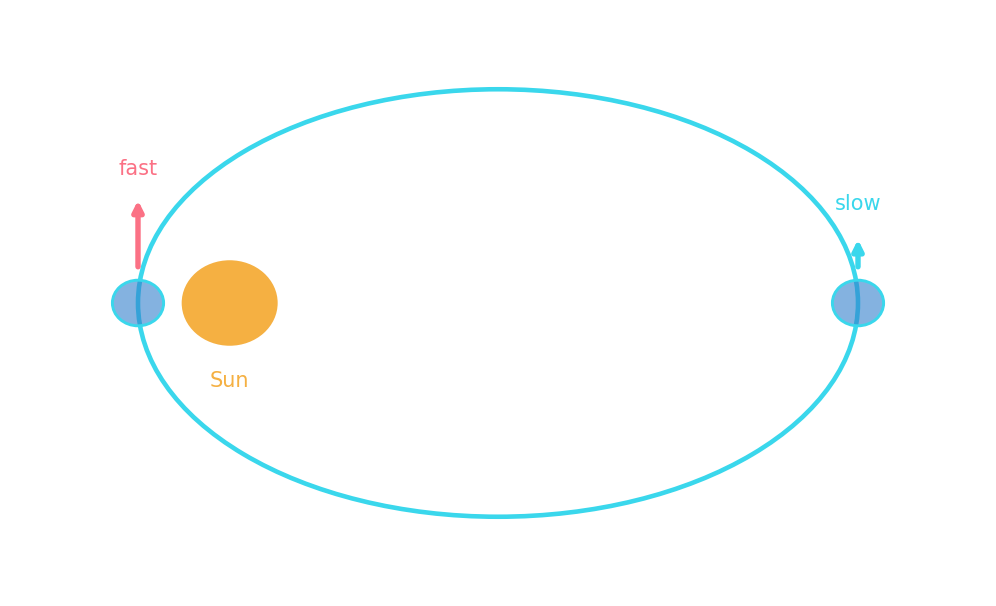
What keeps the planets in their orbits around the Sun? · ¿Qué mantiene a los planetas en sus órbitas alrededor del Sol?
The Sun holds most of the mass of the Solar System, and its gravity pulls the planets into orbit. · El Sol contiene la mayor parte de la masa del Sistema Solar, y su gravedad atrae a los planetas hacia su órbita.
A planet on an elliptical orbit moves fastest when it is: · Un planeta en una órbita elíptica se mueve más rápido cuando está:
As the planet comes closer, its gravitational PE falls and its kinetic energy rises (energy is conserved), so it speeds up. · A medida que el planeta se acerca, su energía potencial gravitatoria disminuye y su energía cinética aumenta (se conserva la energía), por lo que acelera.
Light travel time and how it formed
- Space is huge, so we use light travel time: $\text{time} = \dfrac{\text{distance}}{\text{speed}}$, with light at $3.0 \times 10^8\ \text{m/s}$.
- Sunlight takes about 8 minutes to reach Earth.
- The Solar System formed by accretion 吸积: gravity pulled a spinning cloud of gas and dust into a disc; most fell to the centre to form the Sun, and the planets grew from the rest.
- Near the hot young Sun only rock and metal stayed solid → rocky inner planets; far out, gases collected too → giant outer planets.
The Solar System
Tiempo de viaje de la luz y formación
- El espacio es inmenso, por lo que usamos el tiempo de viaje de la luz: $\text{time} = \dfrac{\text{distance}}{\text{speed}}$, con la luz a $3.0 \times 10^8\ \text{m/s}$.
- La luz solar tarda aproximadamente 8 minutos en llegar a la Tierra.
- El Sistema Solar se formó por acreción 吸积: la gravedad atrajo una nube giratoria de gas y polvo hacia un disco; la mayor parte cayó al centro para formar el Sol, y los planetas crecieron a partir del resto.
- Cerca del joven y caliente Sol solo la roca y el metal permanecieron sólidos → planetas internos rocosos; más allá, los gases también se acumularon → gigantes externos.

El Sistema Solar
The Sun is about $1.5 \times 10^{11}\ \text{m}$ away. How long does its light take to reach Earth, in seconds? (light speed $3.0 \times 10^8\ \text{m/s}$) · El Sol está a unos $1.5 \times 10^{11}\ \text{m}$ de distancia. ¿Cuánto tarda su luz en llegar a la Tierra, en segundos? (velocidad de la luz $3.0 \times 10^8\ \text{m/s}$)
$\text{time} = \dfrac{d}{v} = \dfrac{1.5 \times 10^{11}}{3.0 \times 10^8} = 500\ \text{s}$ (about 8 minutes). · $\text{time} = \dfrac{d}{v} = \dfrac{1.5 \times 10^{11}}{3.0 \times 10^8} = 500\ \text{s}$ (aproximadamente 8 minutos).
Why are the inner planets rocky? · ¿Por qué los planetas interiores son rocosos?
Close to the hot Sun, gases could not condense — only rock and metal stayed solid, so the inner planets are rocky. · Cerca del Sol caliente, los gases no podían condensarse — solo la roca y el metal permanecían sólidos, por lo que los planetas interiores son rocosos.
You've got it
- eight planets: four rocky inner, four gaseous outer (gas giants + ice giants)
- the Sun's gravity holds the planets; outer ones orbit slower
- orbits are ellipses with the Sun at a focus; planets move faster when closer
- light from the Sun takes ~8 min; the system formed by accretion of gas and dust
Ya lo tienes
- ocho planetas: cuatro rocosos internos, cuatro gaseosos externos (gigantes gaseosos + gigantes de hielo)
- la gravedad del Sol mantiene a los planetas; los externos orbitan más despacio
- las órbitas son elipses con el Sol en un foco; los planetas se mueven más rápido cuando están cerca
- la luz del Sol tarda ~8 min; el sistema se formó por acreción de gas y polvo