The magnetic effect of a current and the motor · El efecto magnético de una corriente y el motor
| English | Español |
|---|---|
| solenoid/ˈsəʊlənɔɪd/ | solenoide |
| d.c. motor/ˌdiː ˈsiː ˈməʊtə/ | motor de corriente continua |
| motor effect/ˈməʊtə ɪˈfekt/ | efecto motor |
| left-hand rule/left hænd ruːl/ | regla de la mano izquierda |
| commutator/ˈkɒmjuːteɪtə/ | conmutador |
Electricity makes magnetism
- A wire carrying a current creates a magnetic field around itself.
- Put that wire in another magnet's field and it feels a force — the idea behind every electric motor.
- This is where electricity and magnetism meet.
La electricidad produce magnetismo
- Un alambre que transporta corriente genera un campo magnético a su alrededor.
- Si se coloca ese alambre en el campo de otro imán, experimentará una fuerza —la base del funcionamiento de todo motor eléctrico—.
- Aquí es donde la electricidad y el magnetismo se encuentran.
The magnetic effect of a current
- A current in a straight wire makes circular field lines around it; reverse the current and the field reverses.
- A solenoid 螺线管 (a long coil) makes a field just like a bar magnet, with a N and a S pole.
- Make it stronger by: more current, more turns, or a soft-iron core.
- Used in relays and loudspeakers.
A d.c. motor 直流电动机
El efecto magnético de una corriente
- Una corriente en un alambre recto forma líneas de campo circulares a su alrededor; si se invierte la corriente, también se invierte el campo.
- Un solenoide (una bobina larga) produce un campo idéntico al de un imán en barra, con polos norte y sur.
- Se puede aumentar su intensidad con: más corriente, más vueltas o un núcleo de hierro blando.
- Se utiliza en relevadores y altavoces.

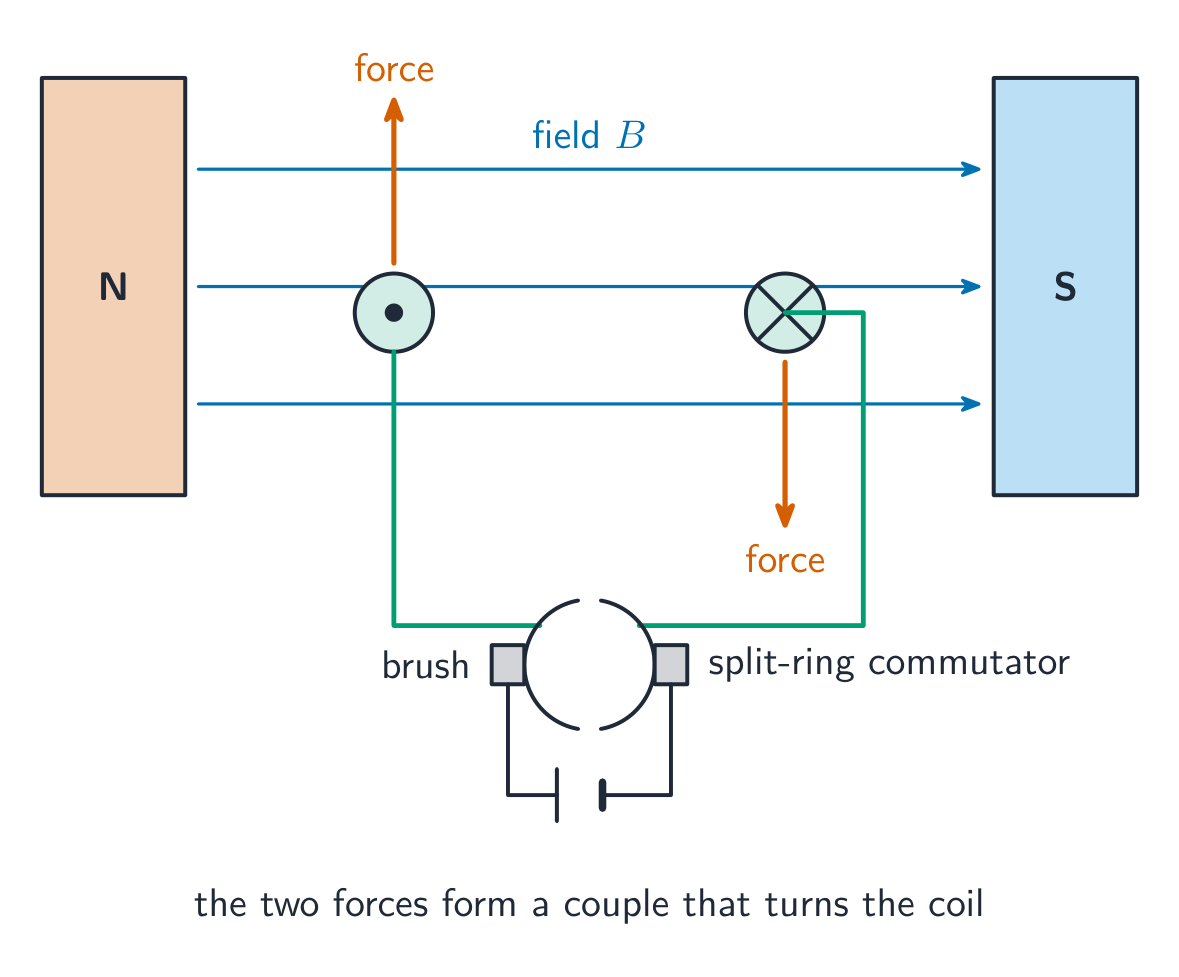
Un motor de c.c.
The force that spins a motor · La fuerza que hace girar un motor
A current in a magnetic field is pushed at right angles to both — reverse the current or flip the magnet and it pushes the other way. That is what turns a motor. · Una corriente en un campo magnético es empujada perpendicularmente a ambos: si inviertes la corriente o volteas el imán, empuja en dirección opuesta. Eso es lo que hace girar un motor.
The magnetic field of a solenoid (a long coil carrying current) looks like the field of: · El campo magnético de un solenoide (una bobina larga con corriente) se parece al campo de:
A solenoid produces a bar-magnet-like field, with a north pole at one end and a south at the other. · Un solenoide produce un campo similar al de un imán en barra, con un polo norte en un extremo y un polo sur en el otro.
Which change makes an electromagnet stronger? · ¿Qué cambio hace que un electroimán sea más fuerte?
More current, more turns, and a soft-iron core all make the field stronger. · Más corriente, más vueltas y un núcleo de hierro blando hacen que el campo sea más fuerte.
The motor effect 电动机效应
- A current-carrying wire in a magnetic field feels a force — the motor effect.
- Reverse the current, or reverse the field, and the force reverses.
- A bigger current or stronger field gives a bigger force; the force is greatest when the wire is at right angles to the field.
- Find the direction with the left-hand rule 左手定则: thumb = force, first finger = field (N→S), second finger = current.
El efecto motor
- Un alambre que transporta corriente dentro de un campo magnético experimenta una fuerza: este fenómeno se conoce como efecto motor.
- Si se invierte la corriente o se invierte el campo, la fuerza también se invierte.
- Una mayor corriente o un campo más intenso producen una fuerza mayor; esta es máxima cuando el alambre está en ángulo recto respecto al campo.
- Para determinar la dirección, se usa la regla de la mano izquierda: pulgar = fuerza, primer dedo = campo (de N a S), segundo dedo = corriente.

In the motor effect, reversing the current direction: · En el efecto motor, invertir la dirección de la corriente:
Reversing either the current or the field reverses the force. Reversing both leaves it unchanged. · Invertir tanto la corriente como el campo invierte la fuerza. Invertir ambas deja la fuerza sin cambios.
In Fleming's left-hand rule, the thumb points in the direction of the: · En la regla de la mano izquierda de Fleming, el pulgar apunta en la dirección de:
Thumb = force, first finger = field, second finger = current — all at right angles. · Pulgar = fuerza, primer dedo = campo, segundo dedo = corriente — todos perpendiculares entre sí.
The force on a current-carrying wire is greatest when the wire is at right angles to the magnetic field. · La fuerza sobre un alambre con corriente es máxima cuando el alambre está perpendicular al campo magnético.
The force is largest when the wire is perpendicular to the field, and zero when the wire lies along the field. · La fuerza es mayor cuando el alambre es perpendicular al campo, y cero cuando el alambre está alineado con el campo.
Match each idea to what it describes. · Empareja cada concepto con lo que describe.
Each item links the term to its correct meaning. · Cada elemento vincula el término con su significado correcto.
The d.c. motor
- A current-carrying coil in a field feels a turning effect: the forces on its two sides act in opposite directions.
- A split-ring commutator 换向器 swaps the current direction every half-turn, so the coil keeps spinning the same way.
- The turning effect is bigger with more turns, a bigger current, or a stronger field.
The motor effect on a current-carrying wire
El motor de c.c.
- Una bobina por la que circula corriente dentro de un campo magnético experimenta un efecto giratorio: las fuerzas sobre sus dos lados actúan en direcciones opuestas.
- Un conmutador de anillo partido invierte la dirección de la corriente cada media vuelta, de modo que la bobina continúa girando siempre en el mismo sentido.
- El efecto giratorio aumenta con más vueltas, mayor corriente o un campo más intenso.
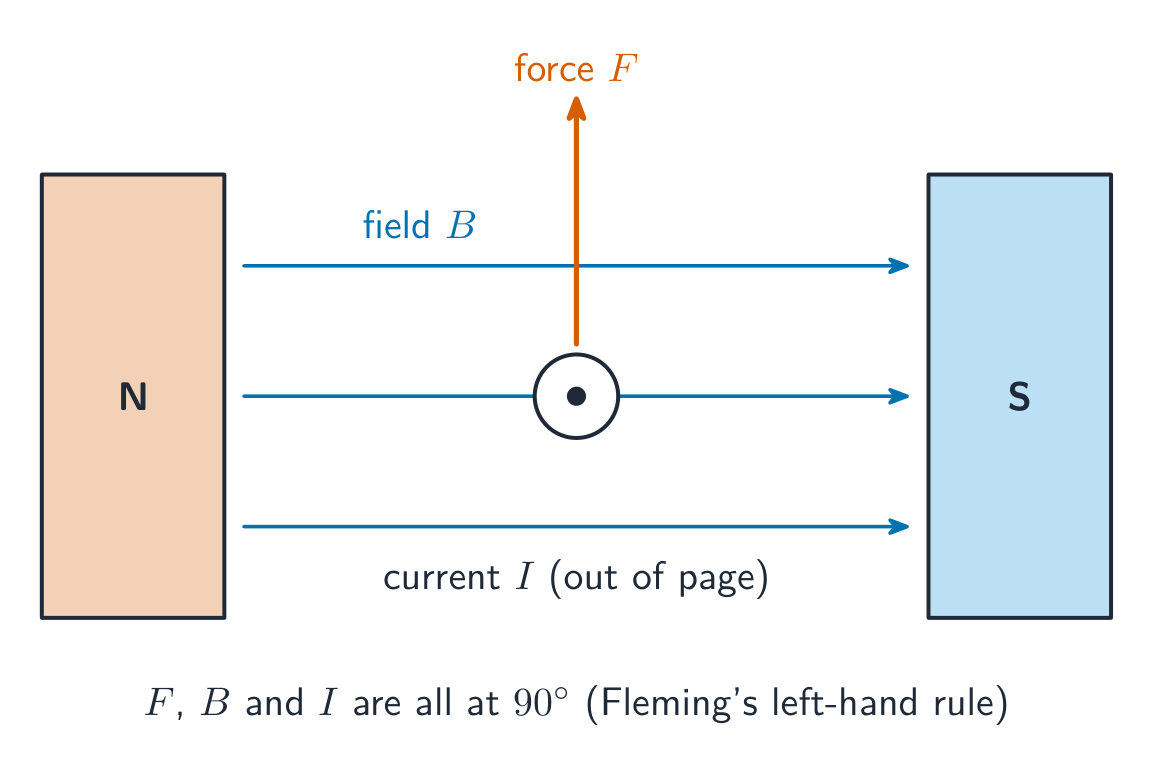
El efecto motor sobre un alambre con corriente
What is the job of the split-ring commutator in a d.c. motor? · ¿Cuál es la función del conmutador de anillo partido en un motor de c.c.?
Without the commutator the coil would stop after half a turn. Swapping the current each half-turn keeps it rotating the same way. · Sin el conmutador, la bobina se detendría después de media vuelta. Cambiar la corriente cada media vuelta mantiene la rotación en la misma dirección.
You've got it
- a current makes a magnetic field: circles round a wire, bar-magnet field for a solenoid
- stronger electromagnet: more current, more turns, soft-iron core
- motor effect: a wire carrying current in a field feels a force (left-hand rule)
- a d.c. motor spins; the split-ring commutator reverses the current each half-turn
Lo has entendido
- Una corriente genera un campo magnético: círculos alrededor de un alambre; campo tipo imán en barra para un solenoide.
- Electromagnetismo más fuerte: más corriente, más vueltas, núcleo de hierro blando.
- Efecto motor: un alambre con corriente en un campo experimenta una fuerza (regla de la mano izquierda).
- Un motor de c.c. gira; el conmutador de anillo partido invierte la corriente cada media vuelta.