Circuitos — serie, paralelo y divisor de potencial
Introducido| English | Significado |
|---|---|
| components/kəmˈpəʊnənts/ | componentes |
| series/ˈsɪəriːz/ | serie |
| parallel/ˈpærəlel/ | paralelo |
| potential divider/pəˈtenʃl dɪˈvaɪdə/ | divisor de tensión |
| fuse/fjuːz/ | fusible |
| thermistor/ˈθɜːmɪstə/ | termistor |
| LDR/ˌel diː ˈɑː/ | LDR (fotorresistencia) |
Building circuits
- Real gadgets are circuits built from a handful of components 元件, wired in two basic ways.
- Get the rules for series 串联 and parallel 并联 and you can predict any simple circuit.
- We finish with a clever trick: the potential divider 分压器.
Components to know
- cell / battery — drives the current; a switch breaks or completes the circuit.
- resistor (fixed) and variable resistor (to control the current).
- fuse 保险丝 — melts if the current is too big; diode / LED — current one way only (an LED also lights).
- thermistor 热敏电阻 — resistance falls as it gets hotter; LDR 光敏电阻 — resistance falls as light gets brighter.
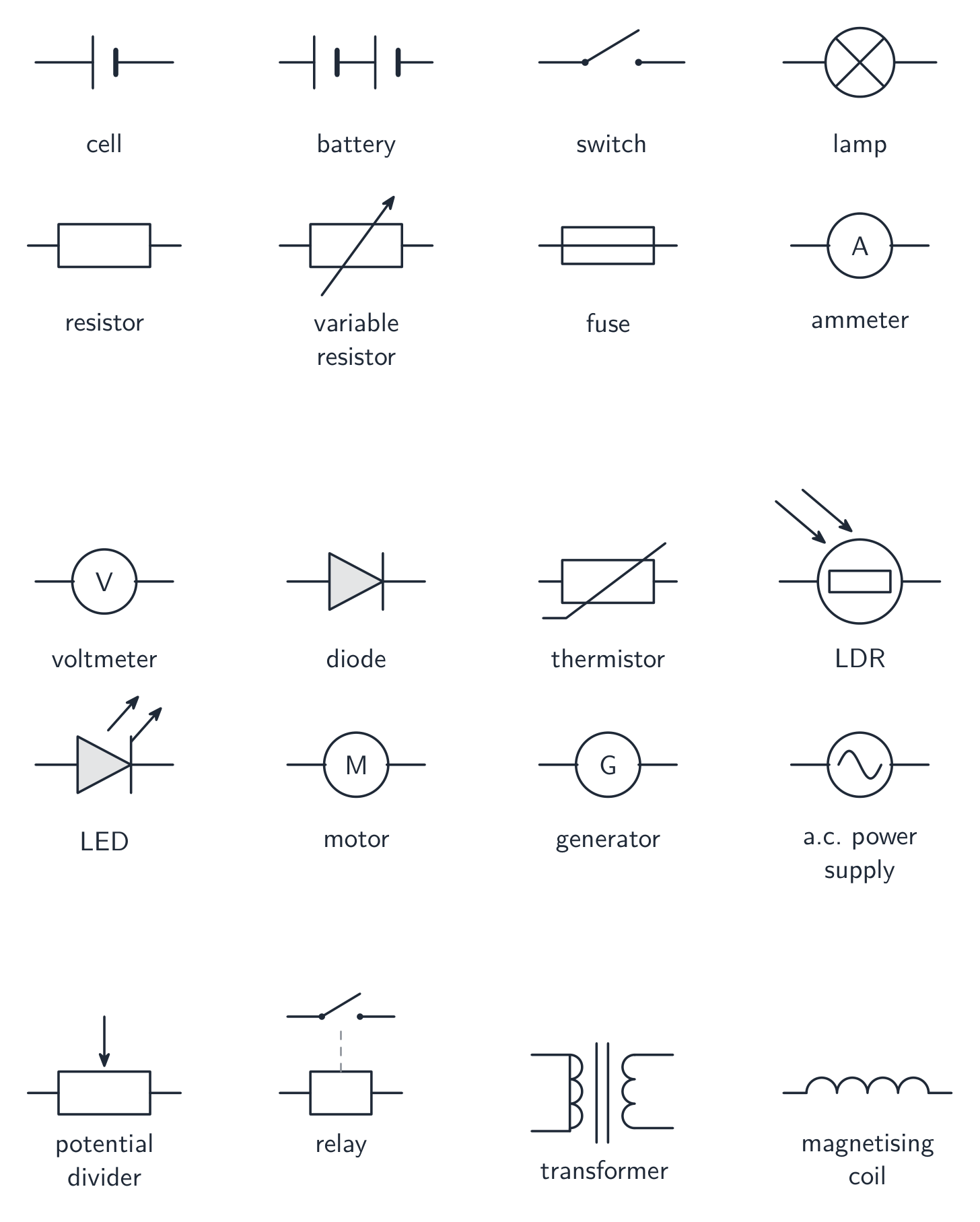
Standard circuit symbols
Construye la corriente con la ley de Ohm
Aumenta el voltaje y los electrones se aceleran, la bombilla brilla más; añade resistencia y la corriente disminuye. I = V/R, brillo = potencia.
¿Qué sucede con la resistencia de un termistor al calentarse?
Dificultad 1/5 · 100 monedas + un pequeño bono en el primer intento de hoy
La resistencia de un termistor disminuye al aumentar la temperatura — útil en circuitos de detección de temperatura.
Empareja cada regla del circuito con donde aplica.
Dificultad 2/5 · 140 monedas + un pequeño bono en el primer intento de hoy
Cada elemento vincula el término con su significado correcto.
Series circuits
- The parts form one single loop.
- The current is the same at every point.
- The supply p.d. is shared between the components.
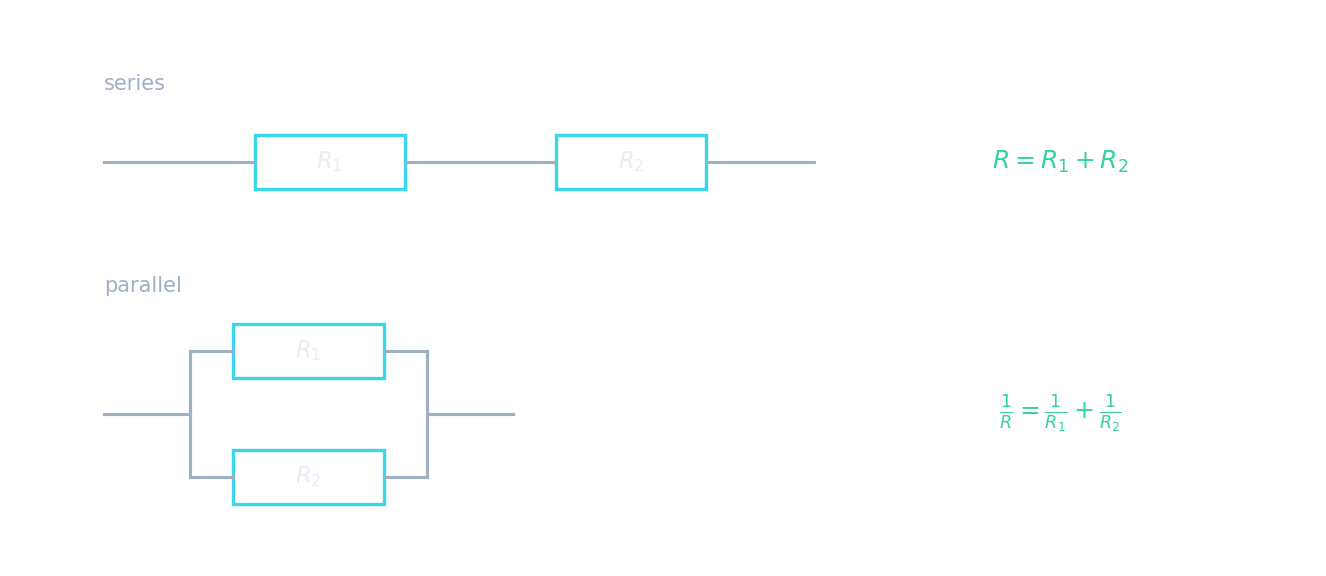
- Resistors in series add up: $R_{\text{total}} = R_1 + R_2 + \dots$
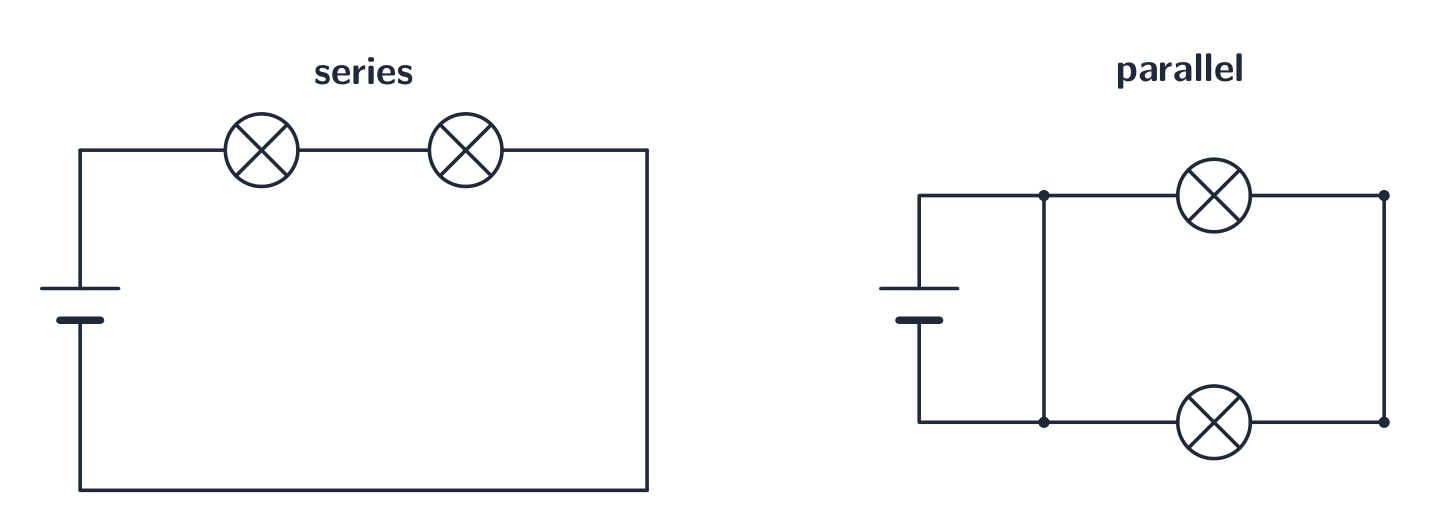
Series and parallel circuits
Una resistencia de $3.0\ \Omega$ y otra de $5.0\ \Omega$ están conectadas en serie. ¿Cuál es la resistencia total, en Ω?
Dificultad 2/5 · 140 monedas + un pequeño bono en el primer intento de hoy
En serie, las resistencias se suman: $R = 3.0 + 5.0 = 8.0\ \Omega$.
En un circuito en serie, la corriente es:
Dificultad 1/5 · 100 monedas + un pequeño bono en el primer intento de hoy
Solo hay un camino, por lo que la misma corriente fluye a través de cada componente en un circuito en serie.
Parallel circuits
- The parts are on separate branches.
- Each branch gets the full supply p.d.; the current splits between branches.
- The total resistance is less than the smallest single resistor: $\dfrac{1}{R_{\text{total}}} = \dfrac{1}{R_1} + \dfrac{1}{R_2}$
- Home lamps are wired in parallel — each gets full voltage, and one failing leaves the others on.
Una resistencia de $6.0\ \Omega$ y otra de $3.0\ \Omega$ están conectadas en paralelo. ¿Cuál es la resistencia total, en Ω?
Dificultad 2/5 · 140 monedas + un pequeño bono en el primer intento de hoy
$\dfrac{1}{R} = \dfrac{1}{6.0} + \dfrac{1}{3.0} = \dfrac{1}{6} + \dfrac{2}{6} = \dfrac{3}{6}$, por lo tanto $R = 2.0\ \Omega$ — menor que la resistencia más pequeña.
¿Por qué las lámparas de una casa están conectadas en paralelo?
Dificultad 1/5 · 100 monedas + un pequeño bono en el primer intento de hoy
En paralelo, cada lámpara recibe toda la p.d. de suministro, y una ruptura en una rama no interrumpe el funcionamiento de las otras.
Potential dividers
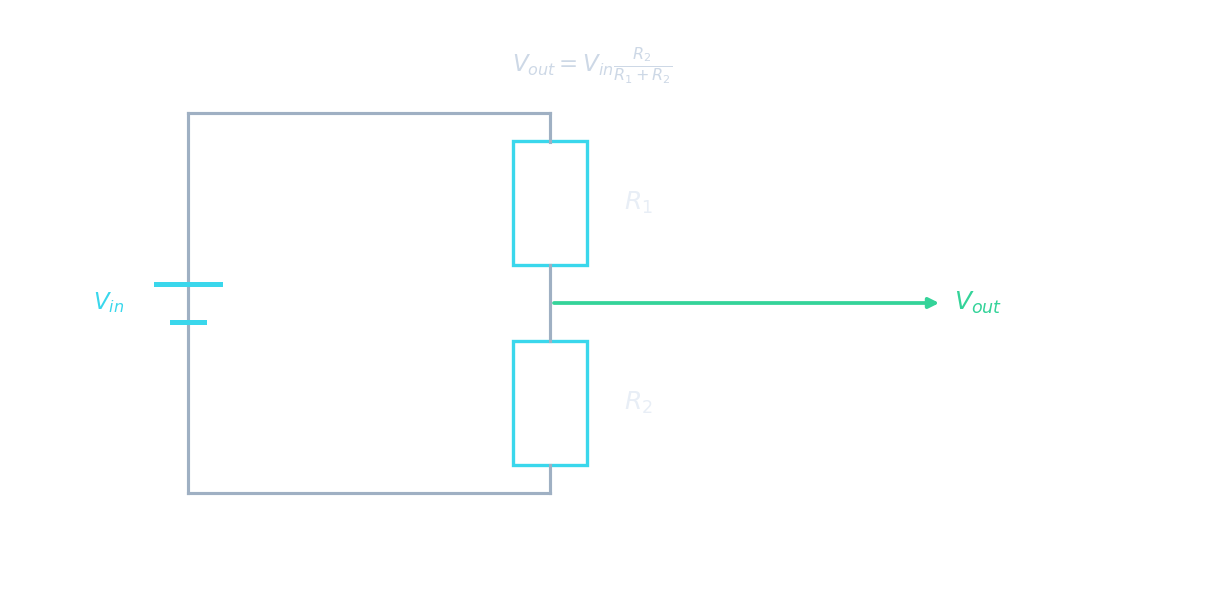
- Two resistors in series share the supply voltage — a potential divider.
- The bigger resistor takes the bigger share of the voltage:
- Use a thermistor or LDR as one resistor and the output voltage changes with temperature or light — perfect for switching a heater or lamp on automatically.
Dos resistencias iguales están en serie conectadas a una fuente de $12\ \text{V}$. ¿Cuál es la p.d. sobre una de ellas, en V?
Dificultad 2/5 · 140 monedas + un pequeño bono en el primer intento de hoy
Las resistencias iguales comparten el voltaje equitativamente: cada una recibe $\dfrac{12}{2} = 6\ \text{V}$.
Worked examples
1. A $4.0\ \Omega$ and a $6.0\ \Omega$ resistor are in series with a $12\ \text{V}$ battery. $R_{\text{total}} = 10\ \Omega$, so $I = \dfrac{V}{R} = \dfrac{12}{10} = 1.2\ \text{A}$.
2. The same current flows through both, so they share the voltage in the ratio of their resistances: $1.2 \times 4.0 = 4.8\ \text{V}$ and $1.2 \times 6.0 = 7.2\ \text{V}$, which add up to $12\ \text{V}$.
Parallel resistors do not add. A $6\ \Omega$ and a $3\ \Omega$ resistor in parallel have a combined resistance of $2\ \Omega$, less than either one. The current is the same at every point in a series circuit; it is not used up.
Calcula los totales en serie y en paralelo de una resistencia de 6 ohmios y otra de 12 ohmios. Si dos resistencias iguales comparten una fuente de 18 V en serie, ¿cuál es la d.p. (diferencia de potencial) a través de una de ellas?
Las resistencias en serie se suman. El producto sobre la suma en paralelo es 72 dividido entre 18, lo cual es 4 ohmios.
¿Cuál es la suma total en serie?
Dificultad 1/5 · 100 monedas + un pequeño bono en el primer intento de hoy
6 más 12 es 18 ohmios, y la combinación en paralelo es 4 ohmios.
You've got it
- series: one loop, same current everywhere, p.d. shared, $R_{\text{total}} = R_1 + R_2$
- parallel: branches, each gets full p.d., current splits, $\dfrac{1}{R_{\text{total}}} = \dfrac{1}{R_1} + \dfrac{1}{R_2}$
- thermistor: R falls when hot · LDR: R falls in bright light
- potential divider: two series resistors share the voltage by their ratio
Write from the data given
- One resistor is 6 ohms and the other is 12 ohms.
- Find the series total and the parallel total. Two equal resistors share 18 V.