Resistencia, energía eléctrica y potencia
Introducido| English | Significado |
|---|---|
| resistance/rɪˈzɪstəns/ | resistencia |
| ohms/əʊmz/ | ohmios |
| filament lamp/ˈfɪləmənt læmp/ | lámpara de filamento |
| diode/ˈdaɪəʊd/ | diodo |
| fixed resistor/fɪkst rɪˈzɪstə/ | resistencia fija |
| kilowatt-hour/ˈkɪləwɒt ˈaʊə/ | kilovatio-hora |
Slowing the flow
- Push current through a thin wire and it gets hot; through a thick one, less so.
- Resistance 电阻 measures how hard it is for current to flow.
- It controls the current, heats your toaster, and sets your electricity bill.
Resistance
- Resistance $R$ is measured in ohms 欧姆 ($\Omega$). A bigger resistance gives a smaller current:
- To measure it: an ammeter in series reads $I$, a voltmeter across the component reads $V$, then divide.
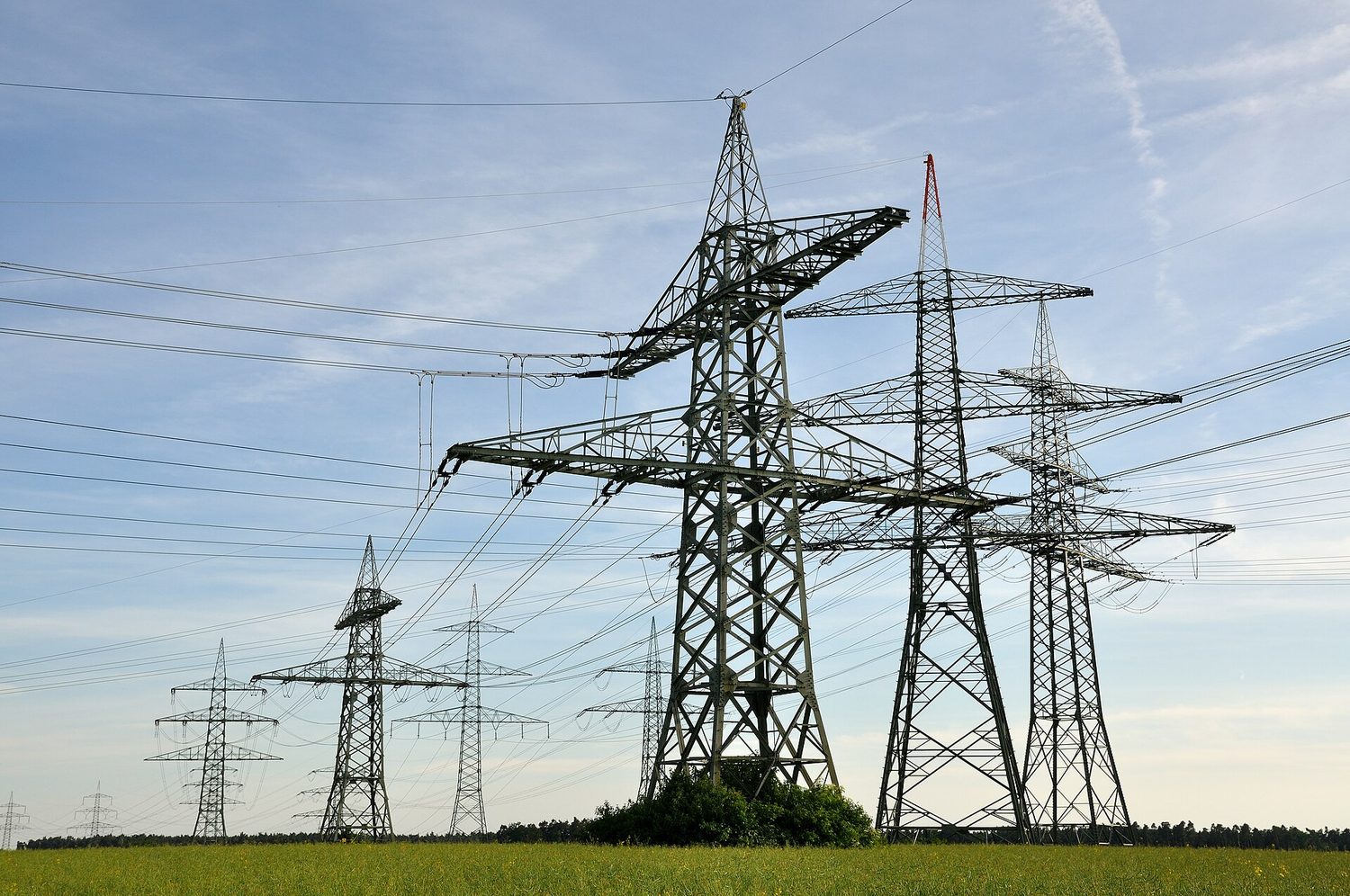
A pylon carries the cables that bring electricity at very high voltage
Resistencia
V = R·I
Ley de Ohm: el voltaje es proporcional a la corriente — la pendiente es la resistencia R.
Un componente tiene $12\ \text{V}$ a través de él y una corriente de $3.0\ \text{A}$ a través de él. ¿Cuál es su resistencia, en Ω?
Dificultad 2/5 · 140 monedas + un pequeño bono en el primer intento de hoy
$R = \dfrac{V}{I} = \dfrac{12}{3.0} = 4.0\ \Omega$.
What changes a wire's resistance
- A longer wire has more resistance — resistance is proportional to length ($R \propto l$).
- A thicker wire has less resistance — resistance is inversely proportional to the cross-sectional area ($R \propto \tfrac{1}{A}$).
- So doubling the length doubles $R$; doubling the area halves it.
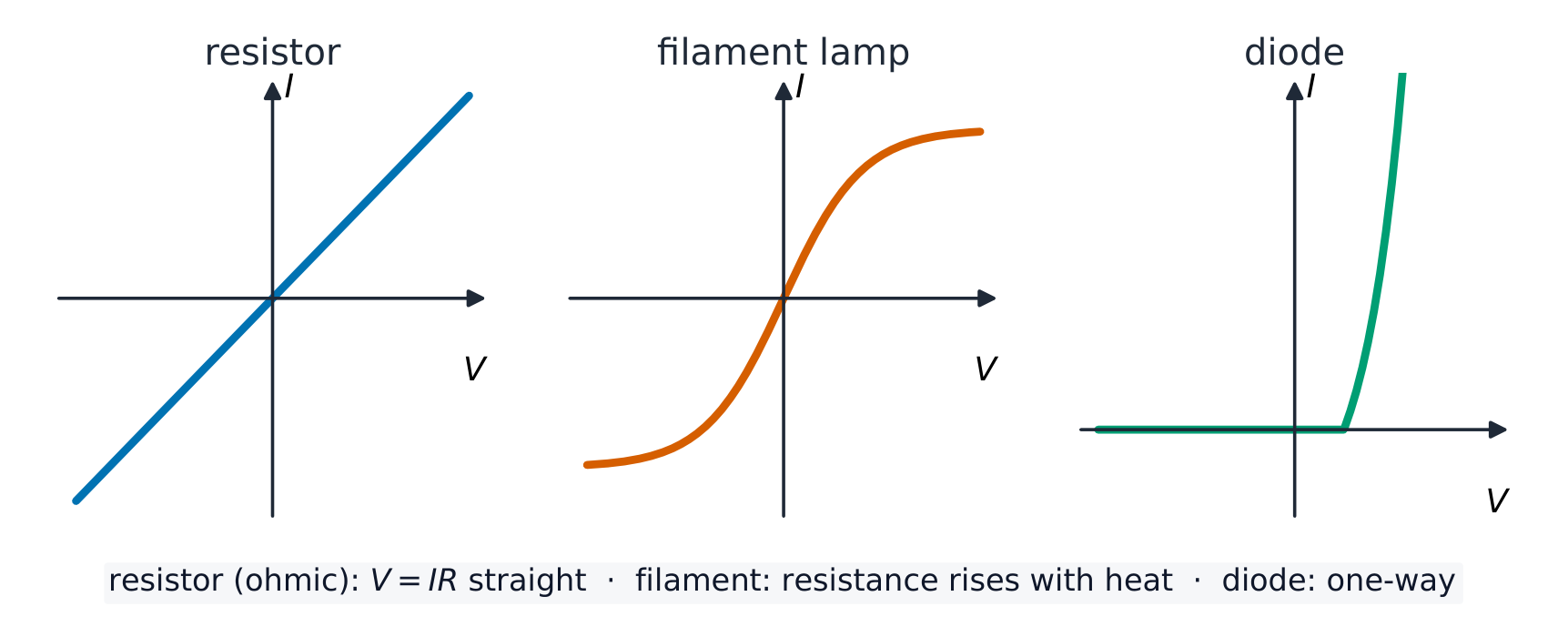
I-V graphs for a resistor, a filament lamp 灯丝灯泡 and a diode 二极管
Características I–V
Un resistor da una línea recta; una lámpara de filamento y un diodo no. Elige un componente y lee I y R en la curva.
Se hace un alambre dos veces más largo (misma grosor). Su resistencia:
Dificultad 1/5 · 100 monedas + un pequeño bono en el primer intento de hoy
La resistencia es proporcional a la longitud, por lo que al duplicar la longitud se duplica la resistencia.
Asocia cada relación eléctrica con su fórmula.
Dificultad 2/5 · 140 monedas + un pequeño bono en el primer intento de hoy
Cada elemento vincula el término con su significado correcto.
Current–voltage graphs
- A fixed resistor 定值电阻: a straight line through the origin — resistance is constant, so $I \propto V$.
- A filament lamp: an S-shape that gets flatter — the wire heats up, so its resistance rises.
- A diode: current one way only — very high resistance the "wrong" way.
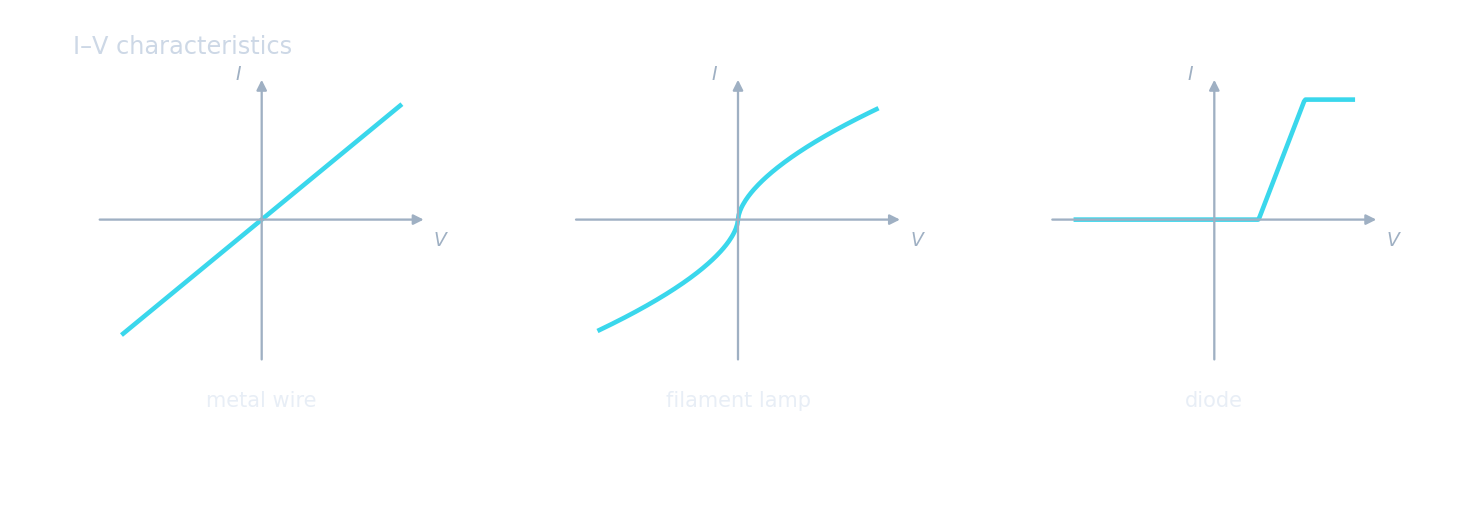
La gráfica I–V de un resistor fijo (a temperatura constante) es:
Dificultad 1/5 · 100 monedas + un pequeño bono en el primer intento de hoy
Un resistor fijo tiene resistencia constante, así que $I \propto V$ — una línea recta que pasa por el origen.
Electrical power and energy
- Power is the energy transferred each second, in watts (W):
- The energy transferred in a time $t$, in joules (J), is:
Un dispositivo funciona a $12\ \text{V}$ y consume $2.0\ \text{A}$. ¿Cuál es su potencia, en W?
Dificultad 2/5 · 140 monedas + un pequeño bono en el primer intento de hoy
$P = IV = 2.0 \times 12 = 24\ \text{W}$.
The kilowatt-hour 千瓦时
- Electricity bills use a bigger unit, the kilowatt-hour (kWh): the energy a $1\ \text{kW}$ appliance uses in $1$ hour.
- Example: a $2\ \text{kW}$ heater for $3$ hours uses $6\ \text{kWh}$.
Un calentador de $2.0\ \text{kW}$ está encendido durante $3.0$ horas. ¿Cuánta energía consume, en kWh?
Dificultad 2/5 · 140 monedas + un pequeño bono en el primer intento de hoy
energía = potencia × tiempo = $2.0 \times 3.0 = 6.0\ \text{kWh}$.
Si un kWh cuesta $20$ centavos, ¿cuánto cuesta $6.0\ \text{kWh}$, en centavos?
Dificultad 2/5 · 140 monedas + un pequeño bono en el primer intento de hoy
costo = energía × precio = $6.0 \times 20 = 120$ centavos.
Worked examples
1. A kettle on a $230\ \text{V}$ supply draws $9.0\ \text{A}$. $P = IV = 9.0 \times 230 = 2070\ \text{W} \approx 2.1\ \text{kW}$, and its resistance is $R = \dfrac{V}{I} = \dfrac{230}{9.0} = 26\ \Omega$.
2. A $2.0\ \text{kW}$ heater runs for $15$ minutes, which is $0.25\ \text{h}$. Energy $= 2.0 \times 0.25 = 0.50\ \text{kWh}$; at ¥0.60 per kWh the cost is $0.50 \times 0.60 =$ ¥0.30.
Use kilowatts and hours for kWh. $1500\ \text{W}$ for $30$ minutes is $1.5\ \text{kW} \times 0.5\ \text{h} = 0.75\ \text{kWh}$. Using watts and seconds gives joules, not kWh.
Un componente tiene 18 V a través de él y transporta 2.0 A. ¿Cuáles son su resistencia y potencia? ¿Cuántos kilovatios-hora consume un calentador de 1.5 kW en 2.0 horas?
18 dividido por 2 es 9 ohmios. Corriente por voltaje es 36 vatios. 1.5 kilovatios por 2.0 horas es 3.0 kilovatios-hora.
¿Cuál es la resistencia?
Dificultad 1/5 · 100 monedas + un pequeño bono en el primer intento de hoy
18 dividido por 2.0 es 9 ohmios.
You've got it
- $R = \dfrac{V}{I}$ (ohms); longer wire → more $R$, thicker wire → less $R$
- I–V graphs: resistor = straight line; lamp = S-curve (heats up); diode = one way
- power $P = IV$ (watts); energy $E = IVt$ (joules)
- kWh = power (kW) × time (h); cost = kWh × price
Write from the data: find the resistance
- A component has 18 V across it and a current of 2.0 A.
- Find the resistance and the power. A 1.5 kW heater runs for 2.0 hours.