Static electricity · Electricidad estática
| English | Español |
|---|---|
| static electricity/ˈstætɪk ɪlekˈtrɪsɪti/ | electricidad estática |
| charge/tʃɑːdʒ/ | carga |
| electrons/ɪˈlektrɒnz/ | electrones |
| coulombs/ˈkuːlɒmz/ | coulombs |
| conductor/kənˈdʌktə/ | conductor |
| insulator/ˈɪnsjuːleɪtə/ | aislante |
| electric field/ɪˈlektrɪk fiːld/ | campo eléctrico |
| ion/ˈaɪɒn/ | ion |
Sparks and sticky balloons
- Rub a balloon on your hair and it sticks to the wall; lightning is the same effect, in giant form.
- Both come from static electricity 静电 — charge 电荷 that has built up and is not moving.
- It all comes down to tiny electrons 电子.
Chispas y globos pegajosos
- Frota un globo en tu cabello y se pegará a la pared; la lluvia eléctrica es el mismo efecto, pero a gran escala.
- Ambos provienen de la electricidad estática 静电 — carga 电荷 acumulada que no se mueve.
- Todo se reduce a los pequeños electrones 电子.
Electric charge
- There are two kinds of charge: positive and negative.
- The rule is like magnetic poles: same charges repel, different charges attract.
- Charge is measured in coulombs 库仑 (C).
Carga eléctrica
- Existen dos tipos de carga: positiva y negativa.
- La regla es similar a los polos magnéticos: cargas iguales se repelen, cargas diferentes se atraen.
- La carga se mide en coulombs 库仑 (C).
Rub a balloon and watch it charge · Frota un globo y observa cómo se carga
Rubbing moves electrons onto the balloon, making it negative — then it attracts a neutral wall or your hair, but repels another negative balloon. · Frotar transfiere electrones al globo, haciéndolo negativo; luego atrae una pared neutra o tu cabello, pero repele otro globo negativo.
Two negative charges attract each other. · Dos cargas negativas se atraen entre sí.
Like charges repel; only different charges (+ and −) attract. · Las cargas iguales se repelen; solo las cargas diferentes (+ y −) se atraen.
Charging by friction
- Rub two different materials together and electrons (tiny negative particles) move from one to the other.
- The material that gains electrons becomes negative; the one that loses them becomes positive.
- Only the negative electrons move — the positive charge stays put.
- Example: a plastic rod rubbed with a cloth becomes negative (it gained electrons); the cloth is left positive.
Carga por fricción
- Frota dos materiales distintos entre sí y los electrones (partículas negativas pequeñas) se transfieren de uno al otro.
- El material que gana electrones se vuelve negativo; el que los pierde se vuelve positivo.
- Solo se mueven los electrones negativos; la carga positiva permanece fija.
- Ejemplo: una varilla de plástico frotada con un paño se vuelve negativa (ganó electrones); el paño queda positivo.
When you rub a plastic rod with a cloth, the rod gains electrons. The rod becomes: · Cuando frotes una varilla de plástico con un paño, la varilla gana electrones. La varilla se vuelve:
Gaining electrons (which are negative) makes the rod negative. The cloth, having lost electrons, is left positive. · Ganar electrones (que son negativos) hace que la varilla sea negativa. El paño, al haber perdido electrones, queda positivo.
During charging by friction, what actually moves between the materials? · Durante la carga por fricción, ¿qué se mueve realmente entre los materiales?
Only the negative electrons move. The positive charge stays fixed in place. · Solo los electrones negativos se mueven. La carga positiva permanece fija en su lugar.
Match each static-electricity idea to what it means. · Empareja cada idea de electricidad estática con lo que significa.
Each item links the term to its correct meaning. · Cada elemento vincula el término con su significado correcto.
Conductors 导体 and insulators 绝缘体
- A conductor (copper and other metals) lets charge flow easily, because it has free electrons.
- An insulator (plastic, rubber, glass) does not — its electrons cannot move freely.
- Test it: put the material in a circuit with a lamp and a battery — the lamp lights only for a conductor.
Conductores 导体 e aislantes 绝缘体
- Un conductor (cobre y otros metales) permite que la carga fluya fácilmente, ya que posee electrones libres.
- Un aislante (plástico, goma, vidrio) no lo hace; sus electrones no pueden moverse libremente.
- Prueba práctica: coloca el material en un circuito con una lámpara y una batería; la lámpara solo se enciende si el material es conductor.
Why is copper a good conductor of electricity? · ¿Por qué el cobre es un buen conductor de electricidad?
A conductor has free electrons that can flow through it. Insulators have no free-moving charges. · Un conductor tiene electrones libres que pueden fluir a través de él. Los aislantes no tienen cargas móviles.
Electric fields 电场 and ions 离子
- An electric field is a region where a charge feels a force.
- Its direction at a point is the direction of the force on a positive charge.
- Field patterns: lines point away from + and toward −; between parallel plates the lines are straight and evenly spaced.
- An atom that loses electrons becomes a positive ion; one that gains electrons becomes a negative ion.
Campos eléctricos 电场 e iones 离子
- Un campo eléctrico es una región donde una carga experimenta una fuerza.
- Su dirección en un punto determinado es la dirección de la fuerza sobre una carga positiva.
- Patrones del campo: las líneas apuntan hacia afuera desde + y hacia −; entre placas paralelas, las líneas son rectas y están espaciadas uniformemente.
- Un átomo que pierde electrones se convierte en un ión positivo; uno que gana electrones se convierte en un ión negativo.
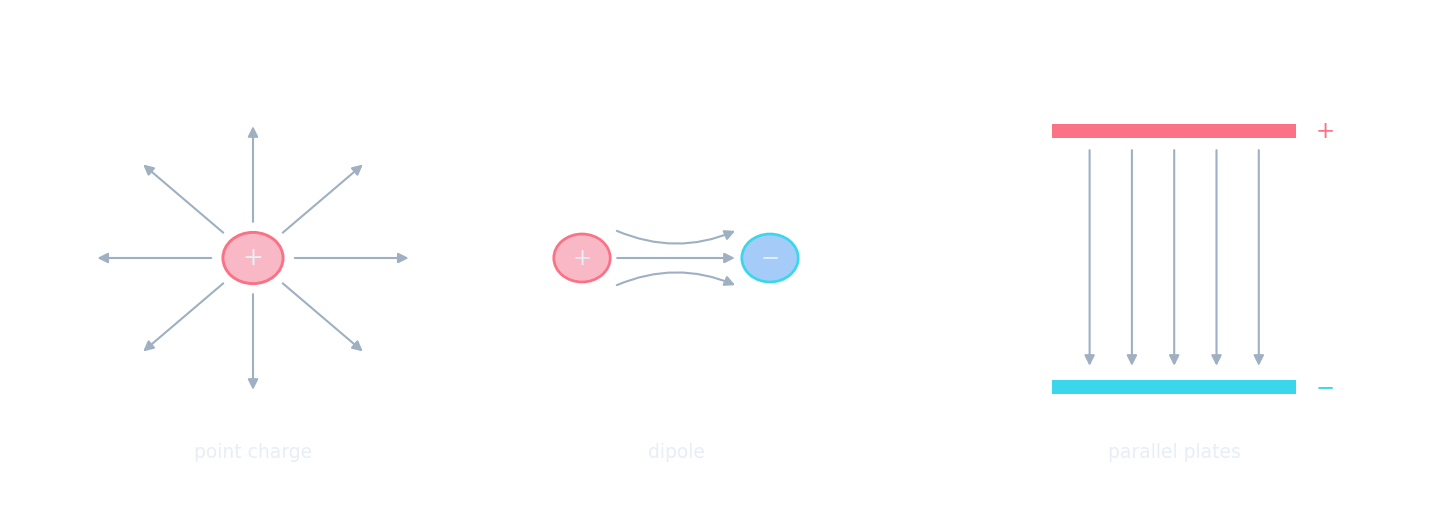
The direction of an electric field at a point is the direction of the force on: · La dirección de un campo eléctrico en un punto es la dirección de la fuerza sobre:
By convention, the electric field direction is the direction of the force on a positive charge. · Por convención, la dirección del campo eléctrico es la dirección de la fuerza sobre una carga positiva.
A neutral atom loses two electrons. It becomes: · Un átomo neutro pierde dos electrones. Se convierte en:
Losing negative electrons leaves more positive charge, so the atom becomes a positive ion. · Perder electrones negativos deja más carga positiva, por lo que el átomo se convierte en un ion positivo.
You've got it
- two charges: + and −; same repel, different attract
- charging by friction moves electrons only: gain → negative, lose → positive
- conductors have free electrons; insulators do not
- electric field direction = force on a positive charge; lose electrons → positive ion
Ya lo dominas
- Dos cargas: + y −; iguales se repelen, diferentes se atraen
- La carga por fricción solo mueve electrones: ganancia → negativo, pérdida → positivo
- Los conductores tienen electrones libres; los aislantes no
- La dirección del campo eléctrico = fuerza sobre una carga positiva; pérdida de electrones → ión positivo