Reflection and refraction · Reflexión y refracción
| English | Español |
|---|---|
| normal/ˈnɔːml/ | normal |
| angle of incidence/ˈæŋɡl ɒv ˈɪnsɪdəns/ | ángulo de incidencia |
| angle of reflection/ˈæŋɡl ɒv rɪˈflekʃn/ | ángulo de reflexión |
| virtual/ˈvɜːtʃuːəl/ | virtual |
| refractive index/rɪˈfræktɪv ˈɪndeks/ | índice de refracción |
| total internal reflection/ˈtəʊtl ɪnˈtɜːnl rɪˈflekʃn/ | reflexión total interna |
| critical angle/ˈkrɪtɪkl ˈæŋɡl/ | ángulo crítico |
| optical fibres/ˈɒptɪkl ˈfaɪbəz/ | fibras ópticas |
Bouncing and bending light
- A mirror bounces light back; a straw in a glass of water looks bent.
- These are reflection and refraction — the two basic things light does at a surface.
- We measure all angles from the normal 法线: a line at $90°$ to the surface.
Luz que rebota y se dobla
- Un espejo devuelve la luz; una pajita en un vaso de agua parece doblada.
- Estos son reflexión y refracción: las dos cosas básicas que hace la luz al chocar con una superficie.
- Medimos todos los ángulos desde la normal: una línea a $90°$ respecto a la superficie.
Reflection
- The law of reflection: the angle of incidence 入射角 equals the angle of reflection 反射角 (both from the normal).
- A plane mirror makes an image that is: the same size, the same distance behind the mirror, and virtual 虚的 (it cannot be caught on a screen).
The law of reflection
Reflexión
- La ley de reflexión: el ángulo de incidencia es igual al ángulo de reflexión (ambos medidos desde la normal).
- Un espejo plano forma una imagen que tiene: el mismo tamaño, la misma distancia detrás del espejo, y es virtual (no puede proyectarse en una pantalla).

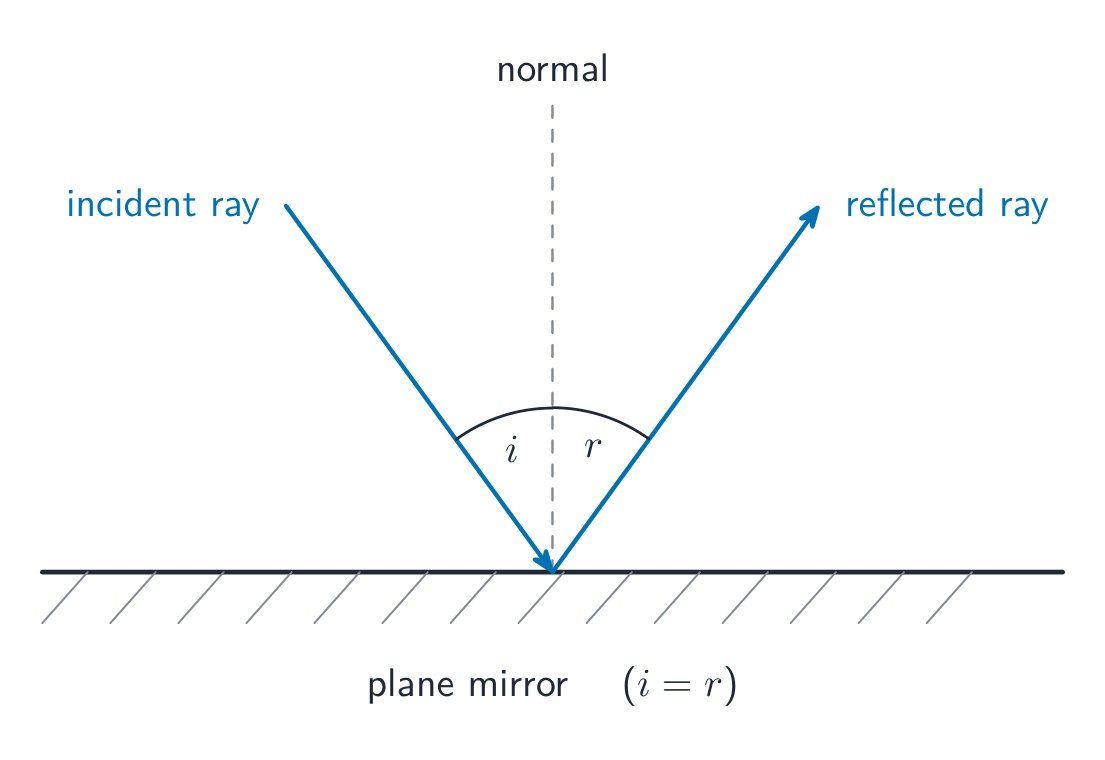
La ley de reflexión
Bend a light ray · Doblar un rayo de luz
Shine light into water, glass or diamond and change the angle. The ray slows and bends toward the normal — the denser the material (higher n), the more it bends. That bending is why a straw looks broken in a glass, and why diamonds sparkle. · Hacer incidir luz en agua, vidrio o diamante y cambiar el ángulo. El rayo se desacelera y se desvía hacia la normal — cuanto más denso es el material (mayor n), mayor es la desviación. Esa desviación explica por qué una pajita parece rota en un vaso y por qué los diamantes brillan.
A ray hits a plane mirror at $30°$ to the normal. At what angle to the normal does it reflect? · Un rayo incide sobre un espejo plano a $30°$ respecto a la normal. ¿A qué ángulo respecto a la normal se refleja?
The law of reflection: the angle of reflection equals the angle of incidence, both measured from the normal. · Ley de la reflexión: el ángulo de reflexión es igual al ángulo de incidencia, ambos medidos desde la normal.
An image in a plane mirror is: · Una imagen en un espejo plano es:
A plane mirror gives a virtual image, the same size, the same distance behind the mirror — it cannot be caught on a screen. · Un espejo plano produce una imagen virtual, del mismo tamaño, a la misma distancia detrás del espejo; no puede proyectarse en una pantalla.
Refraction
- When light passes into a new material it changes speed and bends.
- Going from air into glass, it slows down and bends toward the normal (so $i > r$).
- The refractive index 折射率 compares the bending:
Refracción
- Cuando la luz entra en un nuevo material, cambia de velocidad y se desvía.
- Al pasar del aire hacia el vidrio, frena y se desvía hacia la normal (por lo tanto $i > r$).
- El índice de refracción compara el grado de desviación:

A ray of light passes from air into glass. It: · Un rayo de luz pasa del aire al vidrio. Se:
Light travels slower in glass, so going air → glass it bends toward the normal ($i > r$). · La luz viaja más lento en el vidrio, por lo que al pasar de aire → vidrio se desvía hacia la normal ($i > r$).
For light entering glass, $\sin i = 0.80$ and · y $\sin r = 0.50$. What is the refractive index? · Para la luz que entra al vidrio, $\sin i = 0.80$ y $\sin r = 0.50$. ¿Cuál es el índice de refracción?
$n = \dfrac{\sin i}{\sin r} = \dfrac{0.80}{0.50} = 1.6$.
Total internal reflection 全反射
- Light leaving glass bends away from the normal. Past a certain angle — the critical angle 临界角 $c$ — it cannot get out at all and reflects completely.
- This is total internal reflection, and it happens when the angle inside is bigger than $c$:
- It keeps light bouncing along optical fibres 光纤, the thin glass threads that carry internet and phone signals.
Total internal reflection keeps light bouncing along each optical fibre until it shines out at the tip
Reflexión interna total
- La luz que sale del vidrio se desvía alejándose de la normal. Pasado cierto ángulo —el ángulo crítico $c$— ya no puede salir en absoluto y se refleja completamente.
- Esto es reflexión interna total, y ocurre cuando el ángulo interno es mayor que $c$:
- Mantiene la luz rebotando a lo largo de las fibras ópticas, finos hilos de vidrio que transmiten señales de internet y telefonía.


La reflexión interna total mantiene la luz rebotando a lo largo de cada fibra óptica hasta que esta brilla en su extremo
Total internal reflection happens when light inside glass hits the surface at an angle that is: · La reflexión interna total ocurre cuando la luz dentro del vidrio incide sobre la superficie con un ángulo que es:
Above the critical angle the light cannot escape and is reflected completely back inside. · Por encima del ángulo crítico, la luz no puede salir y se refleja completamente hacia adentro.
Optical fibres use total internal reflection to carry light signals. · Las fibras ópticas usan reflexión interna total para transportar señales de luz.
Light bounces along the fibre by total internal reflection, carrying internet and phone signals over long distances. · La luz rebota a lo largo de la fibra mediante reflexión interna total, transmitiendo señales de internet y teléfono a largas distancias.
You've got it
- measure angles from the normal; reflection: angle i = angle r
- a plane mirror image is virtual, same size, same distance behind
- refraction: into glass → slows, bends toward the normal; $n = \dfrac{\sin i}{\sin r}$
- past the critical angle, light is totally internally reflected (optical fibres)
Lo has entendido
- mide los ángulos desde la normal; en la reflexión: ángulo i = ángulo r
- la imagen de un espejo plano es virtual, del mismo tamaño y a la misma distancia detrás
- refracción: hacia el vidrio → frena, se desvía hacia la normal; $n = \dfrac{\sin i}{\sin r}$
- más allá del ángulo crítico, la luz se refleja total internamente (fibras ópticas)