Índices en álgebra
Introducido| English | Significado |
|---|---|
| indices/ˈɪndɪsiːz/ | índices |
| coefficient/ˌkəʊɪˈfɪʃənt/ | coeficiente |
| index equations/ˈɪndeks ɪˈkweɪʒnz/ | ecuaciones exponenciales |
The tower of powers
- How many times can you double a grain of rice before it fills a room? About 40 doublings — that's $2^{40} \approx 10^{12}$ grains.
- Index laws let you tame these enormous numbers, working with the powers instead of computing the values.
Laboratorio de ley de índices algebraica
Clasificar ejemplos de leyes de índices según la regla que se utiliza.
The three core rules
- Multiply same-base powers → add indices 指数: $\;a^m \times a^n = a^{m+n}$.
- Divide same-base powers → subtract indices: $\;a^m \div a^n = a^{m-n}$.
- Power of a power → multiply indices: $\;(a^m)^n = a^{mn}$.
$(5x^3)^2 = 5^2 \times (x^3)^2 = 25x^6$. Apply the power to every factor — the coefficient 系数 and the letter.
(5x³)² = k·x⁶. ¿Cuál es el coeficiente k?
Dificultad 2/5 · 140 monedas + un pequeño bono en el primer intento de hoy
(5x³)² = 5² × (x³)² = 25x⁶, por lo tanto k = 25.
a³ × a⁴ = a⁷.
Dificultad 1/5 · 100 monedas + un pequeño bono en el primer intento de hoy
Misma base: sumar los índices. a³ × a⁴ = a^(3+4) = a⁷.
Completa la regla: (a^m)^n = a^(____).
Dificultad 1/5 · 100 monedas + un pequeño bono en el primer intento de hoy
Potencia de una potencia: multiplicar los índices. (a^m)^n = a^(mn).
Working with coefficients
- Separate the number part from the letter part, simplify each, then recombine.
- $12a^5 \div 3a^{-2}$: numbers $12 \div 3 = 4$; letters $a^5 \div a^{-2} = a^{5-(-2)} = a^7$. Answer: $4a^7$.
- $6x^7y^4 \times 5x^{-5}y = 30x^{7+(-5)}y^{4+1} = 30x^2y^5$.
Subtracting a negative. $a^5 \div a^{-2} = a^{5 - (-2)} = a^{5+2} = a^7$. Subtracting a negative is adding.
Simplifica 12a⁵ ÷ 3a⁻².
Dificultad 1/5 · 100 monedas + un pequeño bono en el primer intento de hoy
12/3 = 4 y a⁵ ÷ a⁻² = a^(5−(−2)) = a⁷, por lo tanto 4a⁷.
Index equations 指数方程
- Write both sides with the same base, then equate the powers.
- Solve $2^x = 32$: since $32 = 2^5$, we get $x = 5$.
- Solve $3^{2x} = 81$: since $81 = 3^4$, $2x = 4$, so $x = 2$.
Resuelve 2^x = 32.
Dificultad 2/5 · 140 monedas + un pequeño bono en el primer intento de hoy
32 = 2⁵, por lo tanto x = 5.
Resuelve 3^(2x) = 81.
Dificultad 2/5 · 140 monedas + un pequeño bono en el primer intento de hoy
81 = 3⁴, por lo tanto 2x = 4, dando como resultado x = 2.
Where index laws appear
- Scientific notation relies on $10^a \times 10^b = 10^{a+b}$.
- Compound interest uses $(1+r)^n$ — a power of a real-world multiplier.
- Computer science: memory sizes are powers of 2 (KB $= 2^{10}$, MB $= 2^{20}$, GB $= 2^{30}$).
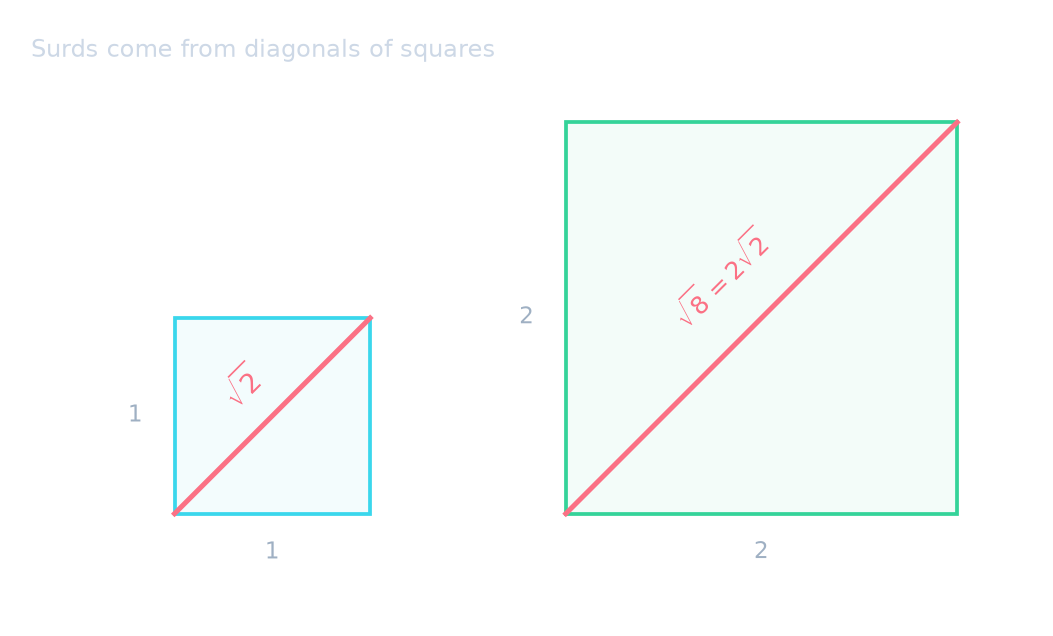
Powers and roots are inverses: the area of a square is $s^2$, and its side is $\sqrt{\text{area}}$.
You've got it
- multiply → add indices; divide → subtract; power of a power → multiply
- handle coefficients and letters separately, then recombine
- solve index equations by writing both sides with the same base
- $(5x^3)^2 = 25x^6$; $\;12a^5 \div 3a^{-2} = 4a^7$; $\;2^x = 32 \Rightarrow x = 5$
Write from the data: find the coefficient
- Expand (2 x squared) cubed.
- The result is k times x to the sixth. Find k.
(2 x al cuadrado) elevado al cubo es igual a k por x a la sexta potencia. ¿Cuál es k?
2³ es 8.
¿Cuál es k?
Dificultad 1/5 · 100 monedas + un pequeño bono en el primer intento de hoy
El número 2 se eleva al cubo por sí solo. Otras opciones — 25 (el coeficiente de la lección); 6 (el exponente de x).