Separation and purification
Introducido| English | Significado |
|---|---|
| separation techniques/ˌsepəˈreɪʃn tekˈniːks/ | técnicas de separación |
| filtration/fɪlˈtreɪʃn/ | filtración |
| crystallisation/ˌkrɪstəlaɪˈzeɪʃn/ | cristalización |
| simple distillation/ˈsɪmpl dɪstɪˈleɪʃn/ | separating a solvent from a solution by boiling it off and condensing the vapour |
| fractional distillation/ˈfrækʃənl dɪstɪˈleɪʃn/ | destilación fraccionada |
A medicine with a deadly solvent, 1937
- In 1937 a US company dissolved a new antibacterial drug in diethylene glycol — a chemical related to antifreeze — to make a sweet liquid "Elixir Sulfanilamide". No one tested what the mixture contained or whether it was safe. More than 100 people died. In 1938 the US passed a law requiring drugs to be tested for safety.
- In chemistry, a pure substance contains only one substance. Separation techniques 分离技术 take mixtures apart; melting and boiling points test the result.
Separation method lab
Choose the method that matches the mixture.
The 1937 Elixir Sulfanilamide deaths led to laws requiring drug safety testing.
Dificultad 1/5 · 100 monedas + un pequeño bono en el primer intento de hoy
In 1938.
Filtration
- Filtration 过滤 separates an insoluble solid from a liquid. The solid left in the filter paper is the residue; the liquid that passes through is the filtrate.
- Example: removing sand from salt solution.
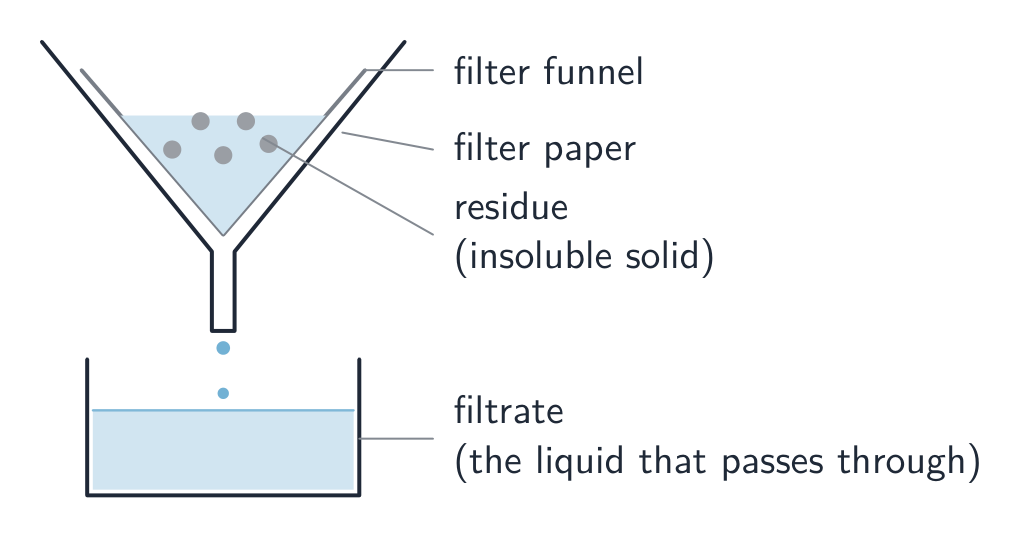
Match each term to its meaning.
Dificultad 2/5 · 140 monedas + un pequeño bono en el primer intento de hoy
Filtration terms.
Crystallisation
- Crystallisation 结晶 obtains a dissolved solid: heat the solution until it is saturated, then cool it; crystals form and are filtered off and dried.
- Used to get pure salt from salt solution, or copper(II) sulfate crystals.
Which method gets solid salt from salt solution?
Dificultad 1/5 · 100 monedas + un pequeño bono en el primer intento de hoy
The salt is dissolved.
Distillation
- Simple distillation 简单蒸馏 separates a solvent from a solution: the water boils off, condenses in the condenser and collects as pure water.
- Fractional distillation 分馏 separates liquids with different boiling points, such as ethanol (78 °C) and water (100 °C): a fractionating column gives repeated evaporation and condensation.
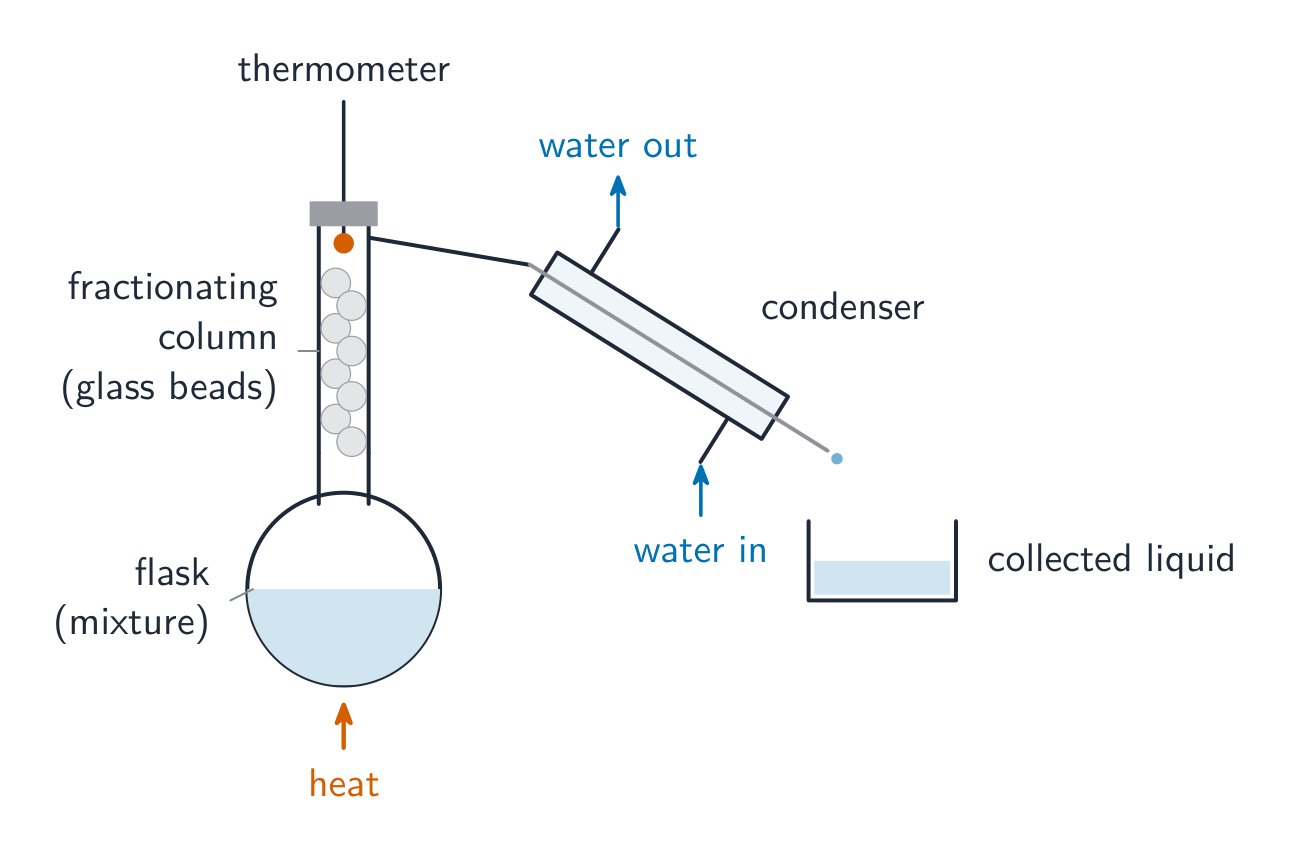
Match each mixture to the best method.
Dificultad 2/5 · 140 monedas + un pequeño bono en el primer intento de hoy
Choose by the differing property.
Worked example: three steps for one mixture
A mixture contains sand, salt and water. Get pure dry salt.
- Step 1: filter — sand stays as residue; salt solution is the filtrate.
- Step 2: heat the filtrate until crystals start to form, then cool to crystallise.
- Step 3: filter off the crystals and dry them between filter papers.
Order the steps to get dry salt from sand, salt and water.
Dificultad 3/5 · 200 monedas + un pequeño bono en el primer intento de hoy
Filter, concentrate, crystallise, dry.
Testing purity
- A pure substance melts and boils at a sharp, fixed temperature: pure water boils at 100 °C at sea level and melts at 0 °C.
- Impurities lower the melting point and raise the boiling point, and make them happen over a range.
A sample melts between 112 and 116 °C. What does this show?
Dificultad 1/5 · 100 monedas + un pequeño bono en el primer intento de hoy
A pure substance melts sharply.
Impurities raise the boiling point of water.
Dificultad 1/5 · 100 monedas + un pequeño bono en el primer intento de hoy
Salt water boils above 100 °C.
Distillation separates by boiling point; filtration separates by solubility. Choose the method from the property that differs between the substances.
Filtration removes an insoluble solid; crystallisation recovers a dissolved solid; simple distillation recovers a solvent; fractional distillation separates liquids with different boiling points. Pure substances have sharp melting and boiling points.
Describe how fractional distillation separates ethanol (boiling point 78 °C) from water, in three or four sentences.
The method step by step.