Uses of metals
Introducido| English | Significado |
|---|---|
| aluminium/ˌæljʊˈmɪnɪəm/ | aluminio |
| corrosion/kəˈrəʊʒn/ | corrosión |
An engine light enough to fly, 1903
- In December 1903 the Wright brothers' Flyer made the first powered, controlled aeroplane flights at Kitty Hawk, North Carolina. No car maker could supply a light enough engine, so their mechanic Charlie Taylor built one with a crankcase cast in aluminium 铝. Low mass mattered more than anything.
- Engineers choose a metal by matching its properties to the job.
Metal use lab
Choose the property that explains each metal use.
Why was aluminium used in the Wright brothers' engine?
Dificultad 1/5 · 100 monedas + un pequeño bono en el primer intento de hoy
Low mass mattered most.
Aluminium
- Low density, strong as an alloy, and resistant to corrosion 腐蚀 because a thin, tough oxide layer forms on its surface.
- Uses: aircraft bodies, overhead power cables (light, conducts well), food cans and foil.
Aluminium resists corrosion because of a thin oxide layer.
Dificultad 1/5 · 100 monedas + un pequeño bono en el primer intento de hoy
The layer protects the metal.
Copper
- Excellent electrical conductor and very ductile, so it is used for electrical wiring.
- Does not react with water, so it is used for water pipes.
Why is copper used for water pipes?
Dificultad 1/5 · 100 monedas + un pequeño bono en el primer intento de hoy
Copper is low in the reactivity series.
Iron and steel
- Mild steel is strong and cheap: buildings, bridges and car bodies — but it rusts unless protected.
- Stainless steel resists corrosion: cutlery, cooking pans and chemical plant.
Match each use to the best metal.
Dificultad 2/5 · 140 monedas + un pequeño bono en el primer intento de hoy
Property matches the job.
Worked example: choose a cable metal
Overhead power lines hang between pylons hundreds of metres apart.
- Copper: conducts better, but is dense — heavy cables need more pylons.
- Aluminium: conducts well, much lower density, resists corrosion — chosen, often with a steel core for strength.
- Reason: the low mass of aluminium matters more than the slightly better conductivity of copper.
Why is aluminium chosen for overhead power cables?
Dificultad 1/5 · 100 monedas + un pequeño bono en el primer intento de hoy
Lighter cables need fewer pylons.
Reactivity and corrosion
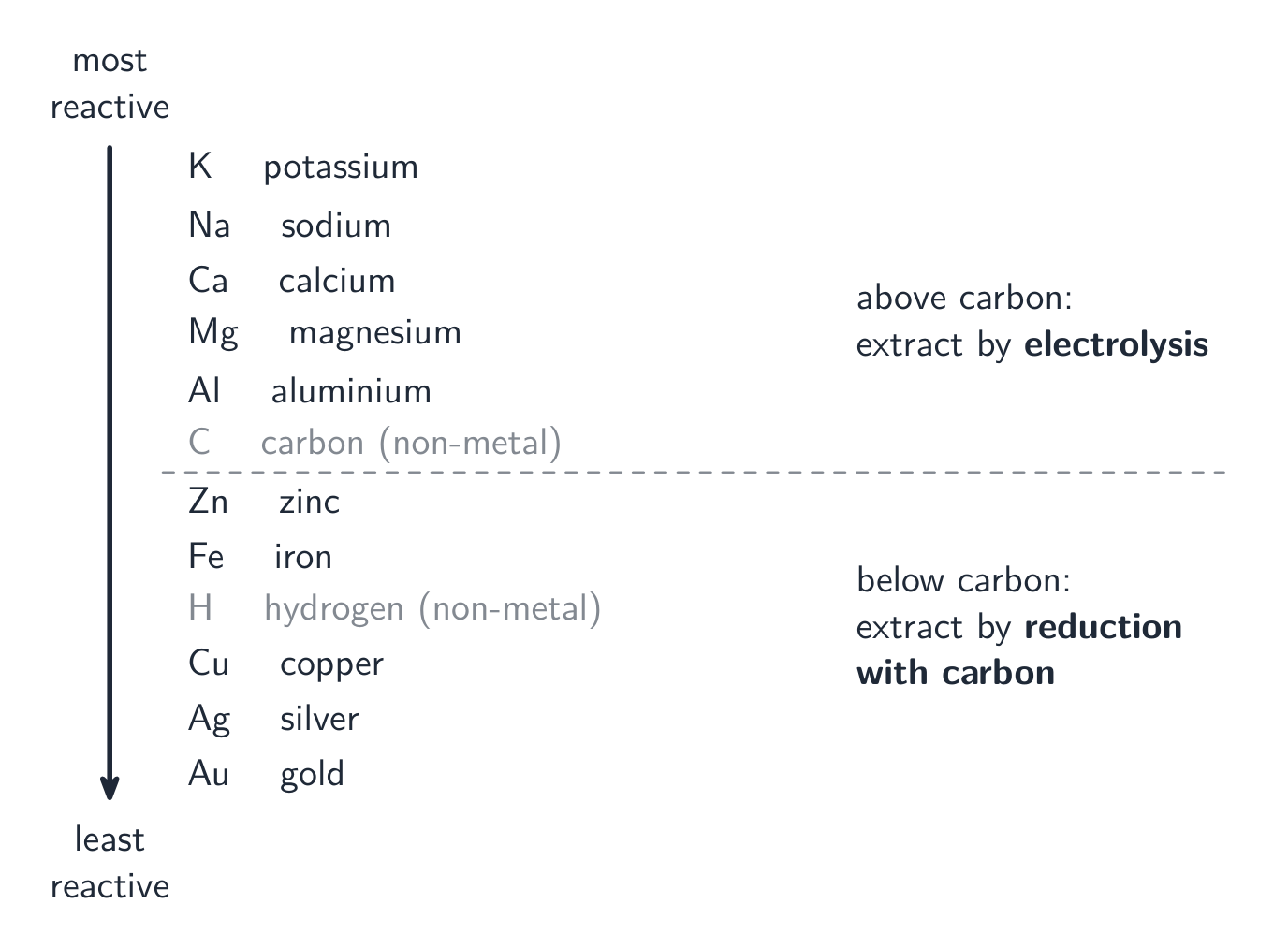
- Aluminium is high in the reactivity series, yet does not corrode easily: its oxide layer protects the metal underneath.
- Metals low in the series (copper, silver, gold) react slowly with air and water; gold stays shiny for thousands of years — jewellery and electrical contacts.
Gold stays shiny because it is low in the reactivity series.
Dificultad 1/5 · 100 monedas + un pequeño bono en el primer intento de hoy
It reacts very slowly.
Reactive does not always mean corrodes fast. Aluminium is more reactive than iron, but its oxide layer protects it, while iron's rust flakes off and exposes more metal.
Aluminium corrodes faster than iron because it is more reactive.
Dificultad 1/5 · 100 monedas + un pequeño bono en el primer intento de hoy
Its oxide layer protects it.
Choose a metal by its properties: aluminium (low density, corrosion-resistant) for aircraft and power cables; copper (conducts, ductile, unreactive with water) for wires and pipes; steel for strength; stainless steel where rusting must be avoided.
Explain why aluminium is used for drink cans rather than iron, giving two properties.
Properties decide use.