Alloys and their properties
Introducido| English | Significado |
|---|---|
| steel/stiːl/ | acero |
| stainless steel/ˈsteɪnləs stiːl/ | acero inoxidable |
| alloy/ˈælɔɪ/ | aleación |
| brass/bræs/ | latón |
| bronze/brɒnz/ | bronce |
A gun barrel that would not rust, 1913
- In August 1913 Harry Brearley, a metallurgist in Sheffield, England, was testing steels for gun barrels. A sample containing about 13% chromium did not rust and resisted the acids he used for etching. It was used for cutlery soon afterwards: the first stainless steel 不锈钢.
- Stainless steel is an alloy 合金: a mixture of a metal with other elements, usually other metals or carbon.
Alloy property lab
See why mixing atoms changes metal properties.
Which element did Brearley add to steel to stop rusting?
Dificultad 1/5 · 100 monedas + un pequeño bono en el primer intento de hoy
About 13% chromium.
Why alloys are harder
- In a pure metal the ions are all the same size, so layers slide easily — pure metals are soft.
- In an alloy, atoms of a different size disrupt the layers, so they cannot slide as easily. The alloy is harder and stronger.
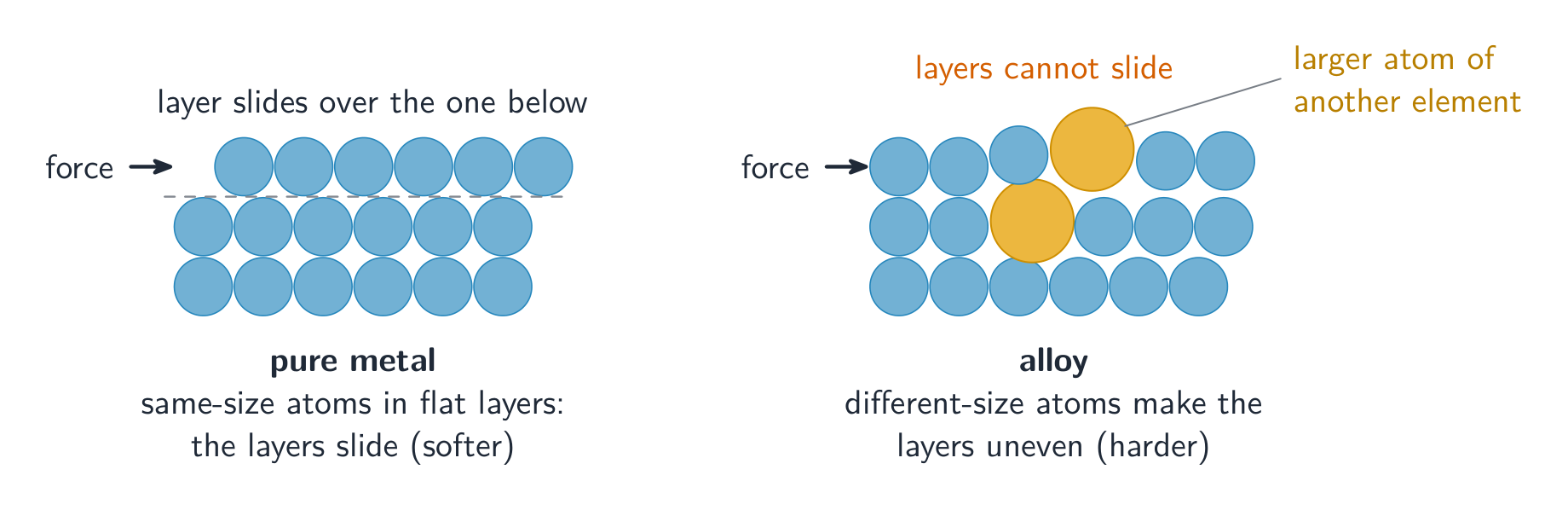
Why is an alloy harder than the pure metal?
Dificultad 1/5 · 100 monedas + un pequeño bono en el primer intento de hoy
The layers are disrupted.
Common alloys
- Brass 黄铜: copper and zinc — harder than copper, gold-coloured, used in musical instruments and door handles.
- Bronze 青铜: copper and tin — hard and resistant to corrosion, used in statues and medals.
Match each alloy to its main metals.
Dificultad 2/5 · 140 monedas + un pequeño bono en el primer intento de hoy
Learn these three.
Steel
- Steel 钢 is iron with carbon (and often other elements). Mild steel, with little carbon, is strong and easy to shape — car bodies, nails.
- Stainless steel adds chromium and nickel; the chromium forms a thin oxide layer that stops rusting — cutlery, sinks, surgical tools.
Stainless steel resists rusting because chromium forms a protective oxide layer.
Dificultad 1/5 · 100 monedas + un pequeño bono en el primer intento de hoy
A thin, tough layer.
Worked example: choose an alloy
A hospital needs scalpels that stay sharp, can be sterilised in steam, and never rust.
- Pure iron: soft and rusts — rejected.
- Mild steel: strong but rusts in steam — rejected.
- Stainless steel: hard, and chromium prevents rusting — chosen.
Which material is best for surgical tools?
Dificultad 1/5 · 100 monedas + un pequeño bono en el primer intento de hoy
Hard and does not rust.
Alloys around you
- Coins are usually alloys: copper-nickel is hard-wearing; pure gold is too soft, so jewellery uses gold alloys (18-carat gold is 75% gold).
- Solder, used to join electrical parts, is a tin alloy with a low melting point.
An 18-carat gold ring has a mass of 8 g. What mass of gold does it contain, in g? (18-carat = 75% gold)
Dificultad 2/5 · 140 monedas + un pequeño bono en el primer intento de hoy
0.75 × 8.
An alloy is a mixture, not a compound. Its composition can vary, and its elements are not chemically bonded in fixed proportions.
An alloy is a compound with a fixed formula.
Dificultad 1/5 · 100 monedas + un pequeño bono en el primer intento de hoy
It is a mixture.
An alloy mixes a metal with other elements. Different-sized atoms stop layers sliding, so alloys are harder than pure metals. Brass = copper + zinc, bronze = copper + tin, steel = iron + carbon, stainless steel adds chromium and nickel.
Explain, using a particle picture, why bronze was better than pure copper for ancient tools.
Structure and use.