Catalysts and measuring rate
Introducido| English | Significado |
|---|---|
| catalyst/ˈkætəlɪst/ | catalizador |
| enzymes/ˈenzaɪmz/ | enzimas |
| Haber process/ˈheɪbə ˈprəʊses/ | proceso Haber |
Speeding reactions without using anything up
- Some substances make a reaction go faster yet are not used up themselves.
- These are catalysts 催化剂, and they work by lowering the activation energy.
A catalyst speeds up a reaction by:
Dificultad 1/5 · 100 monedas + un pequeño bono en el primer intento de hoy
A lower Ea means more successful collisions.
After the reaction, a catalyst is:
Dificultad 1/5 · 100 monedas + un pequeño bono en el primer intento de hoy
Catalysts are regenerated and reused.
A catalyst provides a pathway with a lower ______ energy.
Dificultad 1/5 · 100 monedas + un pequeño bono en el primer intento de hoy
Lower Ea lets more collisions succeed.
How catalysts work
- A catalyst speeds up a reaction by providing a pathway with a lower activation energy.
- It is not used up, so a small amount can be reused again and again.

A catalyst lowers the activation-energy hill, so more collisions succeed and the reaction speeds up.
Catalysts & measuring rate
conc = c₀·bᵗ
A catalizador speeds the fall in concentration.
Biological catalysts found in living things are called:
Dificultad 1/5 · 100 monedas + un pequeño bono en el primer intento de hoy
Enzymes are biological catalysts.
Catalysts in action
- Enzymes 酶 are biological catalysts in living things.
- Industry uses catalysts (e.g. iron in the Haber process 哈伯法) to speed reactions and save energy.
A steeper gradient on a rate graph means a slower reaction.
Dificultad 1/5 · 100 monedas + un pequeño bono en el primer intento de hoy
False. The gradient measures the rate: a steeper line means more product per unit time, so a faster reaction.
Worked example: test a catalyst
Hydrogen peroxide slowly breaks down: $2\text{H}_2\text{O}_2 \rightarrow 2\text{H}_2\text{O} + \text{O}_2$. A student adds 0.50 g of manganese(IV) oxide and collects the oxygen in a gas syringe.
- With the powder, 60 cm³ of oxygen is collected in 30 s; without it, only 5 cm³. The gas-volume graph is much steeper, so the rate is faster.
- Afterwards the powder is filtered, washed and dried: it still has a mass of 0.50 g. It sped up the reaction but was not used up, so it is a catalyst.
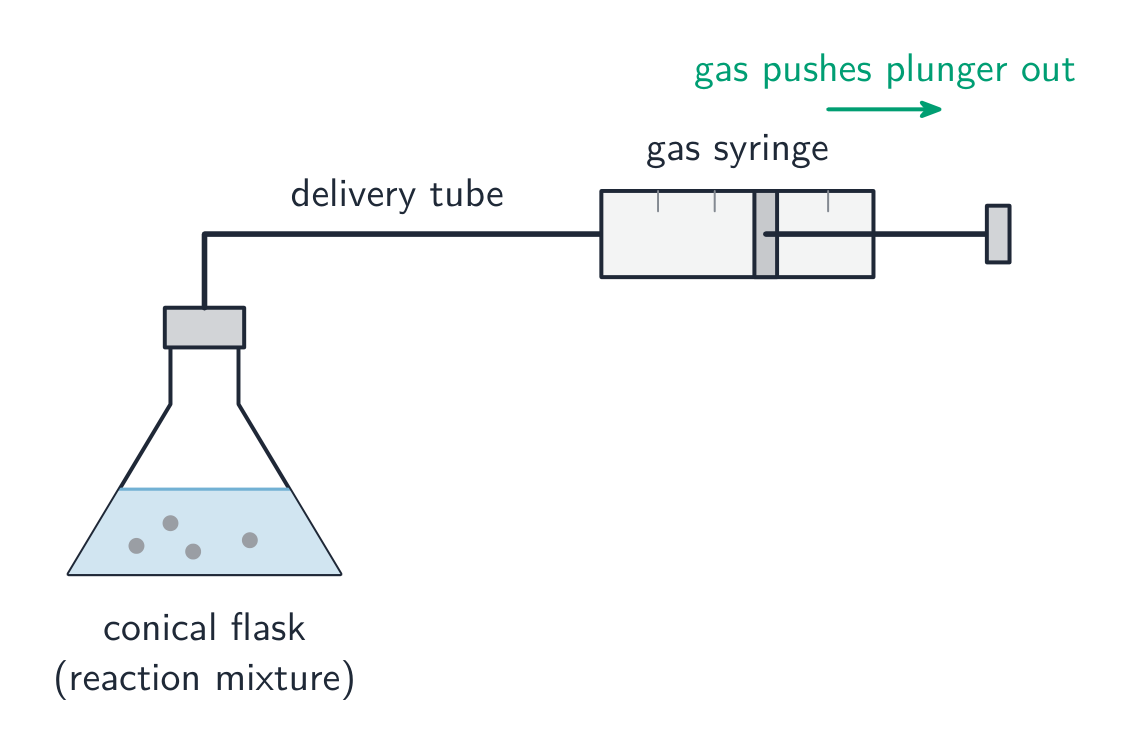
A gas syringe measures the volume of gas given off at regular times
A catalyst is not used up. It takes part in the reaction but is regenerated, so the same catalyst keeps working. That's why only a small amount is needed.
With the catalyst, 60 cm³ of oxygen is collected in 30 s. What is the mean rate, in cm³ per second?
Dificultad 2/5 · 140 monedas + un pequeño bono en el primer intento de hoy
$\dfrac{60}{30} = 2$ cm³ per second.
Why does the student weigh the manganese(IV) oxide again at the end?
Dificultad 1/5 · 100 monedas + un pequeño bono en el primer intento de hoy
The same mass at the end shows it was not used up, which is one test of a catalyst.
You've got it
- a catalyst speeds up a reaction by lowering the activation energy
- it is not used up, so a little is reused many times
- enzymes are biological catalysts; rate = the gradient of a rate graph
Write from this case
- Manganese dioxide speeds the decomposition of hydrogen peroxide.
- The same solid is still there at the end.
What happens to the manganese dioxide?
A catalyst is not used up.
What is true of the manganese dioxide?
Dificultad 1/5 · 100 monedas + un pequeño bono en el primer intento de hoy
The catalyst provides a lower-energy path and remains.