Chemical formulae
Introducido| English | Significado |
|---|---|
| chemical formula/ˈkemɪkl ˈfɔːmjʊlə/ | fórmula química |
| subscript/ˈsʌbskrɪpt/ | subíndice |
| valency/ˈveɪlənsi/ | valencia |
The shorthand of chemistry
- Writing "two hydrogen atoms joined to one oxygen atom" every time would be exhausting.
- Chemists use formulae — a compact code for what a substance is made of.
Ruta para escribir fórmulas
Follow charges or valencies to a neutral chemical formula.
How many hydrogen atoms are in one molecule of H₂O?
Dificultad 2/5 · 140 monedas + un pequeño bono en el primer intento de hoy
The subscript 2 means two hydrogen atoms.
The small number that shows how many atoms of an element are present is the ______.
Dificultad 1/5 · 100 monedas + un pequeño bono en el primer intento de hoy
Subscripts give atom counts in a formula.
Reading a formula
- A chemical formula 化学式 shows the elements and how many atoms of each.
- The small subscript 下标 number gives the count: H₂O = 2 hydrogen + 1 oxygen.
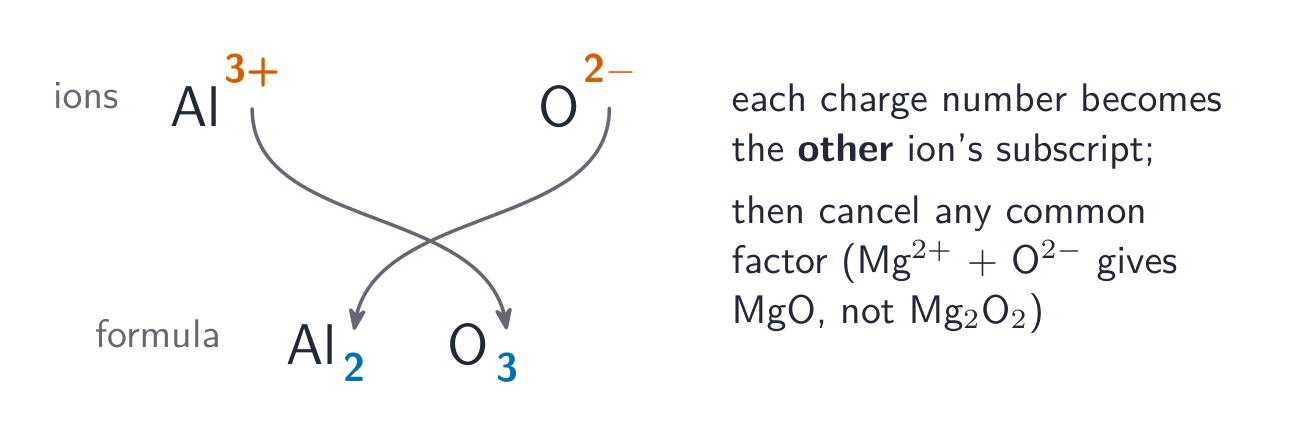
For an ionic compound, the ion charges cross over to give the formula
Why formulae are fixed
- Atoms combine in fixed ratios set by their combining power (valency 化合价).
- For example, hydrogen has valency 1 and oxygen 2, so water is H₂O — not HO.
How many oxygen atoms are in Ca(OH)₂?
Dificultad 2/5 · 140 monedas + un pequeño bono en el primer intento de hoy
The bracket subscript 2 applies to OH, giving 2 O.
How many atoms in total are in CaCO₃?
Dificultad 2/5 · 140 monedas + un pequeño bono en el primer intento de hoy
1 Ca + 1 C + 3 O = 5 atoms.
Brackets in formulae
- Brackets group atoms that repeat: Ca(OH)₂ means one calcium and two OH groups.
- So Ca(OH)₂ contains 1 Ca, 2 O and 2 H.
Worked example. How many atoms are in CaCO₃? One calcium, one carbon, and three oxygen = 5 atoms in total. The subscript 3 applies only to the oxygen.
Balance the charges in an ionic formula
- Supplement: a neutral ionic compound has zero total charge. Two Al³⁺ ions give +6, balanced by three O²⁻ ions giving −6, so the formula is Al₂O₃.
- Use the simplest whole-number ion ratio. Mg²⁺ with O²⁻ gives MgO, not Mg₂O₂. An ionic formula gives an ion ratio in a lattice; a molecular formula gives the atoms in one molecule.
For Ca²⁺ and Cl⁻, which Ca:Cl ratio gives a neutral ionic formula?
Dificultad 1/5 · 100 monedas + un pequeño bono en el primer intento de hoy
One Ca²⁺ balances two Cl⁻ ions. The simplest ratio is 1:2, giving CaCl₂.
Use Ca²⁺ and Cl⁻ to deduce the neutral ionic formula. Type ordinary digits.
Dificultad 1/5 · 100 monedas + un pequeño bono en el primer intento de hoy
One Ca²⁺ needs two Cl⁻ ions to balance +2 with −2, so CaCl₂.
Common ions to learn
| Positive ions | Negative ions | ||
|---|---|---|---|
| sodium | Na⁺ | chloride | Cl⁻ |
| magnesium | Mg²⁺ | oxide | O²⁻ |
| aluminium | Al³⁺ | hydroxide | OH⁻ |
| ammonium | NH₄⁺ | nitrate | NO₃⁻ |
| copper(II) | Cu²⁺ | sulfate | SO₄²⁻ |
| iron(III) | Fe³⁺ | carbonate | CO₃²⁻ |
- Balance the charges, and put a group ion in brackets when you need more than one: aluminium sulfate is Al₂(SO₄)₃ (2 × +3 = +6; 3 × −2 = −6).
What is the formula of calcium nitrate (Ca²⁺ and NO₃⁻)?
Dificultad 1/5 · 100 monedas + un pequeño bono en el primer intento de hoy
Two NO₃⁻ ions (−2) balance one Ca²⁺ (+2). Brackets show there are two nitrate groups.
How many oxygen atoms are in one formula unit of Al₂(SO₄)₃?
Dificultad 2/5 · 140 monedas + un pequeño bono en el primer intento de hoy
Each SO₄ has 4 oxygen atoms, and there are 3 of them: 3 × 4 = 12.
You've got it
- a formula shows which elements and how many atoms of each (subscripts)
- atoms combine in fixed ratios set by their valency
- brackets group repeating units: Ca(OH)₂ has 2 O and 2 H
Count an unfamiliar molecule
- The formula is H2SO4.
- Use its subscripts to count the atoms of each element before finding the total.
How many atoms in total are in one H₂SO₄ molecule? Show the element counts.
H2SO4 contains seven atoms in one molecule.
How many atoms in total are in one H₂SO₄ molecule?
Dificultad 1/5 · 100 monedas + un pequeño bono en el primer intento de hoy
Two plus one plus four is seven. Other options — 5 (the atom count in CaCO3); 4 (the oxygen atoms only).