Business activity
Introducido| English | Significado |
|---|---|
| wants/wɒnts/ | deseos |
| resources/rɪˈzɔːsɪz/ | recursos |
| goods/ɡʊdz/ | bienes |
| services/ˈsɜːvɪsɪz/ | servicios |
| scarcity/ˈskeəsɪti/ | escasez |
| opportunity cost/ɒpəˈtjuːnɪti kɒst/ | costo de oportunidad |
| value added/ˈvæljuː ˈædɪd/ | valor añadido |
Why businesses exist
- People have endless wants 欲望 but the world has limited resources 资源. We can't have everything.
- Businesses exist to turn scarce resources into the goods 商品 and services 服务 people want — adding value along the way.
The economic problem of scarcity arises because:
Dificultad 1/5 · 100 monedas + un pequeño bono en el primer intento de hoy
Scarcity means limited resources cannot meet unlimited wants.
Opportunity cost is:
Dificultad 1/5 · 100 monedas + un pequeño bono en el primer intento de hoy
It is the single next-best alternative sacrificed.
Scarcity 稀缺 and opportunity cost 机会成本
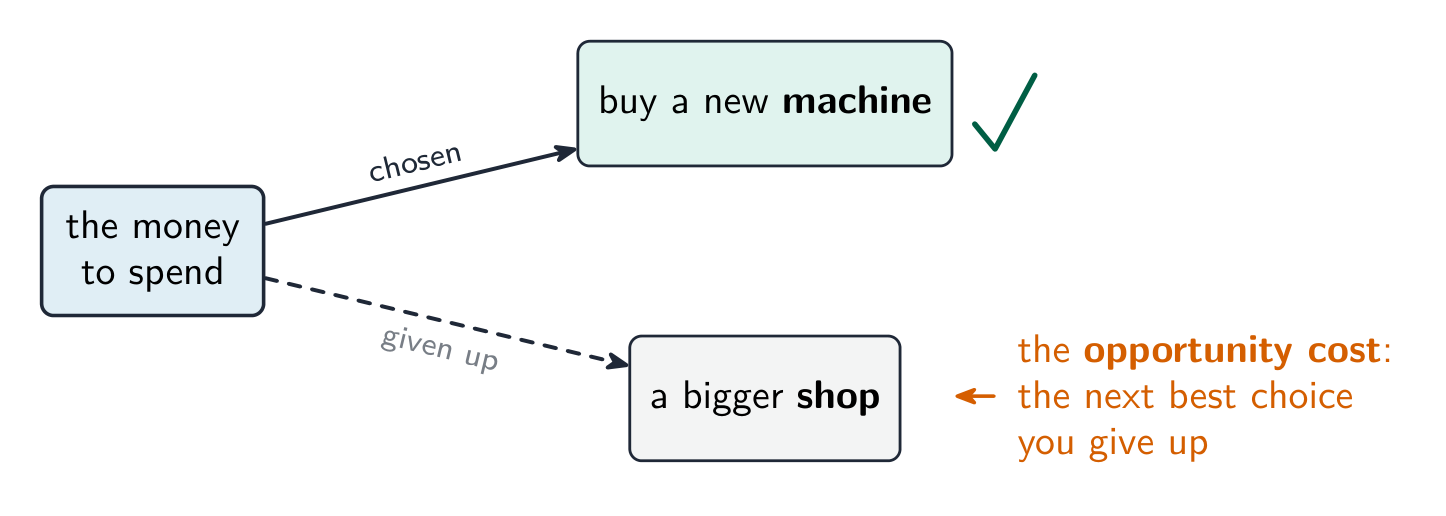
- Scarcity: wants are unlimited but resources are limited, so we must choose.
- Opportunity cost is the next best alternative given up when you choose.
Laboratorio de valor añadido
Change the bought-in cost, the selling price and other costs to see how business activity creates value added.
A business buys materials for 18 and sells the finished product for 50. What is the value added?
Dificultad 2/5 · 140 monedas + un pequeño bono en el primer intento de hoy
Value added = 50 − 18 = 32.
Adding value means the selling price is lower than the cost of bought-in materials.
Dificultad 1/5 · 100 monedas + un pequeño bono en el primer intento de hoy
False. Value added is the selling price minus the cost of bought-in materials, so adding value means the price is higher than those costs.
Selling price minus the cost of bought-in materials is value ______.
Dificultad 1/5 · 100 monedas + un pequeño bono en el primer intento de hoy
Value added helps cover other costs and profit.
Adding value
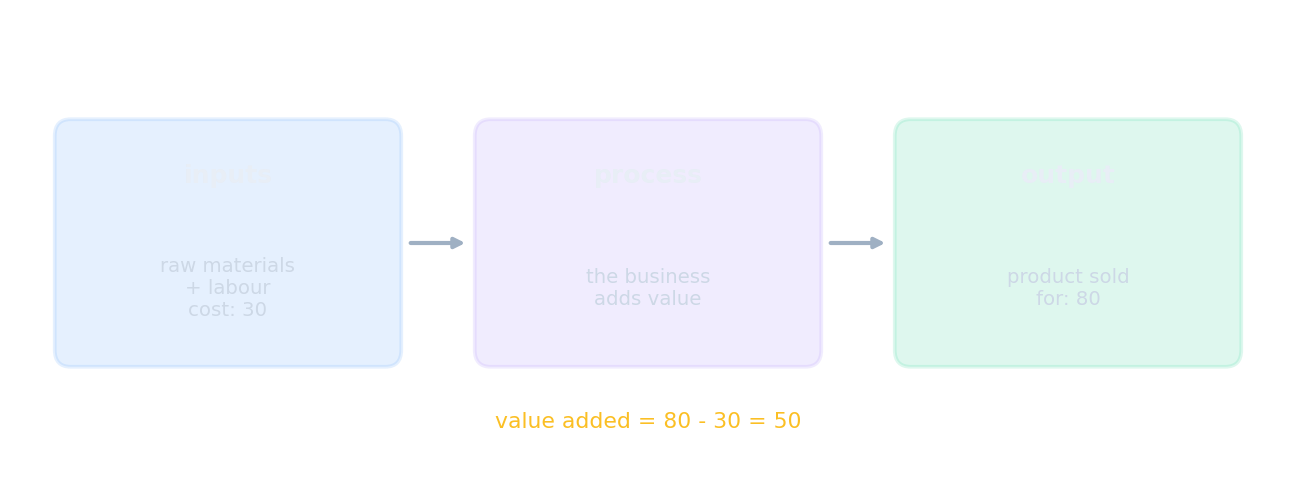
- Value added 附加值 = the selling price minus the cost of the bought-in materials.
- Adding value lets a business charge more than its inputs cost — covering wages, rent and profit.
What businesses provide
- Goods (physical products) and services (things done for you).
- They also create jobs and incomes and meet customers' needs.
Adding value isn't the same as making profit. Value added must still cover wages, rent and other costs. Only what's left after all costs is profit.
Worked example: a café's value added
A café sells a sandwich for £5. The bread, filling and packaging cost £2. Find the value added and say whether it is all profit.
- Value added = selling price − cost of bought-in materials = £5 − £2 = £3 per sandwich. The café adds value through convenience, a fresh recipe and a pleasant place to eat.
- It is not all profit: the £3 must also pay wages, rent and electricity. If these come to £2.20 per sandwich, the profit is only £0.80.
A jeweller buys silver for £40 and sells the finished ring for £150. What is the value added, in pounds?
Dificultad 2/5 · 140 monedas + un pequeño bono en el primer intento de hoy
£150 − £40 = £110.
A farmer can grow either wheat or rice on a field and chooses wheat. What is the opportunity cost?
Dificultad 1/5 · 100 monedas + un pequeño bono en el primer intento de hoy
Opportunity cost is the next best alternative given up.
You've got it
- scarcity forces choice; every choice has an opportunity cost
- value added = selling price − cost of bought-in materials
- businesses provide goods and services, jobs and incomes
Write from the data: find the value added
- Materials cost 24 and the product sells for 70.
- Find the value added. Other costs of 30 still have to be paid before there is profit.
Materials cost 24 and the finished product sells for 70. Other costs are 30. What is the value added, and why is that not the profit?
Value added is selling price minus the cost of bought-in materials. Wages, rent and other costs come off before profit.
What is the value added?
Dificultad 1/5 · 100 monedas + un pequeño bono en el primer intento de hoy
70 minus 24 is 46. The profit of 16 comes only after the other costs. Other options — 32 (the lesson gap from materials of 18 and a price of 50); 16 (the profit after other costs).