Tu plan de aprendizaje · Continuar · Revisar →
以后 vs 的时候 (after vs when)
IntroducidoTu posición guardada se conserva en este navegador. Continuar no completa la lección ni responde sus preguntas.
Cuándo o después?
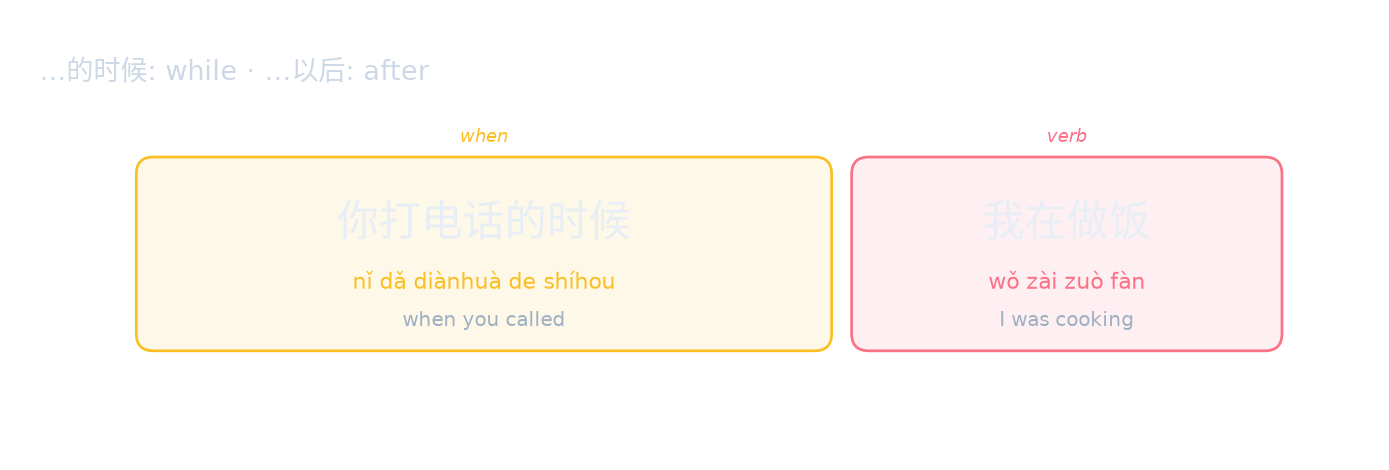
- Le cuentas a un amigo sobre anoche: estabas cocinando cuando él llamó, y le devolviste la llamada después de cenar.
- you你to make a telephone call打电话(modifier / structural particle)的time; when时候I我at / in在to prepare a meal做饭,吃完饭after以后I我to给you你to go back; to return回(completed / change)了a call电话。 — "Cuando llamaste, estaba cocinando; después de cenar te devolví la llamada."
(modifier / structural particle)的time; when时候 = al mismo tiempo
- A (modifier / structural particle)的time; when时候,B = cuando A está ocurriendo, B: las dos acciones se superponen.
- I我arrive到(modifier / structural particle)的time; when时候,he他was正在eating吃饭 — "Cuando llegué, él estaba comiendo."
I我arrive到when的时候,he他was正在eating吃饭。
During the meal: “Don't look at your phone while eating.” 吃饭____别看手机。
Dificultad 1/5 · 100 monedas + un pequeño bono en el primer intento de hoy
Overlapping time takes 的时候.
我到的时候,他正在吃饭 means he was eating when I arrived.
Dificultad 1/5 · 100 monedas + un pequeño bono en el primer intento de hoy
True. …的时候 marks time that overlaps with the main event: when I arrived, he was in the middle of eating. 以后 would mean he ate after I arrived.
after以后 = después, uno tras otro
- A after以后,B = después de que A haya terminado, B: el segundo sigue al primero.
- class ends下课after以后,we我们go去play ball打球 — "Después de clase, iremos a jugar pelota."
class ends下课after以后,we我们go去play ball打球。
Build: “After class, we'll go and play ball.”
Dificultad 3/5 · 200 monedas + un pequeño bono en el primer intento de hoy
A 以后,B.
¿Superposición o secuencia?
- Si B ocurre durante A, use (modifier / structural particle)的time; when时候; si B ocurre después de que A termina, use after以后.
- eating吃饭(modifier / structural particle)的time; when时候don't be fooled by the fact…别看mobile phone手机 (durante la comida) es diferente de eating吃饭after以后don't别right away马上to sleep睡觉 (después de la comida).
“After eating, don't go to bed straight away.” Which fits? 吃饭____别马上睡觉。
Dificultad 1/5 · 100 monedas + un pequeño bono en el primer intento de hoy
After the meal has finished = 以后.
Con verbos completados
- Verbo + (completed / change)了 + after以后 enfatiza la finalización: you你arrive到(completed / change)了after以后to给I我to make a telephone call打电话.
- Para un evento terminado seguido de otro, after以后 es la opción segura: I我做完作业after以后go去to sleep睡觉.
you你arrive到了after以后to给me我make打a call电话。
Resumen
- (modifier / structural particle)的time; when时候 = cuando (tiempo superpuesto); after以后 = después (un evento sigue a otro).
- Pregunta: ¿ocurre B durante A o después?
Lee la referencia completa: Gramática HSK 4 — Comparación de palabras de tiempo similares.
You tell a friend about last night: you were cooking when he called, and you called back after dinner. Close the examples. Say a Mandarin response, then write it in Chinese. Explain briefly in English what the lesson’s pattern adds. Compare with the model, then change one detail and try again.
This is supported productive practice. Compare meaning and structure; your answer need not copy the model. A partner or teacher must hear the spoken response to comment on pronunciation.