Skip to content
Subjects

HSK 4 Grammar

  • 1 Adjectives
    • 1.1 Indicating the whole with "quan"
    • 1.2 Negative adjectives with "-si le"

    Adjectives →

  • 2 Adverbs
    • 2.1 Approximations with "chabuduo"
    • 2.2 Assessing situations with "kanlai"
    • 2.3 Coincidence with "zhenghao"
    • 2.4 Declaring the only option with "zhihao"
    • 2.5 Emphasizing negation with "you"
    • 2.6 Emphatic adverb "ke"
    • 2.7 Expressing "all along" with "yuanlai"
    • 2.8 Expressing "almost" using "chadian"
    • 2.9 Expressing "always" with "conglai"
    • 2.10 Expressing "as a result" with "jieguo"
    • 2.11 Expressing "enough" with "gou"
    • 2.12 Expressing "even" with "shenzhi"
    • 2.13 Expressing "had better" with "haishi"
    • 2.14 Expressing "had better" with "zuihao"
    • 2.15 Expressing "have to" with "budebu"
    • 2.16 Expressing "in the end" with "daodi"
    • 2.17 Expressing "in the end" with "jiujing"
    • 2.18 Expressing "just" with "gang"
    • 2.19 Expressing "one by one" with "yi"
    • 2.20 Expressing "originally" with "benlai"
    • 2.21 Expressing "small quantity" with "jiu"
    • 2.22 Expressing "to make certain" with "qianwan"
    • 2.23 Expressing concern with "kongpa"
    • 2.24 Expressing the unexpected with "jingran"
    • 2.25 Rhetorical questions with "nandao"
    • 2.26 Sequencing with "xian" and "zai"
    • 2.27 Using "ye" and "dou" together

    Adverbs →

  • 3 Adverbs with Adjectives
    • 3.1 Expressing "quite" with "ting"

    Adverbs with Adjectives →

  • 4 Auxiliary Words
    • 4.1 Ending a non-exhaustive list with "shenme de"
    • 4.2 Non-exhaustive lists with "dengdeng"

    Auxiliary Words →

  • 5 Conjunctions
    • 5.1 A softer "but" with "buguo"
    • 5.2 Expressing "and then" with "yushi"
    • 5.3 Expressing "in addition" with "haiyou"
    • 5.4 Expressing "in addition" with "lingwai"
    • 5.5 Expressing "in addition" with "zaishuo"
    • 5.6 Two words for "but"
    • 5.7 Using "er" to explain contrasting ideas
    • 5.8 Using "lai" to connect two verb phrases

    Conjunctions →

  • 6 Nouns
    • 6.1 Expressing "within (it/them)" with "qizhong"

    Nouns →

  • 7 Numbers
    • 7.1 Expressing fractions with "fenzhi"

    Numbers →

  • 8 Particles
    • 8.1 Advanced yes-no questions with "ma"
    • 8.2 Reviewing options with "ba"
    • 8.3 Using "de" (modal particle)

    Particles →

  • 9 Prepositions
    • 9.1 Expressing "along with…" with "suizhe"
    • 9.2 Idiomatic phrases with "zai"

    Prepositions →

  • 10 Sentence Patterns
    • 10.1 Emphasizing a negation with "bing"

    Sentence Patterns →

  • 11 Sentence patterns
    • 11.1 Using "yi... wei..."

    Sentence patterns →

  • 12 Verbs
    • 12.1 Causative verbs
    • 12.2 Expressing "it depends" with "kan"
    • 12.3 Expressing "it seems" with "haoxiang"
    • 12.4 Expressing "lies in" with "zaiyu"
    • 12.5 Expressing "mistakenly think that" with "yiwei"
    • 12.6 Expressing "through" with "tongguo"
    • 12.7 Expressing "to come from" with "laizi"
    • 12.8 Using "lai" as a dummy verb

    Verbs →

  • 13 Auxiliary verbs
    • 13.1 Expressing "don't need to" with "buyong"
    • 13.2 Expressing "must" with "dei"

    Auxiliary verbs →

  • 14 Verb phrases
    • 14.1 Combining verbs with "bing"
    • 14.2 Doing something less with "shao"
    • 14.3 Doing something more with "duo"
    • 14.4 Emphasizing the doer of an action with "you"
    • 14.5 Expressing "moreover" with "bingqie"
    • 14.6 Expressing "never" with "conglai"
    • 14.7 Expressing "to be worth" doing with "zhide"
    • 14.8 Expressing "until" with "dao"
    • 14.9 Indicating negative impact with "haide"
    • 14.10 Separable verb
    • 14.11 Using "zhe" when "verbing away"

    Verb phrases →

  • 15 "But" Statements
    • 15.1 Expressing "although" with "jinguan"
    • 15.2 Expressing contrariness with "dao"
    • 15.3 The "however" adverb "que"

    "But" Statements →

  • 16 "Even If" Statements
    • 16.1 Expressing "even if…" with "jishi"

    "Even If" Statements →

  • 17 "If" Statements
    • 17.1 Expressing "if… then…" with "yaoshi"

    "If" Statements →

  • 18 "No Matter" Statements
    • 18.1 Expressing "no matter" with "buguan"
    • 18.2 Expressing "no matter" with "wulun"

    "No Matter" Statements →

  • 19 Cause/Effect Statements
    • 19.1 Expressing "due to…" with "youyu"
    • 19.2 Expressing "since" with "jiran"
    • 19.3 Expressing "therefore" with "yinci"

    Cause/Effect Statements →

  • 20 Complements
    • 20.1 Advanced uses of direction complement "-qilai"
    • 20.2 Direction complement
    • 20.3 Direction complement "-qilai"
    • 20.4 Potential complement

    Complements →

  • 21 Conditional Statements
    • 21.1 Expressing "as long as" with "zhiyao"
    • 21.2 Expressing "unless" with "chufei"

    Conditional Statements →

  • 22 Noun Phrases
    • 22.1 Expressing "all" with "suoyou"
    • 22.2 Expressing "one of" with "zhiyi"
    • 22.3 Expressing "the other" with "lingwai"

    Noun Phrases →

  • 23 Sentence Patterns
    • 23.1 Advanced uses of "lian"
    • 23.2 Explaining purpose with "wei... er..."
    • 23.3 Expressing "any" with "renhe"
    • 23.4 Expressing "both… and…" with "ji...you"
    • 23.5 Expressing location with "zai... shang / xia / li"

    Sentence Patterns →

  • 24 Basic/Simple Sentence Patterns
    • 24.1 Expressing "even" with "lian" and "dou"
    • 24.2 Expressing "every" with question words
    • 24.3 Expressing "multiples" with "bei"
    • 24.4 Expressing "not at all" with "yidianr ye bu"
    • 24.5 Expressing not knowing how to do something using "hao"
    • 24.6 Phrases using "laishuo"

    Basic/Simple Sentence Patterns →

  • 25 Complex Sentence Patterns
    • 25.1 Conceding a point with "shi"
    • 25.2 Events in quick succession with "yi... jiu..."
    • 25.3 Expressing various aspects with "yi fangmian"

    Complex Sentence Patterns →

  • 26 Not only… but also…
    • 26.1 Many types of "not only... but also..."

    Not only… but also… →

  • 27 Comparing similar adverbs
    • 27.1 Comparing "benlai" and "yuanlai"
    • 27.2 Comparing "changchang" and "wangwang"
    • 27.3 Comparing "gang" and "gangcai"

    Comparing similar adverbs →

  • 28 Comparing similar prepositions
    • 28.1 Comparing "guanyu" and "duiyu"
    • 28.2 Comparing "li" and "cong"

    Comparing similar prepositions →

  • 29 Comparing similar separate functions
    • 29.1 Comparing "fan'er" and “xiangfan"
    • 29.2 Comparing "kending" "queding" and “yiding"
    • 29.3 Comparing "shihe" and "heshi"

    Comparing similar separate functions →

  • 30 Comparing similar time words

    after / from now on以后yǐ hòu vs (modifier / structural particle)的detime; when时候shí hòu (after vs when)

    Form: A (modifier / structural particle)的detime; when时候shí hòu,B (at the same time) · A ((completed / change)了le) after / from now on以后yǐ hòu,B (one after the other)

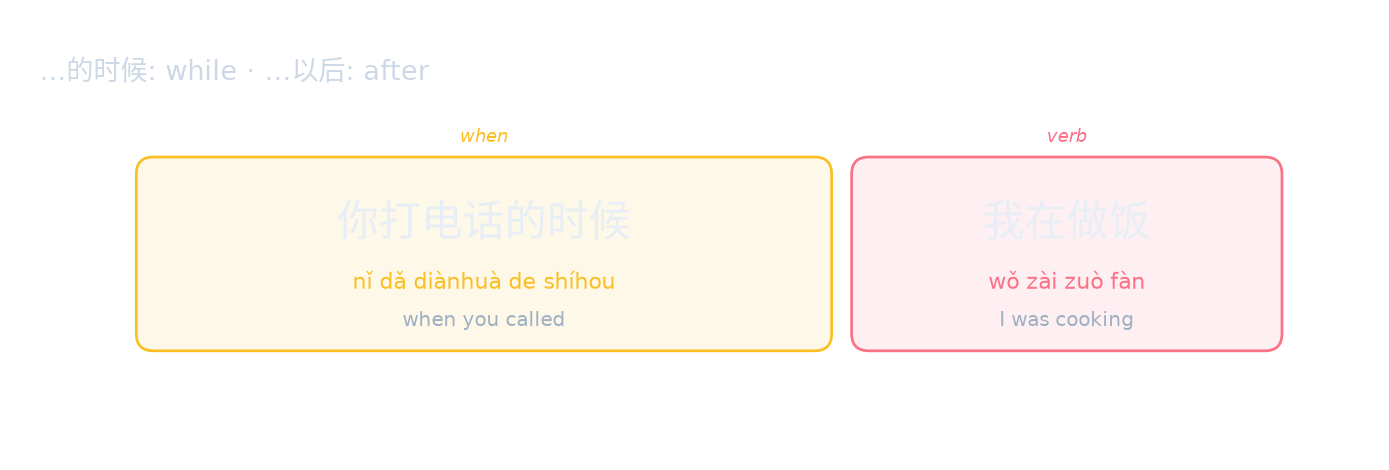
    • you你nǐto make a telephone call打电话dǎ diàn huà(modifier / structural particle)的detime; when时候shí hòuI / me我wǒat / in在zàito prepare a meal做饭zuò fàn,吃完饭chī wán fànafter / from now on以后yǐ hòuI / me我wǒto / for / give给gěiyou你nǐto return / (times)回huí(completed / change)了letelephone电话diàn huà。 Nǐ dǎ diànhuà de shíhou wǒ zài zuò fàn, chīwán fàn yǐhòu wǒ gěi nǐ huíle diànhuà. – When you called, I was cooking; after dinner I called you back.
    • I / me我wǒto / arrive / (result: get)到dào(modifier / structural particle)的detime; when时候shí hòu,he / him他tāin the middle of正在zhèng zàito have a meal吃饭chī fàn。 Wǒ dào de shíhou, tā zhèngzài chī fàn. – When I arrived, he was eating.
    • to finish class下课xià kèafter / from now on以后yǐ hòu,we / us我们wǒ mento go去qùto play ball打球dǎ qiú。 Xià kè yǐhòu, wǒmen qù dǎ qiú. – After class, we'll go and play ball.
    • in one's childhood小时候xiǎo shí hòu,I / me我wǒoften常常cháng chángand / with和héfather's father爷爷yé yéto go去qùto fish (with line and hook)钓鱼diào yú。 Xiǎo shíhou, wǒ chángcháng hé yéye qù diào yú. – When I was little, I often went fishing with my grandpa.
    • you你nǐto / arrive / (result: get)到dào(completed / change)了leafter / from now on以后yǐ hòu给我发gěi wǒ fā(measure word)个gèinformation信息xìn xī。 Nǐ dàole yǐhòu gěi wǒ fā ge xìnxī. – Send me a message after you arrive.
    • to graduate毕业bì yèafter / from now on以后yǐ hòu,he / him他tāto go去qù(completed / change)了leShanghai municipality…上海shàng hǎito work; job工作gōng zuò。 Bìyè yǐhòu, tā qùle Shànghǎi gōngzuò. – After graduating, he went to work in Shanghai.

    How it works. Both patterns put a time clause before the main clause; Chinese never puts it at the end the way English can ("I was cooking when you called"). To choose, ask one question: do the two events overlap, or does one follow the other?

    A (modifier / structural particle)的detime; when时候shí hòu means "during A, while A, when A": B happens inside A's time (I / me我wǒto / arrive / (result: get)到dào(modifier / structural particle)的detime; when时候shí hòu,he / him他tāin the middle of正在zhèng zàito have a meal吃饭chī fàn). A after / from now on以后yǐ hòu means "after A": A finishes, then B starts. Verb + (completed / change)了le + after / from now on以后yǐ hòu stresses that A is complete: you你nǐto / arrive / (result: get)到dào(completed / change)了leafter / from now on以后yǐ hòu, I / me我wǒ做完作业zuò wán zuò yèafter / from now on以后yǐ hòu.

    (modifier / structural particle)的detime; when时候shí hòu after / from now on以后yǐ hòu
    B happens during A B happens after A ends
    to have a meal吃饭chī fàn(modifier / structural particle)的detime; when时候shí hòualthough (you'd think) / don't look别看bié kànmobile phone手机shǒu jī。 (don't look at it while eating) to have a meal吃饭chī fànafter / from now on以后yǐ hòudon't别biéright away马上mǎ shàngto sleep睡觉shuì jiào。 (don't sleep right after)
    to go to class上课shàng kè(modifier / structural particle)的detime; when时候shí hòu (in class) to go to class上课shàng kèafter / from now on以后yǐ hòu (once class has started)

    Watch out

    • The time clause comes first: wrong: I / me我wǒat / in在zàito prepare a meal做饭zuò fànyou你nǐto make a telephone call打电话dǎ diàn huà(modifier / structural particle)的detime; when时候shí hòu → you你nǐto make a telephone call打电话dǎ diàn huà(modifier / structural particle)的detime; when时候shí hòu,I / me我wǒat / in在zàito prepare a meal做饭zuò fàn.
    • Do not add to work as当dāng and leave out (modifier / structural particle)的detime; when时候shí hòu: wrong: to work as当dāngI / me我wǒto / arrive / (result: get)到dào,he / him他tāat / in在zàito have a meal吃饭chī fàn → to work as当dāngI / me我wǒto / arrive / (result: get)到dào(modifier / structural particle)的detime; when时候shí hòu,he / him他tāat / in在zàito have a meal吃饭chī fàn (or just I / me我wǒto / arrive / (result: get)到dào(modifier / structural particle)的detime; when时候shí hòu).
    • after / from now on以后yǐ hòu alone can also mean "in the future": after / from now on以后yǐ hòuI / me我wǒwant / think / miss想xiǎngto work as当dāngdoctor医生yī shēng. After a verb it means "after".

    In a passage

    yesterday昨天zuó tiānI / me我wǒto return home回家huí jiā(modifier / structural particle)的detime; when时候shí hòu,mum; mother妈妈mā māin the middle of正在zhèng zàito prepare a meal做饭zuò fàn。to have a meal吃饭chī fàn(modifier / structural particle)的detime; when时候shí hòu,we / us我们wǒ mento chat聊liáo(completed / change)了leto chat聊liáoschool学校xué xiào(modifier / structural particle)的dematter事shì。吃完饭chī wán fànafter / from now on以后yǐ hòu,I / me我wǒ先洗xiān xǐ(completed / change)了lebowl碗wǎn,then / after然后rán hòuto start开始kāi shǐ做作业zuò zuò yè。做作业zuò zuò yè(modifier / structural particle)的detime; when时候shí hòu,I / me我wǒ(把: marks the object)把bǎmobile phone手机shǒu jī放在fàng zài(completed / change)了leelse别的bié deroom房间fáng jiān。to write写xiěto finish完wánschool assignment作业zuò yèafter / from now on以后yǐ hòu,I / me我wǒonly then / not until才cáito look at; to watch; to read看kàn(completed / change)了lea moment一会儿yī huì ermobile phone手机shǒu jī。

    Read and notice. Mark each (modifier / structural particle)的detime; when时候shí hòu sentence "same time" and each after / from now on以后yǐ hòu sentence "one after the other".

    …的时候: while · …以后: after

    Practice without the models

    Cover the teaching sections before you answer. The answers follow.

    1. During the meal: “Don't look at your phone while eating.” to have a meal吃饭chī fàn…………although (you'd think) / don't look别看bié kànmobile phone手机shǒu jī。

    2. “After eating, don't go to bed straight away.” Which fits? to have a meal吃饭chī fàn____don't别biéright away马上mǎ shàngto sleep睡觉shuì jiào。

    • A. before以前yǐ qián
    • B. time; when时候shí hòu
    • C. (modifier / structural particle)的detime; when时候shí hòu
    • D. after / from now on以后yǐ hòu

    3. Build: “After class, we'll go and play ball.”

    Put in order: to play ball打球dǎ qiú。 / to finish class下课xià kèafter / from now on以后yǐ hòu / , / we / us我们wǒ mento go去qù

    4. True or false? I / me我wǒto / arrive / (result: get)到dào(modifier / structural particle)的detime; when时候shí hòu,he / him他tāin the middle of正在zhèng zàito have a meal吃饭chī fàn means he was eating when I arrived. If false, correct it.

    5. You tell a friend about last night: you were cooking when he called, and you called back after dinner. Use after / from now on以后yǐ hòu or (modifier / structural particle)的detime; when时候shí hòu. Write your answer in Chinese, then say it aloud.

    Answers and explanations

    1. (modifier / structural particle)的detime; when时候shí hòu

    Overlapping time takes (modifier / structural particle)的detime; when时候shí hòu.

    2. D. after / from now on以后yǐ hòu

    After the meal has finished = after / from now on以后yǐ hòu.

    3. to finish class下课xià kèafter / from now on以后yǐ hòu,we / us我们wǒ mento go去qùto play ball打球dǎ qiú。

    A after / from now on以后yǐ hòu,B.

    4. True.

    True. …(modifier / structural particle)的detime; when时候shí hòu marks time that overlaps with the main event: when I arrived, he was in the middle of eating. after / from now on以后yǐ hòu would mean he ate after I arrived.

    5. Model answer: you你nǐto make a telephone call打电话dǎ diàn huà(modifier / structural particle)的detime; when时候shí hòuI / me我wǒat / in在zàito prepare a meal做饭zuò fàn,吃完饭chī wán fànafter / from now on以后yǐ hòuI / me我wǒto / for / give给gěiyou你nǐto return / (times)回huí(completed / change)了letelephone电话diàn huà。

    Check your answer:

    • If B happens during A, use (modifier / structural particle)的detime; when时候shí hòu; if B happens after A ends, use after / from now on以后yǐ hòu.
    • to have a meal吃饭chī fàn(modifier / structural particle)的detime; when时候shí hòualthough (you'd think) / don't look别看bié kànmobile phone手机shǒu jī (during the meal) is different from to have a meal吃饭chī fànafter / from now on以后yǐ hòudon't别biéright away马上mǎ shàngto sleep睡觉shuì jiào (after the meal).

Log in or create account

IGCSE, A-Level & AP