Tu plan de aprendizaje · Continuar · Revisar →
Complemento potencial 得 / 不 (HSK 4)
IntroducidoTu posición guardada se conserva en este navegador. Continuar no completa la lección ni responde sus preguntas.
Agotado / Sin existencias
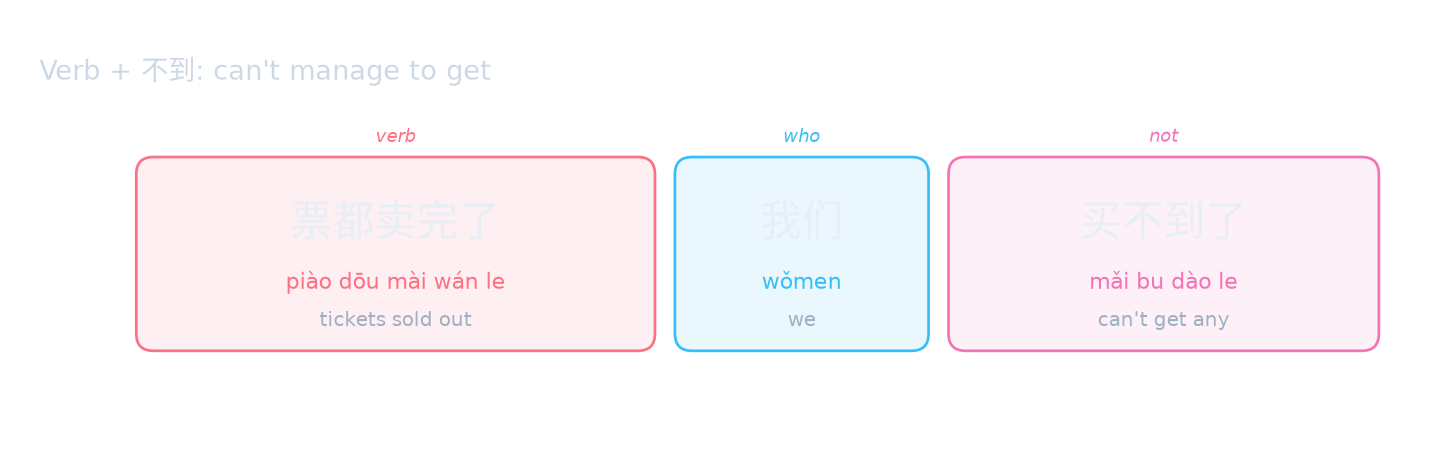
- Intentas reservar entradas para un concierto en línea, pero se agotan en minutos.
- ticket票all / both都to be sold out卖完(completed / change)了,we / us我们to buy买(cannot)不to / arrive到(completed / change)了。 — "Las entradas están agotadas; no podemos conseguir ninguna."
Verbo + (degree marker)得 / (cannot)不 + resultado / dirección
- Verbo + (degree marker)得 + complemento = poder; Verbo + (cannot)不 + complemento = no poder: to buy买to get得到 (poder comprar) / to buy买(cannot)不to / arrive到 (no poder comprar), lift拿(degree marker)得move动 (poder llevar) / lift拿motionless不动 (no poder llevar).
- Indica si el resultado es posible en la situación.
this这个box箱子too太heavy重,I我lift拿(cannot)不move动。
Complete: “The box is too heavy; I can't lift it.” 箱子太重了,我拿____动。
Dificultad 1/5 · 100 monedas + un pequeño bono en el primer intento de hoy
Verb + 不 + 动 = can't move it.
Pares comunes de HSK 4
- in time来得及 / there's not enough time来不及 = hay / no hay suficiente tiempo: now现在set off出发still还in time来得及. (Salir ahora aún da tiempo.)
- unbearable受不了 = no soportar; to listen to听(cannot)不distinct清楚 = no escuchar claramente; can't remember记不住 = no poder recordar.
now现在set off出发still还in time来得及。
Match each form to its meaning.
Dificultad 2/5 · 140 monedas + un pequeño bono en el primer intento de hoy
Verb + 不 + complement = the result can't be achieved.
No lo mismo que cannot不能
- cannot不能 se refiere a permiso o capacidad general: here这里cannot不能to pull up (stop one's…停车. Los complementos de potencial indican si el resultado puede alcanzarse: I我unable to make sense of…听不懂.
- Coloca el objeto después del complemento o antes como tema: I我unable to make sense of…听不懂he / him他if (coming after a…的话 / he / him他if (coming after a…的话I我unable to make sense of…听不懂.
A sign forbids parking. Which fits? 这里____停车。
Dificultad 1/5 · 100 monedas + un pequeño bono en el primer intento de hoy
Prohibition is 不能 (a formal sign may also write 不得); potential complements are about whether a result is achievable, and 不了 cannot stand before a verb.
can't不了 = no poder (para nada)
- Verbo + can't不了 (liǎo) = incapaz de hacerlo: I我go去can't不了 — "No puedo ir." to eat吃can't不了 — "No puedo terminar de comer."
- Positivo: go去(degree marker)得(completed / change)了 — "poder ir".
tomorrow明天I我go去can't不了。
Build: “I've got something on tomorrow; I can't make it.”
Dificultad 3/5 · 200 monedas + un pequeño bono en el primer intento de hoy
Verb + 不了 = unable to.
Resumen
- Verbo + (degree marker)得/(cannot)不 + complemento = poder / no poder lograrlo (to buy买(cannot)不to / arrive到, lift拿motionless不动, in time来得及).
- Verbo + can't不了 = incapaz de; cannot不能 = no permitido / generalmente no poder.
Lee la referencia completa: Gramática HSK 4 — Complementos.
You try to book concert tickets online, but they are gone in minutes. Close the examples. Say a Mandarin response, then write it in Chinese. Explain briefly in English what the lesson’s pattern adds. Compare with the model, then change one detail and try again.
This is supported productive practice. Compare meaning and structure; your answer need not copy the model. A partner or teacher must hear the spoken response to comment on pronunciation.