Verb + get up / (start, become)起来 (in terms of doing it)
Form: thing + verb + get up / (start, become)起来 + comment
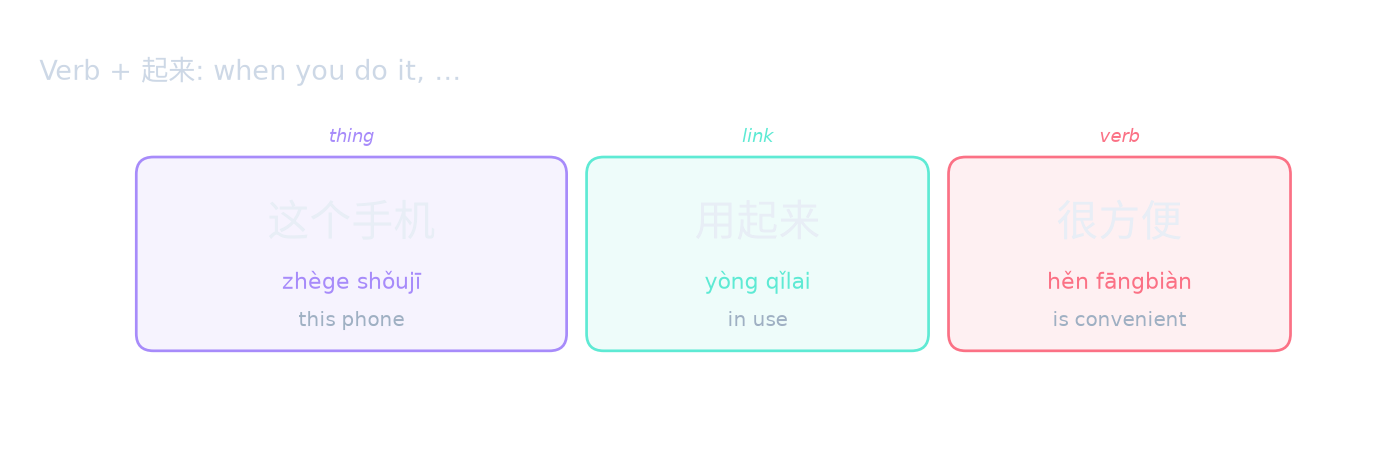
- this这个mobile phone手机to use / with用get up / (start, become)起来degree / adjective linker很convenient方便。 Zhège shǒujī yòng qǐlai hěn fāngbiàn. – This phone is very convenient to use.
- this这个dish (of food); vegetable菜to eat吃get up / (start, become)起来slightly有点儿spicy辣。 – This dish tastes a bit spicy.
- this这首歌to listen to听get up / (start, become)起来degree / adjective linker很to be familiar with熟悉。 – This song sounds familiar.
- to speak说get up / (start, become)起来easy容易,to do; to make做get up / (start, become)起来difficult / hard难。 – Easier said than done.
How it works. Verb + get up / (start, become)起来 + comment judges what it is like to do something. Put the thing you judge first.
Three uses of get up / (start, become)起来.
| Use | Example |
|---|---|
| judging the experience | this这个包背get up / (start, become)起来degree / adjective linker很comfortable舒服 |
| starting an action | everyone大家all / both都to laugh笑get up / (start, become)起来(completed / change)了 |
| upward movement | to stand站get up / (start, become)起来 |
The comment after it tells you it is a judgement.
Watch out
- wrong: to read (aloud); to study读get up / (start, become)起来this这本书degree / adjective linker很interesting有意思 → this这本书to read (aloud); to study读get up / (start, become)起来degree / adjective linker很interesting有意思.
Direction complement to come来 / to go去 (HSK 4)
Form: verb + up / on / last; to get on, attend上 / down / next; to fall (rain), get off下 / to enter; to come in进 / out / to happen出 / to return / (times)回 / (experienced)过 / to rise / (start to)起 + to come来 / to go去
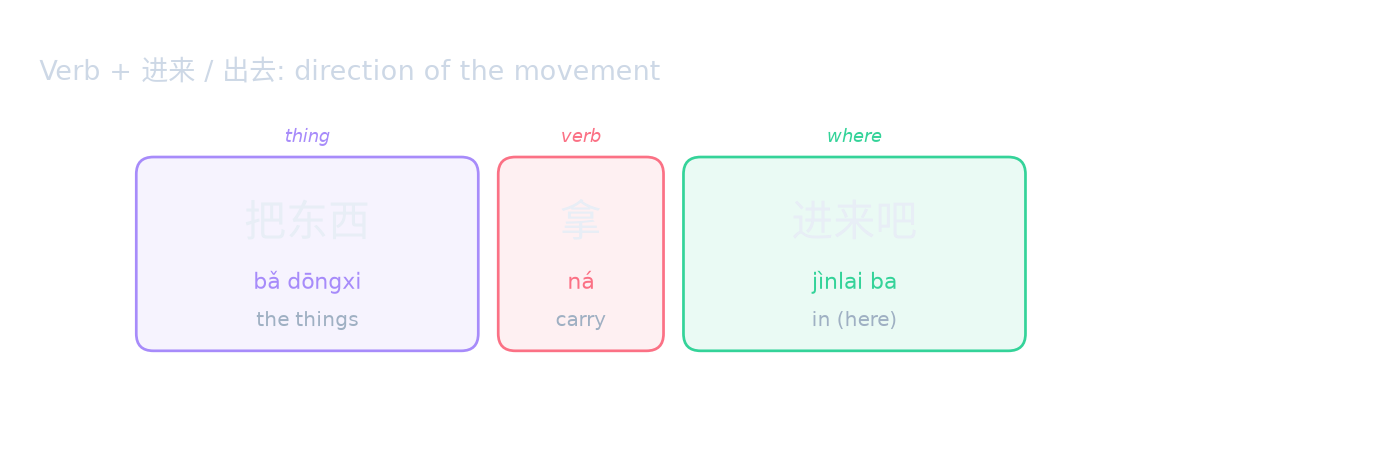
- (把: marks the object)把thing; stuff东西to take拿to come in进来(suggestion)吧。 Bǎ dōngxi ná jìnlai ba. – Bring the things in.
- he / him他to enter走进classroom教室to come来(completed / change)了。 Tā zǒujìn jiàoshì lái le. – He walked into the classroom.
- he / him他to take out拿出one / a一本书to come来。 – He took a book out.
- I / me我want / think / miss想get up / (start, become)起来(completed / change)了! – I've remembered!
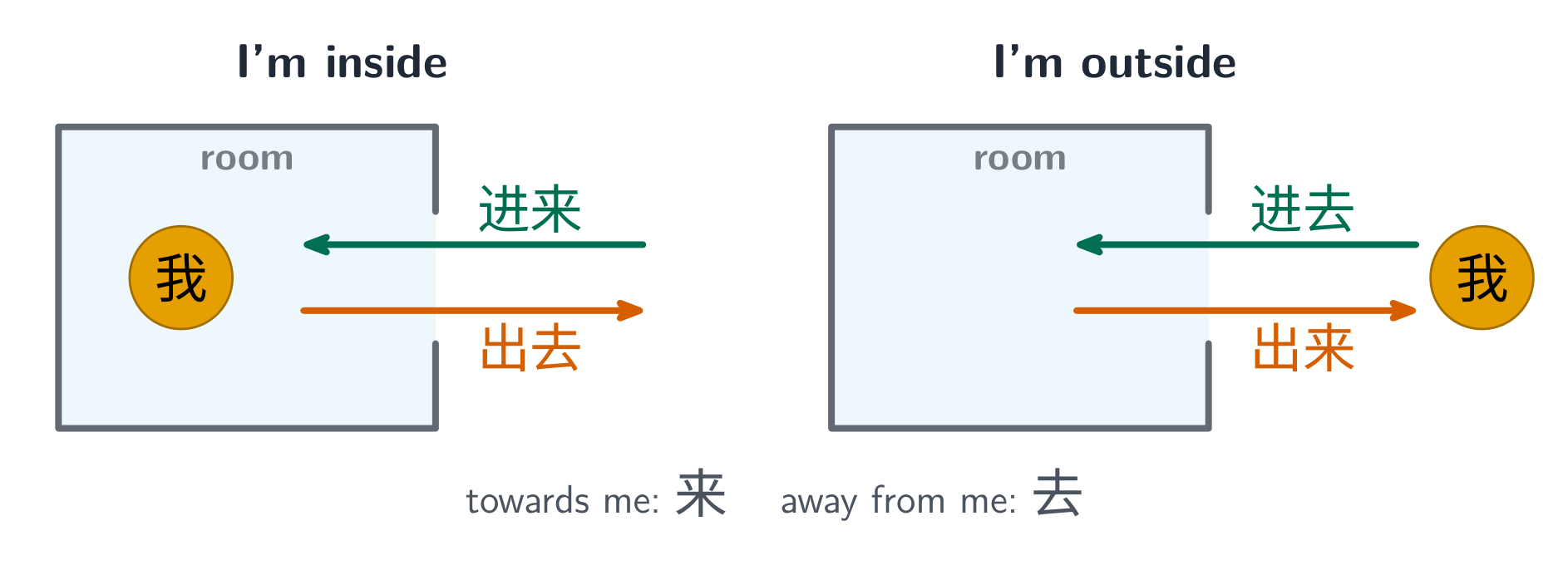
How it works. The direction word shows the path; to come来 / to go去 shows whether it moves towards the speaker (to come来) or away (to go去). If you are inside, a friend to come in进来; if you are outside, they to go in进去.
Places and things.
| Item | Position | Example |
|---|---|---|
| a place | before to come来 / to go去 | to enter走进classroom教室to come来 |
| a thing | before to come来 / to go去, or after the whole complement | to take out拿出one / a一本书to come来 / to take拿come out / (result: see, think up)出来one / a一本书 |
Abstract meanings. want / think / miss想get up / (start, become)起来 = remember; to look at; to watch; to read看come out / (result: see, think up)出来 = notice, tell: I / me我to look at; to watch; to read看come out / (result: see, think up)出来he / him他not不happy; glad高兴.
Watch out
- A place never follows to come来 / to go去: wrong: to enter走进to come来classroom教室 → to enter走进classroom教室to come来.
Verb / Adj + get up / (start, become)起来 (start to …)
Form: verb / adjective + get up / (start, become)起来 · verb + to rise / (start to)起 + object + to come来
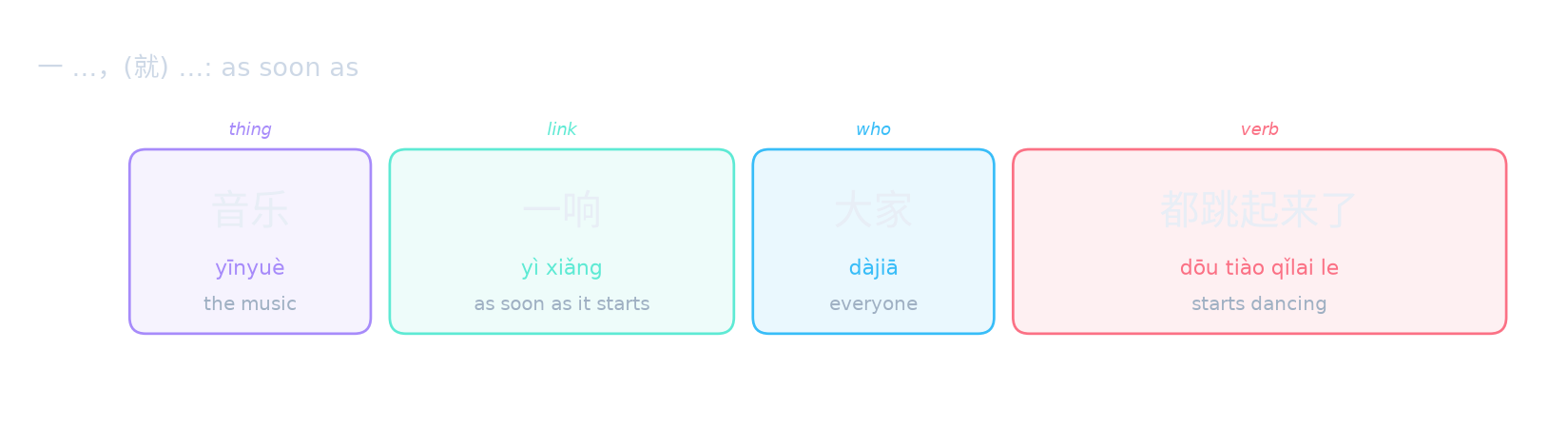
- music音乐一响,everyone大家all / both都to jump跳get up / (start, become)起来(completed / change)了。 Yīnyuè yì xiǎng, dàjiā dōu tiào qǐlai le. – As soon as the music played, everyone started dancing.
- darling宝宝suddenly突然to cry哭get up / (start, become)起来(completed / change)了。 – The baby suddenly started crying.
- down / next; to fall (rain), get off下起雪来(completed / change)了。 Xià qǐ xuě lái le. – It started to snow.
- weather天气hot热get up / (start, become)起来(completed / change)了。 – It's getting hot.
How it works. After a verb, get up / (start, become)起来 means an action starts and goes on: to laugh笑get up / (start, become)起来, 聊起来. After an adjective, it means a state begins to develop, usually towards "more": hot热get up / (start, become)起来, good好get up / (start, become)起来, fat胖get up / (start, become)起来. (Getting cooler is often 冷下来 / to let sth cool down凉come down / (write down, stop)下来.) An object goes between to rise / (start to)起 and to come来: down / next; to fall (rain), get off下to rise / (start to)起雨来, 唱起歌to come来.
| get up / (start, become)起来 | go down / (keep on)下去 |
|---|---|
| start something new | continue something already going |
| they他们聊起来(completed / change)了 | please; to invite请to speak说go down / (keep on)下去 |
Watch out
- wrong: down / next; to fall (rain), get off下get up / (start, become)起来rain雨 → down / next; to fall (rain), get off下to rise / (start to)起雨来.
Potential complement (degree marker)得 / not不 (HSK 4)
Form: verb + (degree marker)得 / not不 + result or direction · verb + (degree marker)得(completed / change)了 / (as a resultative verb…不了 (liǎo)
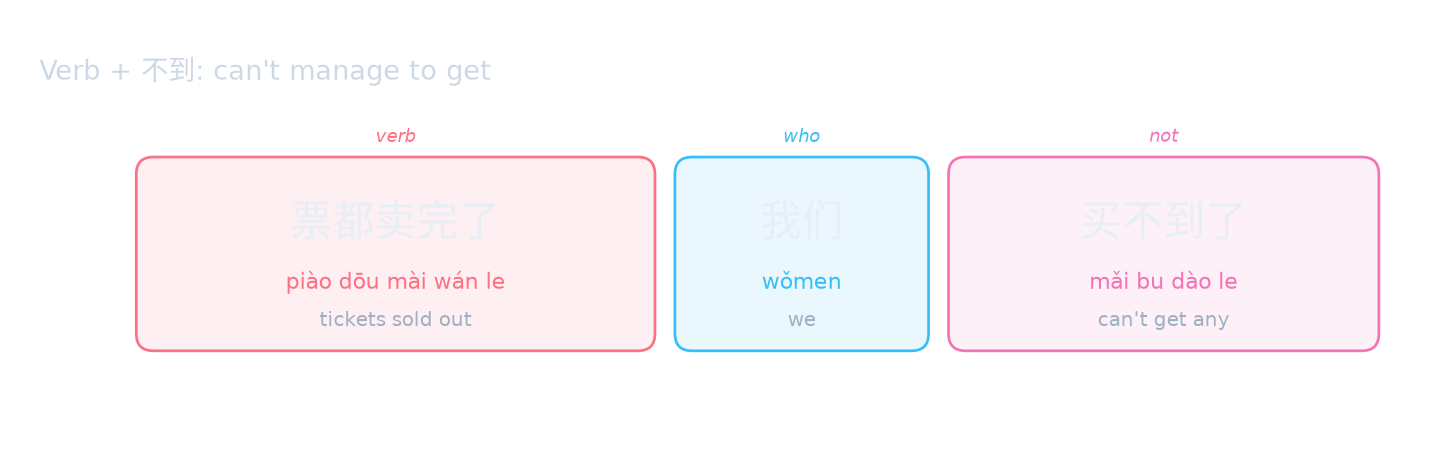
- ticket票all / both都to be sold out卖完(completed / change)了,we / us我们买不到(completed / change)了。 Piào dōu màiwán le, wǒmen mǎi bu dào le. – The tickets are sold out; we can't get any.
- suitcase箱子太重(completed / change)了,I / me我to take拿not move不动。 – The box is too heavy; I can't lift it.
- now现在to set off出发still / also / even还to have enough time来得及。 – If we leave now, there's still time.
- I / me我tomorrow明天to be occupied with sth有事,to go去(as a resultative verb…不了。 – I've got something on tomorrow; I can't make it.
How it works. (degree marker)得 or not不 between a verb and its complement says whether the result can be achieved in the situation.
| Form | Meaning |
|---|---|
| to buy买to get得到 / 买不到 | can / can't get hold of |
| 拿得动 / to take拿not move不动 | can / can't lift |
| to have enough time来得及 / there's not enough time来不及 | there is / isn't time |
| can't stand受不了 | can't stand it |
| to listen to听not不distinct清楚 | can't hear clearly |
| can't remember记不住 | can't remember |
| to go去(degree marker)得(completed / change)了 / to go去(as a resultative verb…不了 | able / unable to go |
The object goes after the complement, or first as the topic: I / me我unable to make sense of…听不懂he / him他if (coming after a…的话 / he / him他if (coming after a…的话I / me我unable to make sense of…听不懂.
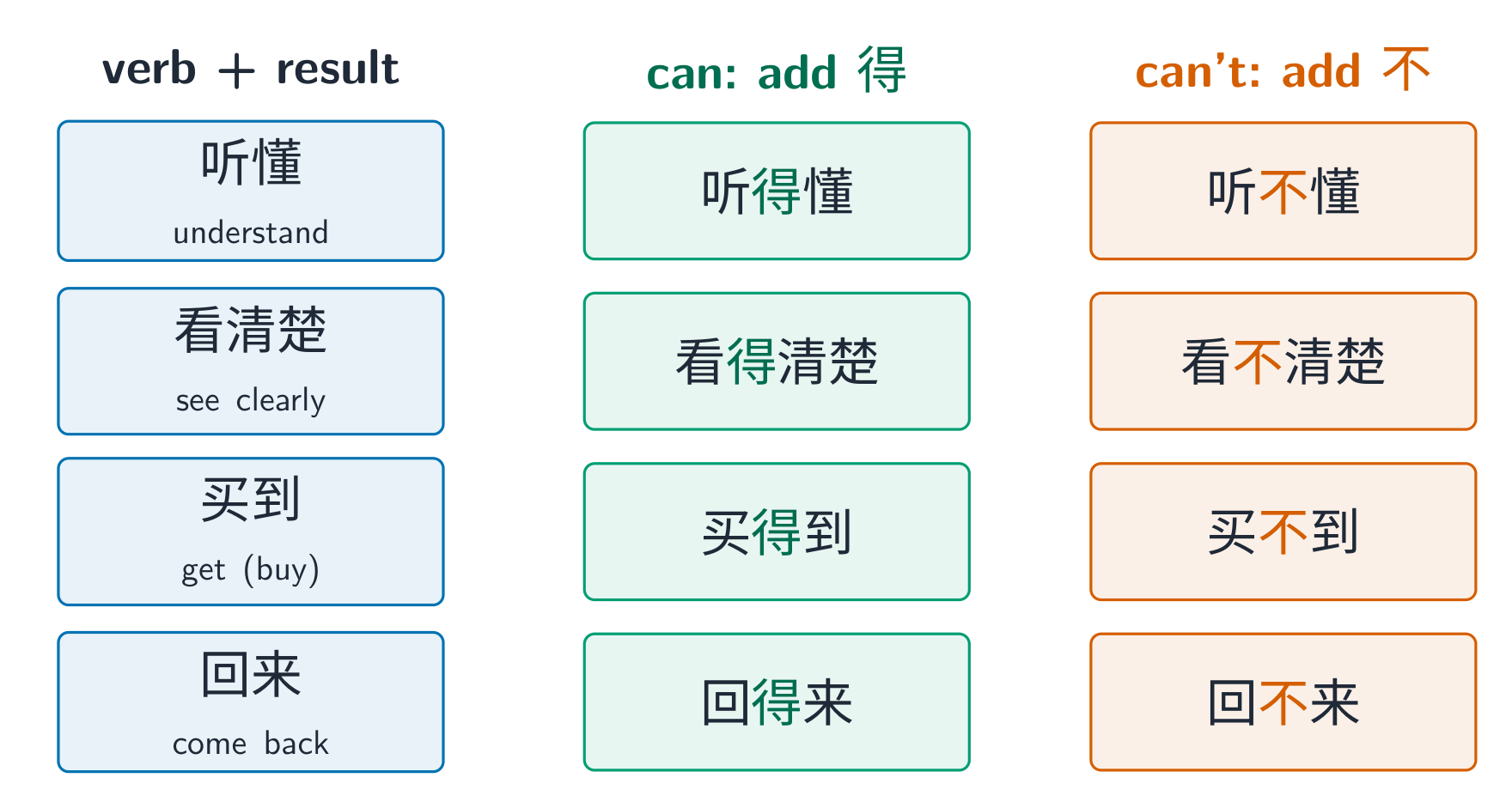
Build it from a result. Start from verb + result and put (degree marker)得 (can) or not不 (can't) in the middle:
| verb + result | can | can't |
|---|---|---|
| to understand (on hearing)听懂 understand | to understand (by hearing)听得懂 | unable to make sense of…听不懂 |
| 看清楚 see clearly | to look at; to watch; to read看(degree marker)得distinct清楚 | 看不清楚 |
| to buy买to / arrive / (result: get)到 get (buy) | to buy买to get得到 | 买不到 |
| to return回来 come back | 回得来 | 回不来 |
not / haven't没to understand (on hearing)听懂 vs unable to make sense of…听不懂. not / haven't没to understand (on hearing)听懂 = didn't understand (this time); unable to make sense of…听不懂 = can't understand (beyond you). Answer a question with the complement itself: you你to understand (by hearing)听得懂(yes/no ?)吗?— to understand (by hearing)听得懂。 / unable to make sense of…听不懂。
Watch out
- Permission and rules take cannot不能, not a complement: here这里cannot不能to pull up (stop one's…停车.
Practice without the models
Cover the teaching sections before you answer. The answers follow.
Verb + get up / (start, become)起来 (in terms of doing it)
1. Complete: “This method sounds simple but is hard to do.” this这个method方法to listen to听…………simple简单,to do; to make做get up / (start, become)起来difficult / hard难。
2. Match each sentence to the use of get up / (start, become)起来.
-
(1) this这个包背get up / (start, become)起来degree / adjective linker很comfortable舒服。
-
(2) everyone大家all / both都to laugh笑get up / (start, become)起来(completed / change)了。
-
(3) please; to invite请to stand站get up / (start, become)起来。
-
A. judging the experience
-
B. upward movement
-
C. starting an action
3. Build: “This song sounds familiar.”
Put in order: this这首歌 / degree / adjective linker很to be familiar with熟悉。 / to listen to听get up / (start, become)起来
4. True or false? to speak说get up / (start, become)起来easy容易,to do; to make做get up / (start, become)起来difficult / hard难 means “easier said than done”. If false, correct it.
5. A friend asks what you think of your new phone after a week. Use Verb + get up / (start, become)起来. Write your answer in Chinese, then say it aloud.
Direction complement to come来 / to go去 (HSK 4)
6. You are in the classroom. Your classmate is at the door. What do you say?
- A. 快进去(suggestion)吧!
- B. 快进来(suggestion)吧!
7. You are waiting outside the shop for your friend. You phone them – "Come out, I'm at the door!"
- A. you你to go out出去(suggestion)吧,I / me我at / in在doorway门口!
- B. you你come out / (result: see, think up)出来(suggestion)吧,I / me我at / in在doorway门口!
8. You are inside. Ask a friend: “Bring the chairs in.” (把: marks the object)把chair椅子搬进…………(suggestion)吧。
9. Which sentence is correct?
- A. he / him他to enter走进to come来classroom教室(completed / change)了。
- B. he / him他to come in进来to walk / to leave走classroom教室(completed / change)了。
- C. he / him他to walk / to leave走classroom教室to come in进来(completed / change)了。
- D. he / him他to enter走进classroom教室to come来(completed / change)了。
10. Build: “He took a book out.”
Put in order: to come来。 / one / a一本书 / to take out拿出 / he / him他
11. True or false? I / me我to look at; to watch; to read看come out / (result: see, think up)出来he / him他not不happy; glad高兴 means “I could tell he was unhappy.” If false, correct it.
12. You ask your brother to carry the shopping bags from the car into the kitchen. Use Direction complement to come来 / to go去. Write your answer in Chinese, then say it aloud.
Verb / Adj + get up / (start, become)起来 (start to …)
13. Complete: “The baby suddenly started crying.” darling宝宝suddenly突然to cry哭…………(completed / change)了。
14. Which says “It started to snow”?
- A. 雪下to rise / (start to)起(completed / change)了to come来。
- B. down / next; to fall (rain), get off下起雪来(completed / change)了。
- C. down / next; to fall (rain), get off下get up / (start, become)起来snow雪(completed / change)了。
- D. get up / (start, become)起来to snow下雪(completed / change)了。
15. Build: “They started singing.”
Put in order: 唱起 / to come来(completed / change)了。 / they他们 / song歌
16. True or false? please; to invite请to speak说go down / (keep on)下去 asks someone to start speaking. If false, correct it.
17. At a party, the band plays a favourite song and the room comes alive. Use Verb / Adj + get up / (start, become)起来. Write your answer in Chinese, then say it aloud.
Potential complement (degree marker)得 / not不 (HSK 4)
18. From 看清楚, build “can't see clearly”: …………
19. From to return回来, build “can come back”: he / him他七点before以前…………(yes/no ?)吗?
20. The film was in English and you understood almost nothing – your English is only basic. Which fits best?
- A. this这个film; movie电影I / me我to understand (by hearing)听得懂。
- B. this这个film; movie电影I / me我not / haven't没to listen to听。
- C. this这个film; movie电影I / me我unable to make sense of…听不懂。
21. You missed one sentence because a bus went past. “Sorry, I didn't catch that – say it again?”
- A. I'm sorry对不起,I / me我not / haven't没to listen to听distinct清楚,you你talk later / besides再说one time (all the way…一遍?
- B. I'm sorry对不起,I / me我to listen to听not不distinct清楚,you你talk later / besides再说one time (all the way…一遍?
22. you你can see看得见blackboard黑板up / on / last; to get on, attend上(modifier / structural particle)的Chinese character字(yes/no ?)吗? You can see them. What do you answer?
- A. to be / is是。
- B. can see看得见。
23. Complete: “The box is too heavy; I can't lift it.” suitcase箱子太重(completed / change)了,I / me我to take拿…………(of sth) to move动。
24. A sign forbids parking. Which fits? here这里____to pull up (stop one's…停车。
- A. cannot不能
- B. (as a resultative verb…不了
- C. to stop停not reach / less than不到
- D. to stop停(as a resultative verb…不了
25. Match each form to its meaning.
-
(1) there's not enough time来不及
-
(2) can't stand受不了
-
(3) can't remember记不住
-
(4) 买不到
-
A. not enough time
-
B. can't remember
-
C. can't stand it
-
D. can't get hold of
26. Build: “I've got something on tomorrow; I can't make it.”
Put in order: (as a resultative verb…不了。 / I / me我tomorrow明天 / ,to go去 / to be occupied with sth有事
27. You try to book concert tickets online, but they are gone in minutes. Use Potential complement (degree marker)得 / not不. Write your answer in Chinese, then say it aloud.
Answers and explanations
Verb + get up / (start, become)起来 (in terms of doing it)
1. get up / (start, become)起来
Verb + get up / (start, become)起来 + comment.
2. (1) A: this这个包背get up / (start, become)起来degree / adjective linker很comfortable舒服。 = judging the experience; (2) C: everyone大家all / both都to laugh笑get up / (start, become)起来(completed / change)了。 = starting an action; (3) B: please; to invite请to stand站get up / (start, become)起来。 = upward movement
The comment and the verb tell you which use it is.
3. this这首歌to listen to听get up / (start, become)起来degree / adjective linker很to be familiar with熟悉。
Thing + Verb + get up / (start, become)起来 + comment.
4. True.
It judges saying versus doing.
5. Model answer: this这个mobile phone手机to use / with用get up / (start, become)起来degree / adjective linker很convenient方便。
Check your answer:
- Put what you are judging first: this这本书to read (aloud); to study读get up / (start, become)起来degree / adjective linker很interesting有意思, not to read (aloud); to study读get up / (start, become)起来this这本书degree / adjective linker很interesting有意思 in most speech.
- get up / (start, become)起来 here does not mean "get up" or "start"; it marks the experience of doing.
Direction complement to come来 / to go去 (HSK 4)
6. B. 快进来(suggestion)吧!
You are inside, so moving towards you – to come in进来.
7. B. you你come out / (result: see, think up)出来(suggestion)吧,I / me我at / in在doorway门口!
You are outside; coming out moves towards you – come out / (result: see, think up)出来.
8. to come来
Towards the speaker: to come in进来.
9. D. he / him他to enter走进classroom教室to come来(completed / change)了。
he / him他to enter走进classroom教室to come来(completed / change)了 is right: with a place word, the place goes between to enter; to come in进 and to come来 (to enter走进 + classroom教室 + to come来).
10. he / him他to take out拿出one / a一本书to come来。
Verb + out / to happen出 + object + to come来.
11. True.
True. to look at; to watch; to read看come out / (result: see, think up)出来 means “can tell, make out” from what you see: I / me我to look at; to watch; to read看come out / (result: see, think up)出来he / him他not不happy; glad高兴 “I could tell he was unhappy.”
12. Model answer: (把: marks the object)把thing; stuff东西to take拿to come in进来(suggestion)吧。
Check your answer:
- to enter走进classroom教室to come来, not to enter走进to come来classroom教室: a place never follows to come来 / to go去.
- Pick to come来 or to go去 by where the speaker is: inside the room → to come in进来; outside → to go in进去.
Verb / Adj + get up / (start, become)起来 (start to …)
13. get up / (start, become)起来
Verb + get up / (start, become)起来 = start to.
14. B. down / next; to fall (rain), get off下起雪来(completed / change)了。
The object goes between to rise / (start to)起 and to come来.
15. they他们唱起歌to come来(completed / change)了。
Verb + to rise / (start to)起 + object + to come来.
16. False.
go down / (keep on)下去 = continue; starting is get up / (start, become)起来.
17. Model answer: music音乐一响,everyone大家all / both都to jump跳get up / (start, become)起来(completed / change)了。
Check your answer:
- down / next; to fall (rain), get off下to rise / (start to)起雨来, not down / next; to fall (rain), get off下get up / (start, become)起来rain雨: the object sits between to rise / (start to)起 and to come来.
- Adj + get up / (start, become)起来 usually describes a change towards more: hot热get up / (start, become)起来, good好get up / (start, become)起来; "getting cold" is often 冷下来 / to let sth cool down凉come down / (write down, stop)下来.
Potential complement (degree marker)得 / not不 (HSK 4)
18. 看不清楚
Put not不 between the verb and the result – 看不清楚.
19. 回得来
Put (degree marker)得 in the middle – 回得来.
20. C. this这个film; movie电影I / me我unable to make sense of…听不懂。
Can't understand (it's beyond your level) – unable to make sense of…听不懂.
21. A. I'm sorry对不起,I / me我not / haven't没to listen to听distinct清楚,you你talk later / besides再说one time (all the way…一遍?
One time, a result that didn't happen – not / haven't没to listen to听distinct清楚. to listen to听not不distinct清楚 suggests you can't hear clearly in general (for example, the line is always bad).
22. B. can see看得见。
Repeat the complement – can see看得见. to be / is是 alone does not answer this question.
23. not不
Verb + not不 + (of sth) to move动 = can't move it.
24. A. cannot不能
Prohibition is cannot不能 (a formal sign may also write must not不得); potential complements are about whether a result is achievable, and (as a resultative verb…不了 cannot stand before a verb.
25. (1) A: there's not enough time来不及 = not enough time; (2) C: can't stand受不了 = can't stand it; (3) B: can't remember记不住 = can't remember; (4) D: 买不到 = can't get hold of
Verb + not不 + complement = the result can't be achieved.
26. I / me我tomorrow明天to be occupied with sth有事,to go去(as a resultative verb…不了。
Verb + (as a resultative verb…不了 = unable to.
27. Model answer: ticket票all / both都to be sold out卖完(completed / change)了,we / us我们买不到(completed / change)了。
Check your answer:
- cannot不能 is about permission or general ability: here这里cannot不能to pull up (stop one's…停车 ("You can't park here"). Potential complements are about whether the result can be achieved: I / me我unable to make sense of…听不懂.
- Put the object after the complement or before as a topic: I / me我unable to make sense of…听不懂he / him他if (coming after a…的话 / he / him他if (coming after a…的话I / me我unable to make sense of…听不懂 – "I can't understand what he's saying."