Tu plan de aprendizaje · Continuar · Revisar →
Verbo + 着 (estado continuo)
IntroducidoTu posición guardada se conserva en este navegador. Continuar no completa la lección ni responde sus preguntas.
La puerta está abierta
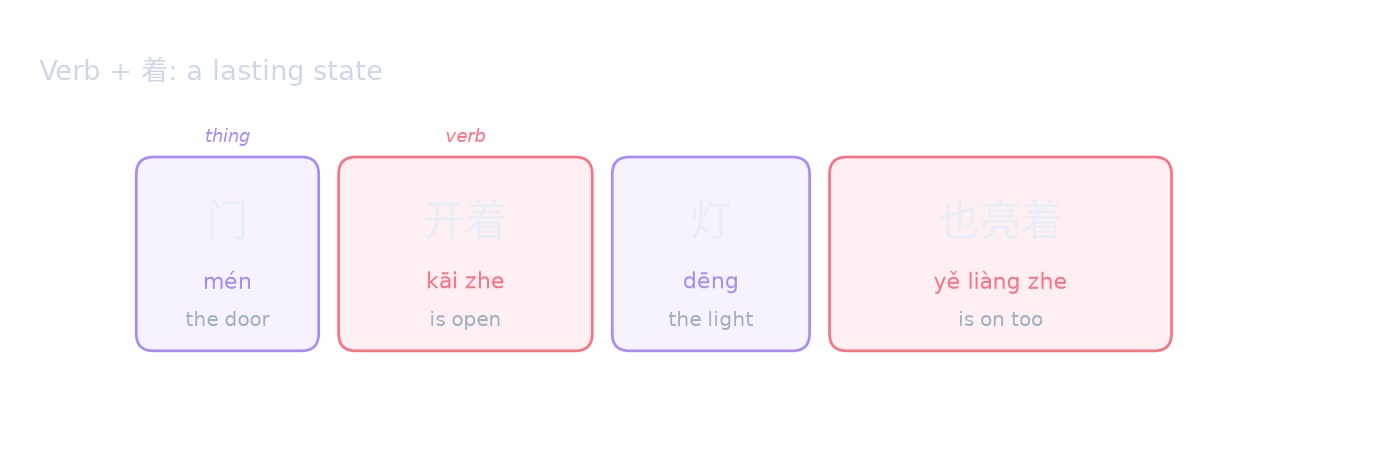
- Llegas a casa y notas la puerta abierta y las luces encendidas.
- 门开(ongoing)着,lamp灯also也bright亮(ongoing)着。 — "La puerta está abierta y las luces también están encendidas." (ongoing)着 describe un estado que persiste.
Verbo + (ongoing)着 = un estado continuo
- Verbo + (ongoing)着 describe un estado duradero: to open; to drive开(ongoing)着 (está abierta), attire穿着 (lleva puesto), to sit坐(ongoing)着 (está sentado).
- Se niega con not / haven't没: door门not / haven't没to open; to drive开(ongoing)着 — "La puerta no está abierta."
she她wear穿(ongoing)着a一(measure word)件red红top衣服。
Complete: “The window is open.” 窗户开____。
Dificultad 1/5 · 100 monedas + un pequeño bono en el primer intento de hoy
Verb + 着 describes the continuing state.
Hacer una cosa mientras se está en un estado
- Verbo1 + (ongoing)着 + Verbo2: el primer estado continúa mientras ocurre la segunda acción: he他smile笑(ongoing)着say说:"it doesn't matter没关系。" — "Dijo sonriendo: 'No pasa nada.'"
- we / us我们to sit坐(ongoing)着to chat聊天。 — "Nos sentamos a charlar."
he他smile笑(while)着say说:it doesn't matter没关系。
Build: “He said with a smile...”
Dificultad 3/5 · 200 monedas + un pequeño bono en el primer intento de hoy
V1 + 着 + V2.
Estado, no progreso
- (ongoing)着 describe un estado; para una acción en progreso, use (in progress)在: he他(in progress)在to open a door (lit. and…开门 (él está abriendo la puerta) vs 门开(ongoing)着 (la puerta está abierta).
- Se niega con not / haven't没, no con not不: lamp灯not / haven't没bright亮(ongoing)着.
Which says “He is opening the door” (the action in progress)?
Dificultad 1/5 · 100 monedas + un pequeño bono en el primer intento de hoy
An action in progress takes 在 + Verb; 门开着 is the state.
The negative of 门开着 is 门不开着.
Dificultad 1/5 · 100 monedas + un pequeño bono en el primer intento de hoy
着 is negated with 没: 门没开着.
(ongoing)着 frente a (in progress)在
- (in progress)在 + Verbo = en medio de hacer: he他(in progress)在wear穿top衣服 — "Se está vistiendo."
- Verbo + (ongoing)着 = el estado resultante: he他attire穿着a一(measure word)件白衬衫 — "Lleva puesta una camisa blanca."
he他(in progress)在put on穿clothes衣服。
Resumen
- Verbo + (ongoing)着 = un estado continuo (门开(ongoing)着); V1(ongoing)着 + V2 = realizar V2 mientras se está en el estado V1.
- (in progress)在 + Verbo = acción en progreso. Se niega (ongoing)着 con not / haven't没.
Lee la referencia completa: Gramática HSK 3 — Partículas.
You come home and notice the door open and the lights on. Close the examples. Say a Mandarin response, then write it in Chinese. Explain briefly in English what the lesson’s pattern adds. Compare with the model, then change one detail and try again.
This is supported productive practice. Compare meaning and structure; your answer need not copy the model. A partner or teacher must hear the spoken response to comment on pronunciation.