Study strategies, CV and statement
Introducido| English | Significado |
|---|---|
| active recall/ˈæktɪv ˈriːkɔːl/ | recuperación activa |
| spaced practice/speɪst ˈpræktɪs/ | reviewing material in several sessions spread out over time |
| Cornell method/kɔːˈnel ˈmeθəd/ | método Cornell |
Learning nonsense syllables, 1885
- In 1885 the German psychologist Hermann Ebbinghaus published experiments on himself. He learned lists of nonsense syllables such as "WID" and "ZOF", then measured how much he had forgotten. Much was lost within the first day, and forgetting then slowed — the "forgetting curve". Relearning was faster each time.
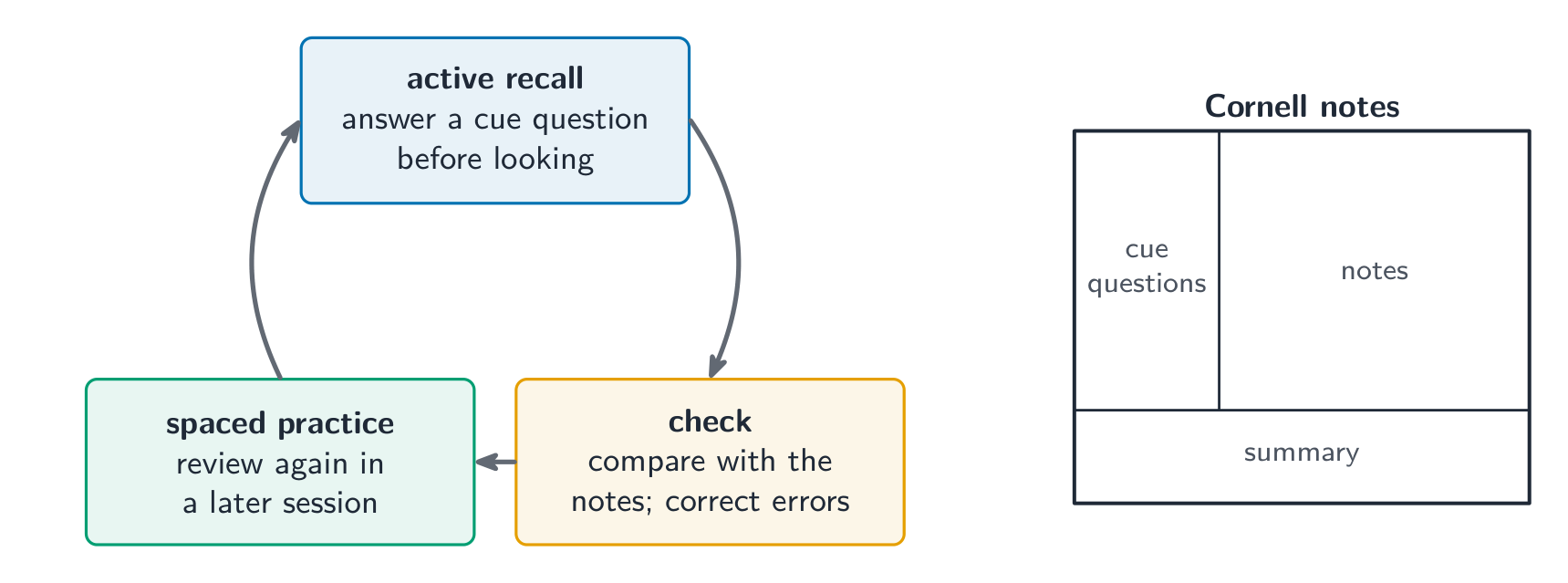
- Two methods use this: active recall 主动回忆 (testing yourself) and spaced practice 间隔练习 (returning after gaps).
What did Ebbinghaus find about forgetting?
Dificultad 1/5 · 100 monedas + un pequeño bono en el primer intento de hoy
The forgetting curve.
Active recall
- Close the book and write or say what you remember; then check. Recall strengthens memory more than rereading.
- Rereading feels easy because the page looks familiar, but familiarity is not the same as being able to produce the answer.
Which is active recall?
Dificultad 1/5 · 100 monedas + un pequeño bono en el primer intento de hoy
Producing the answer from memory.
Spaced practice
- Review after one day, then a few days, then a week. Each return comes just as the memory starts to fade.
- Several short sessions over days beat one long session the night before.
Three one-hour sessions over a week usually beat one three-hour session the night before.
Dificultad 1/5 · 100 monedas + un pequeño bono en el primer intento de hoy
Spaced practice.
The Cornell method
- The Cornell method 康奈尔笔记法, from Walter Pauk at Cornell University: divide the page into a wide notes column, a narrow cue column and a summary box at the bottom.
- After the lecture, write questions in the cue column; later cover the notes and answer them — recall built into your notes.
Match each part of a Cornell page to its use.
Dificultad 2/5 · 140 monedas + un pequeño bono en el primer intento de hoy
Three areas.
Worked example: a two-week plan for one topic
Topic: the water cycle, test in 14 days.
- Day 1: take Cornell notes; write 8 cue questions.
- Day 2: cover the notes, answer the cues, mark the gaps.
- Days 5, 9, 13: answer the cues again from memory; spend time only on the questions you missed.
Put the plan in order.
Dificultad 3/5 · 200 monedas + un pequeño bono en el primer intento de hoy
Notes, recall, space.
Mixing topics
- Interleaving — mixing problem types in one session — helps you learn to choose the right method, not just repeat one.
- It feels harder, and that difficulty is part of why it works.
Interleaving feels harder but helps you choose the right method.
Dificultad 1/5 · 100 monedas + un pequeño bono en el primer intento de hoy
Mixing types.
Highlighting and rereading are not revision on their own. They feel productive but test nothing. Turn every highlight into a question and answer it from memory.
Highlighting on its own tests your memory.
Dificultad 1/5 · 100 monedas + un pequeño bono en el primer intento de hoy
Turn it into questions.
Forgetting is fast at first. Test yourself, check, and return after growing gaps; build cue questions into Cornell notes and mix topics.
Rewrite this plan to use active recall and spacing - "I will read chapter 4 three times on Sunday."
Recall and spacing.