Memory and cognition
Introducido| English | Significado |
|---|---|
| encoding/enˈkəʊdɪŋ/ | codificación |
| storage/ˈstɔːrɪdʒ/ | almacenamiento |
| retrieval/rɪˈtriːvl/ | recuperación |
| cognition/kɒɡˈnɪʃn/ | cognición |
| multi-store model/ˈmʌlti stɔː ˈmɒdl/ | modelo de múltiples almacenes |
| working memory/ˈwɜːkɪŋ ˈmeməri/ | memoria de trabajo |
| heuristics/hjuːˈrɪstɪks/ | Heurísticas |
| biases/ˈbaɪəsɪz/ | Sesgos |
A man who could not form new memories, 1953
- In 1953 surgeons removed parts of both temporal lobes from Henry Molaison, known in research as "H.M.", to stop severe seizures. Afterwards he could hold a conversation, but minutes later he could not remember it. Yet he improved at a mirror-drawing task over several days without remembering having practised.
- H.M. showed that memory has different parts. Memory involves encoding 编码, storage 存储 and retrieval 提取 — all part of cognition 认知.
What could H.M. still learn after his operation?
Dificultad 1/5 · 100 monedas + un pequeño bono en el primer intento de hoy
A skill improved without memory of practising.
Put the memory processes in order.
Dificultad 3/5 · 200 monedas + un pequeño bono en el primer intento de hoy
In, kept, out.
The multi-store model
- Atkinson and Shiffrin's 1968 multi-store model 多重存储模型: information passes from sensory memory to short-term memory (with attention) and then to long-term memory (with rehearsal).
- H.M.'s short-term memory worked, but new information could not move into long-term memory.
In the multi-store model, what moves information from short-term to long-term memory?
Dificultad 1/5 · 100 monedas + un pequeño bono en el primer intento de hoy
Attention then rehearsal.
Working memory
- Baddeley and Hitch (1974) described short-term memory as working memory 工作记忆: a central executive controlling a phonological loop (sounds and words) and a visuo-spatial sketchpad (images and positions).
- Two tasks using the same part interfere — for example, reading while listening to speech.
Match each task to the working-memory part it uses most.
Dificultad 2/5 · 140 monedas + un pequeño bono en el primer intento de hoy
Sounds versus images.
Heuristics and biases
- Heuristics 启发式 are mental shortcuts. They are quick, but they can produce biases 偏差: systematic errors.
- The availability heuristic judges how common something is by how easily examples come to mind, so vivid stories feel more common than they are.
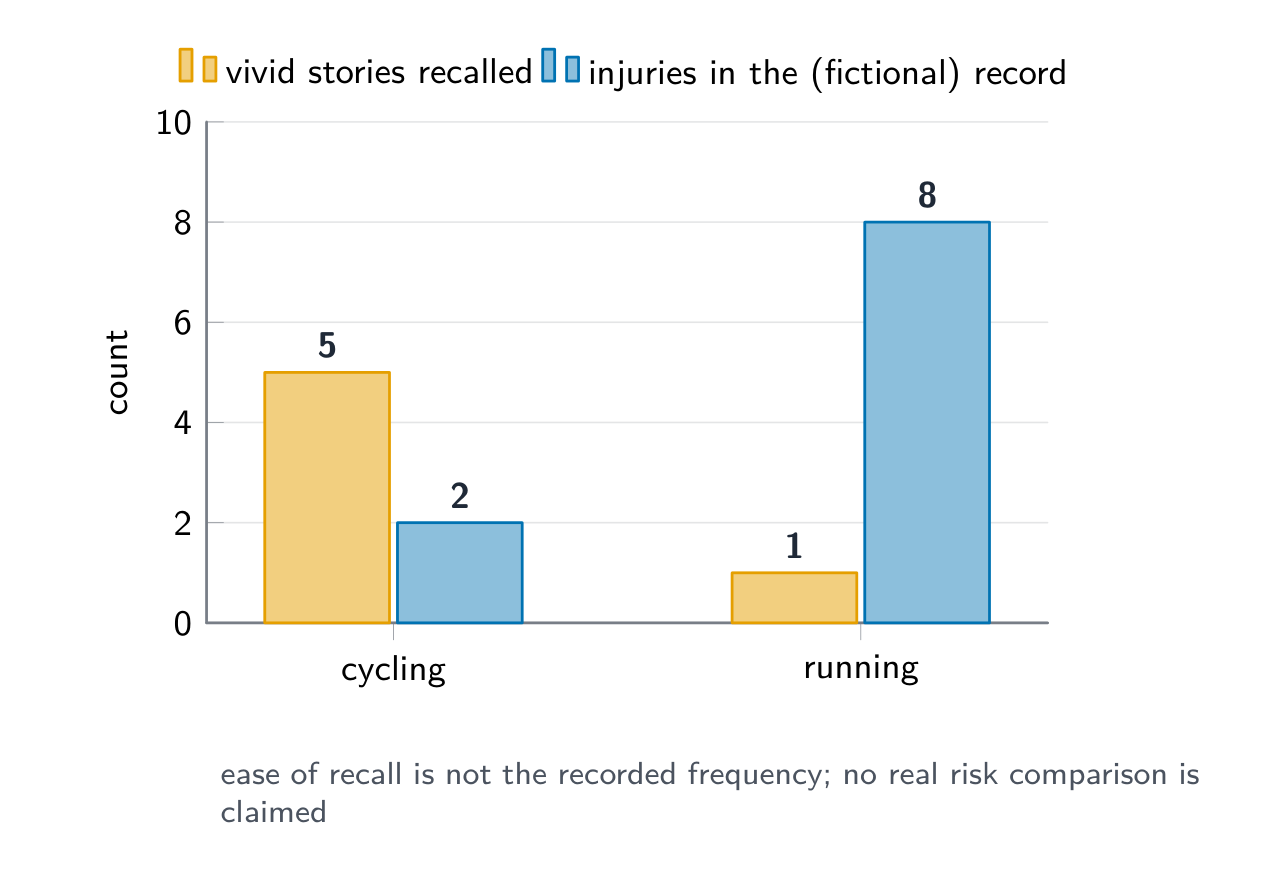
Someone thinks shark attacks are common after watching a film. Which heuristic?
Dificultad 1/5 · 100 monedas + un pequeño bono en el primer intento de hoy
Vivid examples come to mind easily.
Worked example: plane crashes or car crashes?
Many people feel flying is more dangerous than driving.
- Heuristic: a plane crash is reported worldwide for days, so examples are easy to recall (availability).
- Recorded counts: per kilometre travelled, deaths in cars are far higher than in commercial planes.
- Conclusion: check counts, not how vivid the memories feel.
Per kilometre travelled, cars cause more deaths than commercial planes.
Dificultad 1/5 · 100 monedas + un pequeño bono en el primer intento de hoy
Vivid reports mislead.
Improving memory
- Meaningful encoding (linking new ideas to what you know) and spaced retrieval practice both improve long-term recall.
- Rereading feels familiar but tests memory far less than recalling from a blank page.
Memory is not a video recording. Retrieval rebuilds a memory, and later information can change it. A confident memory can still be wrong.
A confident memory must be accurate.
Dificultad 1/5 · 100 monedas + un pequeño bono en el primer intento de hoy
Retrieval rebuilds memory.
Memory encodes, stores and retrieves. The multi-store model separates short- and long-term stores; working memory splits short-term memory into parts. Heuristics speed thinking but cause biases, so check recorded counts.
Give a revision plan for one topic that uses meaningful encoding and retrieval practice, in three or four sentences.
Encode, retrieve, space.