Sistemas de numeración
Introducido| English | Significado |
|---|---|
| binary/ˈbaɪnəri/ | binario |
| number base/ˈnʌmbə beɪs/ | base numérica |
| place value/pleɪs ˈvæljuː/ | valor posicional |
| hexadecimal/ˌheksəˈdesɪml/ | hexadecimal |
The same digits can name different values
- The numeral 10 is two in binary and ten in decimal. State the base before calculating.
- A positional number base 进制 b uses digits from zero to b minus one and powers of b as place weights. Binary 二进制 has only 0 and 1.
Multiply digits by their place weights
- Place value 位值 gives each digit its contribution. From right to left, binary weights are 1, 2, 4, 8 and so on.
- To convert a nonnegative value back, select its weights or use repeated division with remainders. Leading zeros preserve a chosen width without changing its unsigned value.
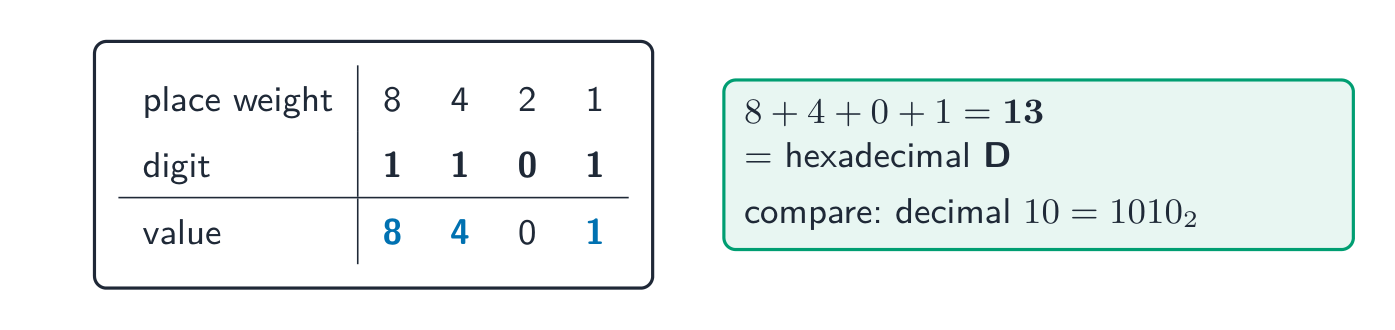
El mismo valor en tres bases
La posición es la única idea; la base solo cambia qué lugares representan.
Group four bits for a hexadecimal digit
- Hexadecimal 十六进制 uses sixteen digits: 0 to 9 then A to F. Each digit corresponds to four binary bits.
- Hexadecimal FF is decimal 255 and unsigned pattern 11111111. Its value depends on representation conventions; a signed eight-bit interpretation is a different task.
Convierte 1101 binario a decimal.
Dificultad 2/5 · 140 monedas + un pequeño bono en el primer intento de hoy
Posiciones 8, 4, 2, 1 con dígitos 1, 1, 0, 1 dan 8 + 4 + 0 + 1 = 13.
Escribe el decimal 10 en binario.
Dificultad 1/5 · 100 monedas + un pequeño bono en el primer intento de hoy
Se usan 8 y 2, no se usan 4 y 1. Escribir primero los valores de posición lo hace inmediato.
Read 1101 in binary. The weighted sum is $V=1(8)+1(4)+0(2)+1(1)=13$. Grouping those four bits gives hexadecimal D. Decimal 10 instead has binary pattern 1010.
¿Cuántos bits representa un dígito hexadecimal?
Dificultad 2/5 · 140 monedas + un pequeño bono en el primer intento de hoy
Dieciséis valores necesitan cuatro bits, por eso hex es una notación compacta para binario.
¿Cuál es el valor decimal sin signo de FF hexadecimal?
Dificultad 2/5 · 140 monedas + un pequeño bono en el primer intento de hoy
15 × 16 + 15 = 255, también representado por el patrón de ocho bits sin signo 11111111.
Distinguish a mathematical sum from stored bits. Eight unsigned bits allow zero to 255. Adding 10 to 250 gives mathematical sum 260; an explicitly specified eight-bit wraparound rule stores 4. Sheet 4.2 asks you to state the overflow and the rule.
Do not discard an extra carry silently. The question may request an unrestricted result, an overflow decision or a fixed-width stored pattern, and those are different answers.
Binario 10 tiene el valor diez.
Dificultad 1/5 · 100 monedas + un pequeño bono en el primer intento de hoy
Es dos. Lee los dígitos binarios uno por uno — "uno cero" — para nunca tratarlo como decimal por accidente.