The passive · La voz pasiva
When the action matters, not the doer
- The passive focuses on what happens to something, not on who does it.
- English is spoken here. The window was broken.
- The receiver of the action becomes the subject.
The cake was eaten; the suspect left crumbs.
Cuando importa la acción, no el agente
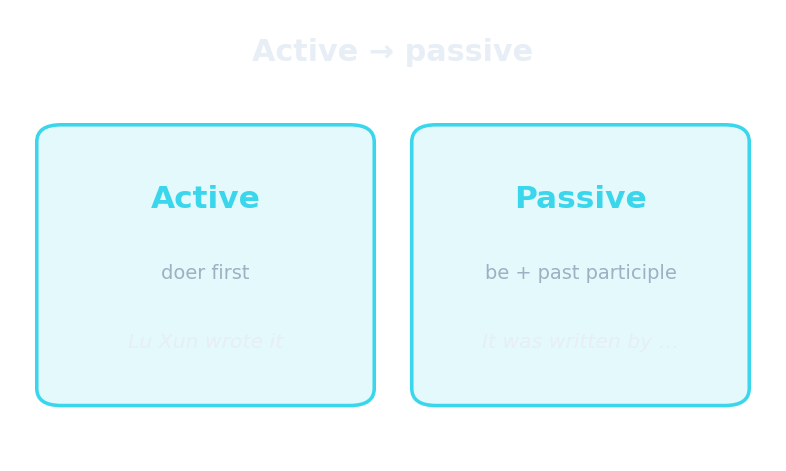
- La pasiva se centra en lo que le sucede a algo, no en quién lo hace.
- English is spoken here. The window was broken. (Aquí se habla inglés. La ventana fue rota.)
- El receptor de la acción se convierte en el sujeto.
The cake was eaten; the suspect left crumbs. (El pastel fue comido; el sospechoso dejó migas.)
Form: be + past participle
- be (in the right tense) + past participle.
- Present: is / are + p.p. → The cars are made here.
- Past: was / were + p.p. → The house was built in 1990.
Estructura: be + past participle
- be (en el tiempo verbal correcto) + past participle.
- Presente: is / are + p.p. → The cars are made here. (Los coches se fabrican aquí.)
- Pasado: was / were + p.p. → The house was built in 1990. (La casa fue construida en 1990.)
Turn active into passive · Transformar de activo a pasivo
The object moves to the front, and the verb becomes be + past participle. · El objeto se mueve al principio, y el verbo se convierte en be + participio pasado.
Make it passive: “People speak English here.” · Hazlo pasivo: “People speak English here.”
Passive = be + past participle: “English is spoken here.” · Pasivo = be + participio pasado: “English is spoken here.”
Complete: The window was ___ (break) yesterday. · Completa: The window was ___ (break) yesterday.
was + past participle: break → broken. · was + participio pasado: break → broken.
by + the doer
- Add by to say who did it — if it matters.
- This book was written by Lu Xun.
- If the doer is unknown or unimportant, leave it out.
by + the doer
- Añade by para indicar quién hizo la acción — si es relevante.
- This book was written by Lu Xun. (Este libro fue escrito por Lu Xun.)
- Si el agente es desconocido o irrelevante, omítelo.
Do we use “by” to say who did the action? · ¿Usamos “by” para decir quién realizó la acción?
Yes — “by + the doer”: “It was written by Lu Xun.” · Sí — “by + el agente”: “It was written by Lu Xun.”
Translate into English: 这本书是鲁迅写的。 · Traduce al inglés: 这本书是鲁迅写的。
Passive + by: “This book was written by Lu Xun.” · Pasivo + by: “This book was written by Lu Xun.”
When to use it
- The doer is unknown or unimportant: The road was repaired.
- You want to focus on the receiver: The painting was bought by a museum.
Cuándo usarla
- El agente es desconocido o irrelevante: The road was repaired. (Se reparó la carretera.)
- Quieres centrarte en el receptor: The painting was bought by a museum. (El cuadro fue comprado por un museo.)
Common mistakes
- ❌ The window was broke. → ✓ The window was broken. — the passive needs the participle.
- ❌ The accident was happened. → ✓ The accident happened. — happen has no passive.
- Remember: ✓ I was born in 2008. — always passive in English.
Errores comunes
- ❌ The window was broke. → ✓ The window was broken. — La pasiva requiere el participio.
- ❌ The accident was happened. → ✓ The accident happened. — happen no tiene forma pasiva.
- Recuerda: ✓ I was born in 2008. — siempre es pasiva en inglés.
Match the active sentence to its passive. · Une la oración activa con su versión pasiva.
The object moves to the front; be takes the tense; the verb becomes a participle. · El objeto se mueve al principio; be toma el tiempo verbal; el verbo se convierte en un participio.
Complete: This book was ___ by Lu Xun. (write) · Completa: This book was ___ by Lu Xun. (write)
write – wrote – written: the passive takes the third form. · write – wrote – written: el pasivo requiere la tercera forma.
- Passive = be + past participle (be carries the tense).
- Add by + the doer only if it matters.
- Use it when the doer is unknown/unimportant or to focus on the receiver.
- Pasiva = be + past participle (be lleva el tiempo verbal).
- Añade by + the doer solo si es relevante.
- Úsala cuando el agente sea desconocido/irrelevante o para centrarse en el receptor.
Write one passive sentence about something that is made, grown or built (for example: “Rice is grown in …”). · Escribe una oración pasiva sobre algo que se fabrica, cultiva o construye (por ejemplo: “Rice is grown in …”).
Example: “Tea is grown in many countries.” · Ejemplo: “Tea is grown in many countries.”