Reported speech · Discurso indirecto
Telling people what others said
- Reported speech tells what someone said — without quotation marks.
- Direct: "I am tired," he said.
- Reported: He said he was tired.
He said he was early. The clock reported a different story.
Decir lo que otros dijeron
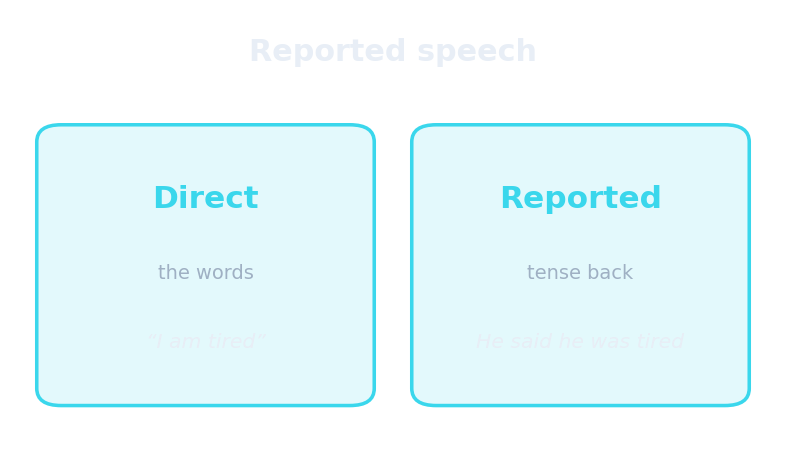
- El discurso indirecto indica lo que alguien dijo, sin usar comillas.
- Discurso directo: "Estoy cansado," dijo.
- Discurso indirecto: Dijo que estaba cansado.
Él dijo que llegó temprano. El reloj contaba una historia diferente.
say and tell
- say (that) … — no listener: She said she was busy.
- tell someone (that) … — with a listener: She told me she was busy.
- that can be left out.
say y tell
- say (that) … — sin oyente: Ella dijo que estaba ocupada.
- tell someone (that) … — con oyente: Ella me dijo que estaba ocupada.
- Se puede omitir el that.
Complete with say or tell: He ___ me that he was busy. · Completa con say o tell: He ___ me that he was busy.
“tell” takes a listener (me): “He told me …”. “say” does not. · “tell” lleva un oyente (me): “He told me …”. “say” no lo hace.
Tense backshift
- When the reporting verb is past (said, told), the tense moves back one step.
- am / is → was; are → were; will → would; can → could.
- present perfect / past simple → past perfect.
Retroceso de tiempos verbales
- Cuando el verbo introductorio está en pasado (said, told), el tiempo verbal se retrocede un paso.
- am / is → was; are → were; will → would; can → could.
- Present perfect / past simple → past perfect.
Direct → reported speech · Discurso directo → discurso indirecto
Shift the tense back, change the pronoun, and adjust time words. · Desplazar el tiempo verbal hacia atrás, cambiar los pronombres y ajustar las palabras de tiempo.
Report this: She said, “I will help you.” · Reporta esto: She said, “I will help you.”
After “said”, will moves back to would: “She said she would help me.” · Después de “said”, will se desplaza a would: “She said she would help me.”
Translate into English: 他说他累了。 · Traduce al inglés: 他说他累了。
Backshift after “said”: is → was: “He said he was tired.” · Desplazamiento temporal después de “said”: is → was: “He said he was tired.”
Pronouns and time words change
- I → he / she, you → me, my → his / her.
- now → then, today → that day, tomorrow → the next day.
Cambios en pronombres y palabras de tiempo
- I → he / she, you → me, my → his / her.
- now → then, today → that day, tomorrow → the next day.
In reported speech, does “tomorrow” often change to “the next day”? · En el discurso indirecto, ¿cambia frecuentemente “tomorrow” por “the next day”?
Yes — time words shift too: tomorrow → the next day, now → then. · Sí — las palabras de tiempo también se desplazan: tomorrow → the next day, now → then.
Common mistakes
- ❌ He said me that he was busy. → ✓ He told me… / He said… — tell takes a person, say doesn't.
- ❌ She asked me where did I live. → ✓ …where I lived. — statement order, no did.
- ❌ He said he will come tomorrow. → ✓ …he would come the next day.
Errores comunes
- ❌ He said me that he was busy. → ✓ Él me dijo… / Él dijo… — tell requiere una persona, say no.
- ❌ She asked me where did I live. → ✓ …donde yo vivía. — orden afirmativo, sin did.
- ❌ He said he will come tomorrow. → ✓ …él vendría al día siguiente.
Match the direct speech to its reported form. · Une el discurso directo con su forma indirecta.
Backshift: am → was, will → would, can → could. · Desplazamiento temporal: am → was, will → would, can → could.
Report the question: “Are you busy?” · Reporta la pregunta: “Are you busy?”
Yes/no questions report with if / whether + statement order. · Las preguntas de sí/no se reportan con if / whether + orden de afirmación.
- say (no listener) / tell + someone.
- Past reporting verb → backshift (is → was, will → would).
- Pronouns and time words change too (tomorrow → the next day).
- say (sin oyente) / tell + alguien.
- Verbo introductorio en pasado → retroceso (is → was, will → would).
- Los pronombres y las palabras de tiempo también cambian (tomorrow → the next day).
Think of something a friend said. Report it in one sentence using “said” or “told” (with backshift). · Piensa en algo que haya dicho un amigo. Repórtalo en una oración usando “said” o “told” (con desplazamiento temporal).
Example: “My friend told me she had passed the exam.” · Ejemplo: “My friend told me she had passed the exam.”