Advanced passive
IntroducedThe passive in any tense
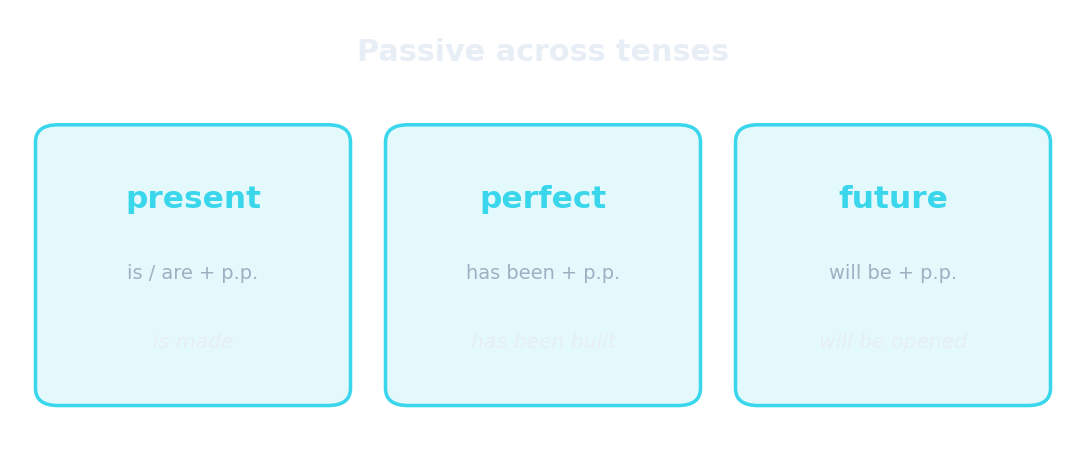
- The passive isn't only present and past — it works in every tense.
- Just change be; the past participle stays the same.
- It has been done. It will be done. It is being done.
The cake had been eaten before anyone admitted to seeing it.
Form across tenses
- Present perfect: has / have been + p.p. → The bridge has been repaired.
- Future: will be + p.p. → The work will be done soon.
- Modal: must / can be + p.p. → It must be finished today.
Same passive, four tenses
The passive follows every tense — only 'be' changes its form; the past participle never moves.
Choose the present perfect passive: The bridge ___.
Present perfect passive = has/have been + past participle.
Complete the future passive: The work will ___ done soon. (one word)
Future passive = will be + past participle: “will be done”.
Passive reporting (it is said that …)
- To report a general opinion without naming who: It is said / believed / thought that ….
- Or: subject + is said / believed to + verb.
- It is said that he is rich. = He is said to be rich.
Is “It is said that he is rich.” a correct passive reporting structure?
Yes — “It is said/believed/thought that …” reports an opinion impersonally.
Translate into English: 据说他很有钱。
Impersonal report → “It is said that he is very rich.”
Why use it
- Common in news and formal writing.
- It reports unconfirmed information objectively, without a source.
Common mistakes
- ❌ The bridge has repaired. → ✓ The bridge has been repaired. — don't drop been.
- ❌ The problem must be solve. → ✓ …must be solved. — modal + be + participle.
- ❌ He is said that he is rich. → ✓ It is said that he is rich. / He is said to be rich.
Match the tense to its passive shape.
be carries the tense; the participle never changes.
Complete with one word: The road is ___ repaired at the moment.
Continuous passive: is / are being + participle.
- Passive = be (any tense) + past participle.
- Perfect: has been + p.p.; future: will be + p.p.
- It is said that … reports an opinion impersonally.
Write one passive sentence using a perfect or future tense (for example: “… has been built”, “… will be opened”).
Example: “A new library has been built in our town.”