International Organisations
Introducido| English | Significado |
|---|---|
| United Nations/juːˈnaɪtɪd ˈneɪʃnz/ | The organisation founded in 1945 to maintain international peace. |
| veto/ˈviːtəʊ/ | The right to stop a decision alone; each permanent member of the UN Security Council has one. |
| peacekeeping | The use of international forces, usually from the UN, to keep peace between sides in a conflict. |
Fifty nations sign a charter, June 1945
- On 26 June 1945, delegates from 50 countries signed the Charter of the United Nations 联合国 in San Francisco, while war still raged in the Pacific. Its first line promised "to save succeeding generations from the scourge of war, which twice in our lifetime has brought untold sorrow to mankind". Today the UN has 193 member states.
- After 1945, new international organisations aimed to keep the peace and to help states cooperate.
The UN began with 50 signing countries and now has 193 members. How many more?
Dificultad 2/5 · 140 monedas + un pequeño bono en el primer intento de hoy
193 − 50.
Why 1945 succeeded where 1919 failed
- The League of Nations (1920) failed partly because the United States never joined and it had no army.
- The UN placed the great powers inside it: the US, the Soviet Union, Britain, France and China became permanent members of the Security Council, each with a veto 否决权.
Why was the UN designed with permanent Security Council members?
Dificultad 1/5 · 100 monedas + un pequeño bono en el primer intento de hoy
The League had failed without the US.
Cooperation is broader than peace
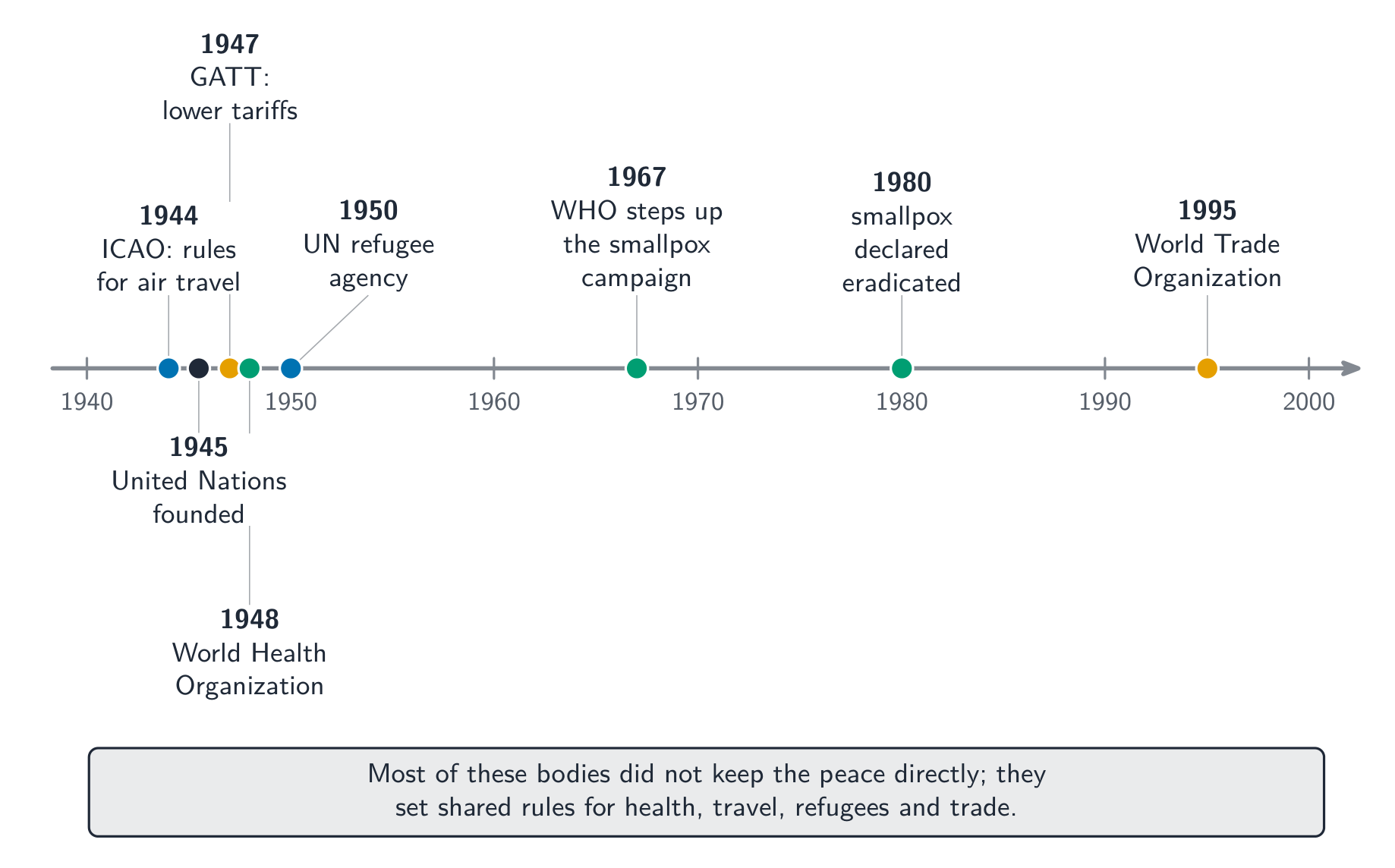
- Agencies such as the World Health Organization (1948), the International Civil Aviation Organization (1944) and the UN refugee agency (1950) set rules most people never notice.
- The WHO led the campaign that ended smallpox, declared eradicated in 1980.
Peace, cooperation, or the historian's caution?
Sort each element of this subtopic.
Match each agency to its work.
Dificultad 2/5 · 140 monedas + un pequeño bono en el primer intento de hoy
Cooperation beyond peace.
Worked example: one organisation, two goals
- Peace goal: UN peacekeeping 维和行动 forces were first sent to Egypt after the Suez crisis in 1956; by 2020, over 70 missions had been sent.
- Cooperation goal: the WHO's smallpox campaign (1967–80) vaccinated millions and ended a disease that killed about 300 million people in the 20th century.
- The caution: a stated goal is not the same as success — the Security Council veto often blocked action during the Cold War.
Match each example to its goal.
Dificultad 2/5 · 140 monedas + un pequeño bono en el primer intento de hoy
Stated goal and result.
Economic and regional organisations
- The IMF and World Bank (1944) and later the World Trade Organization (1995) set rules for money and trade.
- Regional groups formed too: the European Union, the African Union (2002) and ASEAN (1967).
Which are regional organisations?
Dificultad 2/5 · 140 monedas + un pequeño bono en el primer intento de hoy
The WHO is a UN agency.
How states' relations changed
- States gave up some independence in return for shared rules and markets.
- Non-governmental organisations, such as Doctors Without Borders, also became important actors.
The UN did not end war. Its stated goal was peace, but wars continued, and the veto often stopped the Security Council from acting.
The UN ended war after 1945.
Dificultad 1/5 · 100 monedas + un pequeño bono en el primer intento de hoy
Wars continued.
After two world wars, the UN (1945) placed the great powers inside a new organisation to keep peace, and agencies such as the WHO built cooperation in health, aviation and refugees. Economic and regional organisations followed. Stated goals, though, did not always become results.
Explain how international organisations changed relations between states after 1945.
Change.