The Global Economy Since 1900
Introducido| English | Significado |
|---|---|
| special economic zone | An area where a government gives foreign and private firms lower taxes and fewer rules to attract investment, as in Shenzhen from 1980. |
| economic liberalisation/ˌiːkəˈnɒmɪk ˌlɪbərəlaɪˈzeɪʃn/ | liberalización económica |
| supply chain/səˈplaɪ tʃeɪn/ | The chain of firms and countries that design, make, assemble and deliver the parts of a product. |
| knowledge economies/ˈnɒlɪdʒ ɪˈkɒnəmiz/ | economías basadas en el conocimiento |
A fishing border town becomes a zone, August 1980
- On 26 August 1980, China's national legislature approved a special economic zone 经济特区 at Shenzhen, a border area of about 300 000 people next to Hong Kong. Foreign firms could build factories there with low taxes and fewer rules. Factories, ports and towers followed; by 2020, Shenzhen had about 17 million people and was a world centre for electronics.
- After 1900, and especially after 1970, many states moved toward freer markets, and the world economy became more connected.
Shenzhen grew from about 300 000 to about 17 million people. About how many times larger? (whole number)
Dificultad 2/5 · 140 monedas + un pequeño bono en el primer intento de hoy
17 000 000 ÷ 300 000 ≈ 57.
A turn toward free markets
- Economic liberalisation 经济自由化 — lowering trade barriers, selling state firms and cutting regulation — spread from the 1970s.
- In the 1980s, Margaret Thatcher in Britain and Ronald Reagan in the US cut taxes and regulation; China under Deng Xiaoping opened to foreign trade from 1978.
Which are forms of economic liberalisation?
Dificultad 2/5 · 140 monedas + un pequeño bono en el primer intento de hoy
Nationalising is the opposite.
Two kinds of economy
- In the 20th century, planned economies (the Soviet Union, China before 1978) competed with market economies (the US, Western Europe, Japan).
- After 1991, most former communist states moved to market economies.
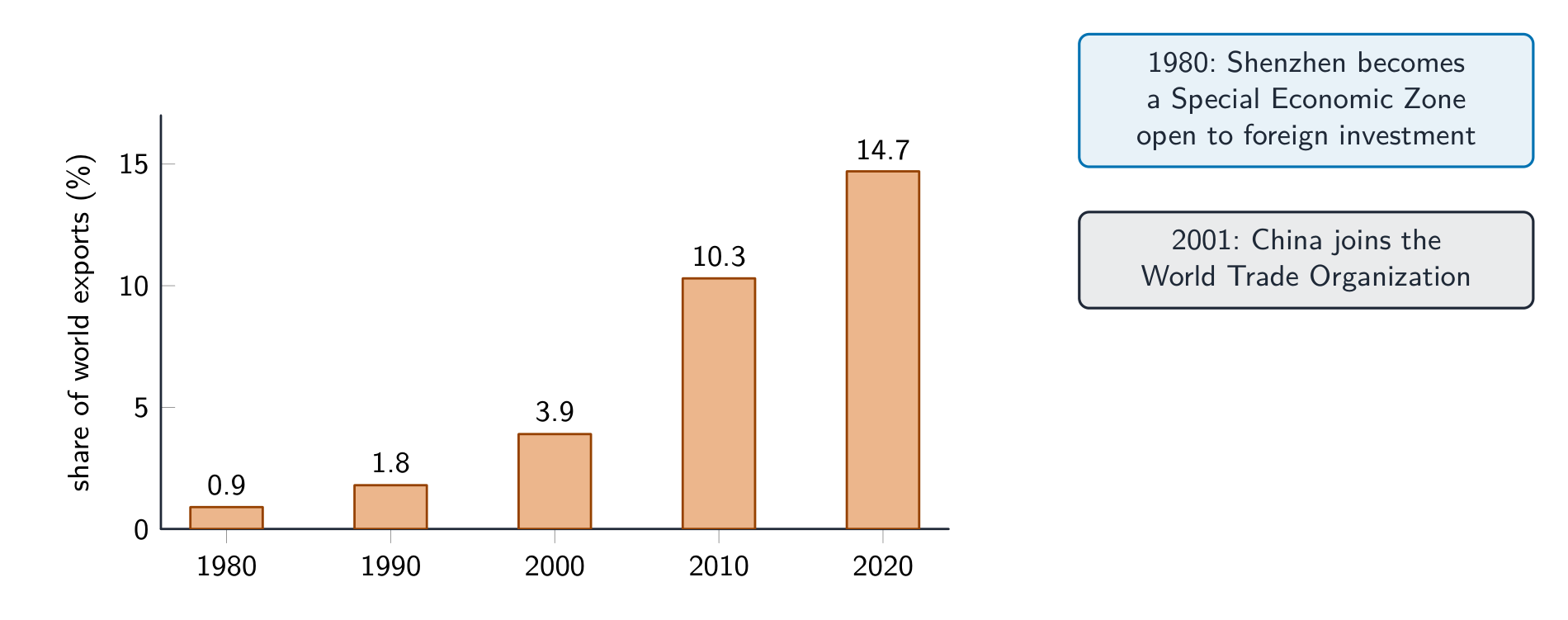
Follow the global economy since 1900
Free-market policy, communications technology and new institutions act together rather than in sequence.
Worked example: one phone, many countries
- Design: a smartphone is designed in one country, such as the United States or South Korea.
- Parts and assembly: chips come from Taiwan, screens from South Korea, and assembly happens in China or Vietnam.
- Why: lower trade barriers and cheap shipping in containers let firms split production — a supply chain 供应链 — across countries to cut costs.
Match each stage to a typical place.
Dificultad 2/5 · 140 monedas + un pequeño bono en el primer intento de hoy
A global supply chain.
Institutions carried the principles
- The World Trade Organization (1995) set trade rules for its members; China joined in 2001.
- Regional agreements such as NAFTA (1994) and the European single market (1993) lowered barriers further.
Put these in order.
Dificultad 3/5 · 200 monedas + un pequeño bono en el primer intento de hoy
1978, 1993, 1995, 2001.
Continuity as well as change
- Some states kept a large role in the economy, as China did with state-owned banks and firms.
- Rich countries shifted to knowledge economies 知识经济 based on services, finance and technology, while manufacturing moved to Asia.
What is a knowledge economy?
Dificultad 1/5 · 100 monedas + un pequeño bono en el primer intento de hoy
Rich countries shifted to them.
Liberalisation was not one single policy. It was a trend with different forms: Britain sold state firms, China opened special zones but kept state control of key industries.
All states liberalised in exactly the same way.
Dificultad 1/5 · 100 monedas + un pequeño bono en el primer intento de hoy
Forms differed.
After 1970, liberalisation spread: Thatcher and Reagan cut regulation, China opened zones like Shenzhen, and the WTO and regional agreements lowered barriers. Production split across countries into global supply chains, and rich countries moved to knowledge economies.
Explain how the global economy changed after 1970.
Change over time.