Weighing the Effects of Imperialism
Introducido| English | Significado |
|---|---|
| indentured labourers | indentured labourers |
| economic imperialism/ˌiːkəˈnɒmɪk ɪmˈpɪərɪəlɪzəm/ | The extension of a state's influence over another region through control of trade, investment or economic resources. |
Grain leaves a starving country, 1876–78
- In 1876 the monsoon rains failed in southern and western India. Millions of people starved, but grain was still shipped out of India and sold abroad, and the British government kept famine relief small to save money. Between 5 and 10 million people died.
- Imperialism had many effects. Some, like this famine, were deadly; others, like railways and new crops, lasted for generations. Historians must decide which mattered most.
During the Indian famine of 1876-78, grain was still shipped out of India.
Dificultad 1/5 · 100 monedas + un pequeño bono en el primer intento de hoy
Relief was kept small to save money.
Effects on colonised peoples
- Colonies were reshaped to export raw materials and food: cotton from India and Egypt, rubber from the Congo, cocoa from the Gold Coast.
- Colonial rule brought violence and loss of land, and new railways, schools and ports built mainly to serve the rulers.
Match each colony to its export.
Dificultad 2/5 · 140 monedas + un pequeño bono en el primer intento de hoy
Colonies were reshaped to export raw materials.
Migration on a new scale
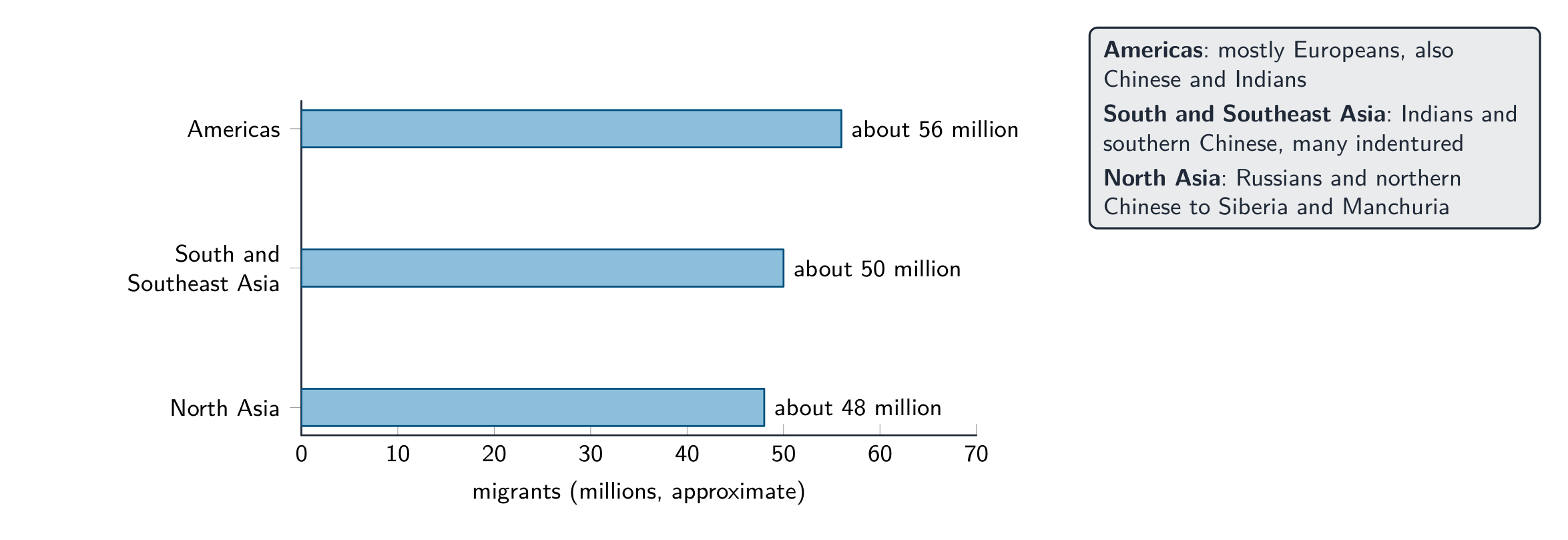
- Between about 1846 and 1940, over 150 million people moved: Europeans to the Americas, Indians and southern Chinese to Southeast Asia and around the Indian Ocean, and Russians and northern Chinese to Siberia and Manchuria.
- Many Asians went as indentured labourers 契约劳工: they signed contracts to work for years, often on plantations, in return for their passage.
Workers who signed contracts to work for years in return for their passage were called ____ labourers.
Dificultad 1/5 · 100 monedas + un pequeño bono en el primer intento de hoy
Many were Indian or Chinese.
Effects at home
- Industrial countries got cheap food and raw materials, and new markets for their factory goods; for some, living standards rose.
- Empire also shaped ideas: racist theories claimed Europeans had a right to rule others, while critics at home and in the colonies began to organise against empire.
Which were effects of empire on industrial countries?
Dificultad 2/5 · 140 monedas + un pequeño bono en el primer intento de hoy
China, not the imperial powers, lost tariff control.
Worked example: ranking with a criterion. "Measured by the number of people affected, migration was the most significant effect of imperialism: over 150 million people moved between 1846 and 1940, from Ireland to the Caribbean to Manchuria. Famines such as India's in 1876–78 killed millions, but in fewer places." The criterion — numbers affected — comes first, so the ranking is an argument, not an opinion.
What makes a ranking of effects an argument?
Dificultad 1/5 · 100 monedas + un pequeño bono en el primer intento de hoy
For example, the number of people affected.
Effects beyond colonies
- States that were never colonised were also changed: China lost control of its tariffs and ports after the Opium Wars, and foreign banks financed Latin American railways and mines.
- This economic imperialism 经济帝国主义 shaped countries that kept their own governments.
Where was the effect felt?
Sort each effect of imperialism by where it was felt most.
Imperialism changed only places that became colonies.
Dificultad 1/5 · 100 monedas + un pequeño bono en el primer intento de hoy
Economic imperialism shaped independent states too.
"Relative significance" means compare and rank. A list of effects is not enough. Choose a criterion — how many people, how long it lasted, how hard it was to reverse — and say which effect was greater and why.
What does a "relative significance" question ask you to do?
Dificultad 1/5 · 100 monedas + un pequeño bono en el primer intento de hoy
Rank with a reason.
Imperialism from 1750 to 1900 reshaped colonies into exporters of raw materials, brought violence and famine, moved over 150 million migrants, enriched industrial countries and changed even uncolonised states through economic imperialism. To judge relative significance, choose a criterion such as numbers affected or how long an effect lasted, then rank.
Evaluate the relative significance of the effects of imperialism, 1750-1900.
Criterion first, then rank.