Empires Give Way
Introducido| English | Significado |
|---|---|
| abdication | The act of a ruler formally giving up the throne. |
A six-year-old emperor gives up the throne, February 1912
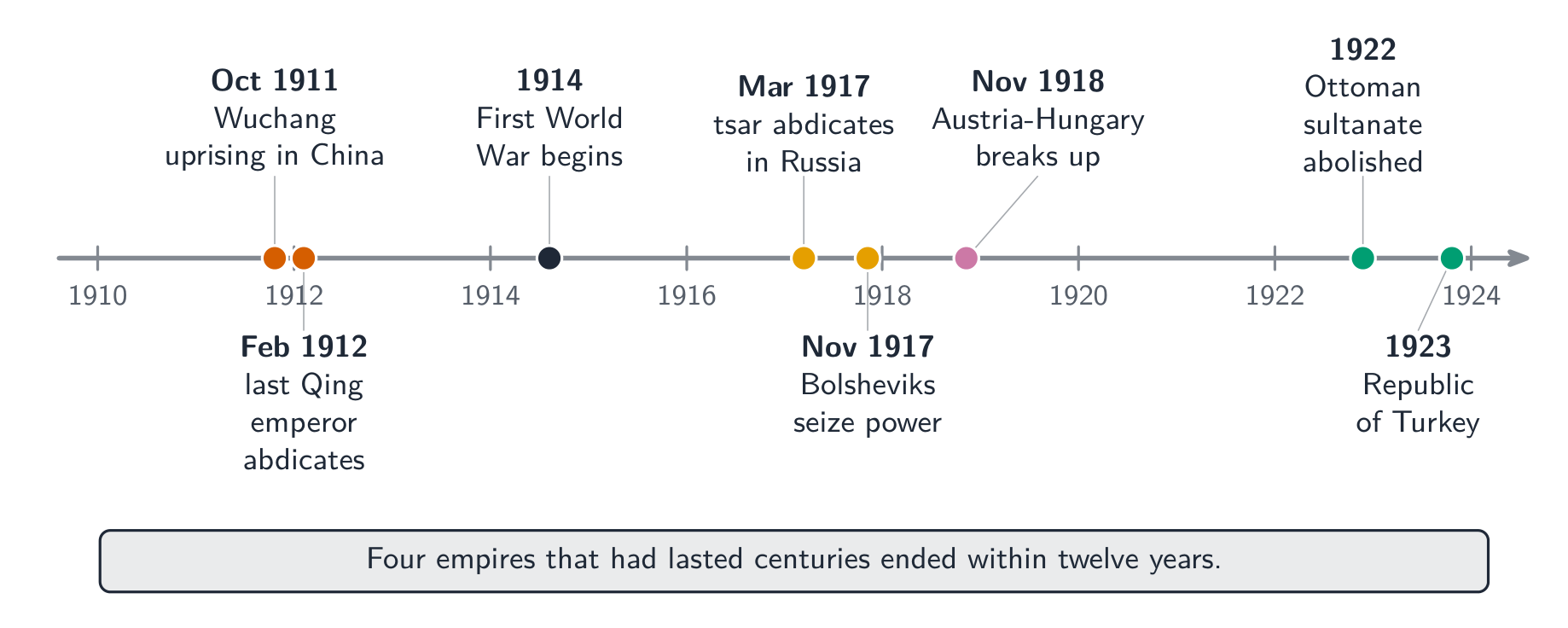
- On 10 October 1911, army units in Wuchang rose against the Qing dynasty. Province after province declared independence. On 12 February 1912, the Empress Dowager Longyu announced the abdication 退位 of the six-year-old emperor Puyi. More than 2000 years of imperial rule in China ended, and the Republic of China took its place.
- From 1900, old land empires collapsed under pressure from inside and outside.
The Wuchang Uprising began in October 1911 and Puyi abdicated in February 1912. About how many months later?
Dificultad 2/5 · 140 monedas + un pequeño bono en el primer intento de hoy
October to February.
A century of change
- In 1900, Western states dominated world politics, and large land empires still ruled much of Eurasia.
- By the end of the century, those empires had given way to many new states.
Three land empires collapsed
- The Qing dynasty in China (1912), the Ottoman Empire (1922) and the Russian Empire (1917).
- Austria-Hungary also broke apart in 1918.
Internal factor, external factor, or the frame?
Sort each item in the collapse of the old order.
Put the collapses in order.
Dificultad 3/5 · 200 monedas + un pequeño bono en el primer intento de hoy
1912, 1917, 1918, 1922.
Worked example: the end of the Qing
- External: defeats by Britain, France and Japan (1895), and the indemnity imposed after the Boxer Rebellion (1901) — about 450 million taels of silver — weakened the state.
- Internal: reformers and revolutionaries such as Sun Yat-sen argued over how to change China; provincial elites lost faith in the court.
- Combination: no single pressure was fatal, but together they ended the dynasty in 1912.
What was imposed on the Qing after the Boxer Rebellion?
Dificultad 1/5 · 100 monedas + un pequeño bono en el primer intento de hoy
An external pressure.
The Ottoman and Russian cases
- Ottoman: lost land in the Balkans and Africa; the Young Turks seized power in 1908; defeat in World War I ended the empire, and Atatürk founded Turkey in 1923.
- Russia: defeat by Japan (1905), revolution in 1905 and heavy losses in World War I led to the revolutions of 1917.
Challenges from many directions
- Nationalist movements within empires — Arabs, Armenians, Poles, Finns — demanded their own states.
- Foreign loans and debts gave outside powers control over finances.
Match each to its category.
Dificultad 2/5 · 140 monedas + un pequeño bono en el primer intento de hoy
Internal, external, frame.
Which peoples demanded their own states within old empires?
Dificultad 2/5 · 140 monedas + un pequeño bono en el primer intento de hoy
Nationalist movements.
These empires did not fall from one cause. Each faced both internal problems and external defeats; the combination made collapse likely.
Each empire fell from one single cause.
Dificultad 1/5 · 100 monedas + un pequeño bono en el primer intento de hoy
A combination.
From 1900, the Qing (1912), Russian (1917) and Ottoman (1922) empires collapsed. Each faced external defeat and debt and internal reform struggles and nationalist movements — survivable alone, fatal together.
Explain the internal and external causes of the end of the Qing dynasty.
Causation.