Diversity, Elites and Social Categories
Introducido| English | Significado |
|---|---|
| accommodate | To make room for different groups or needs, for example by letting minorities keep their own religion. |
| Casta system/ˈkæstə ˈsɪstəm/ | The system in Spanish America that ranked people by birth and ancestry, with Spanish-born people at the top. |
Expelled by one ruler, welcomed by another, 1492
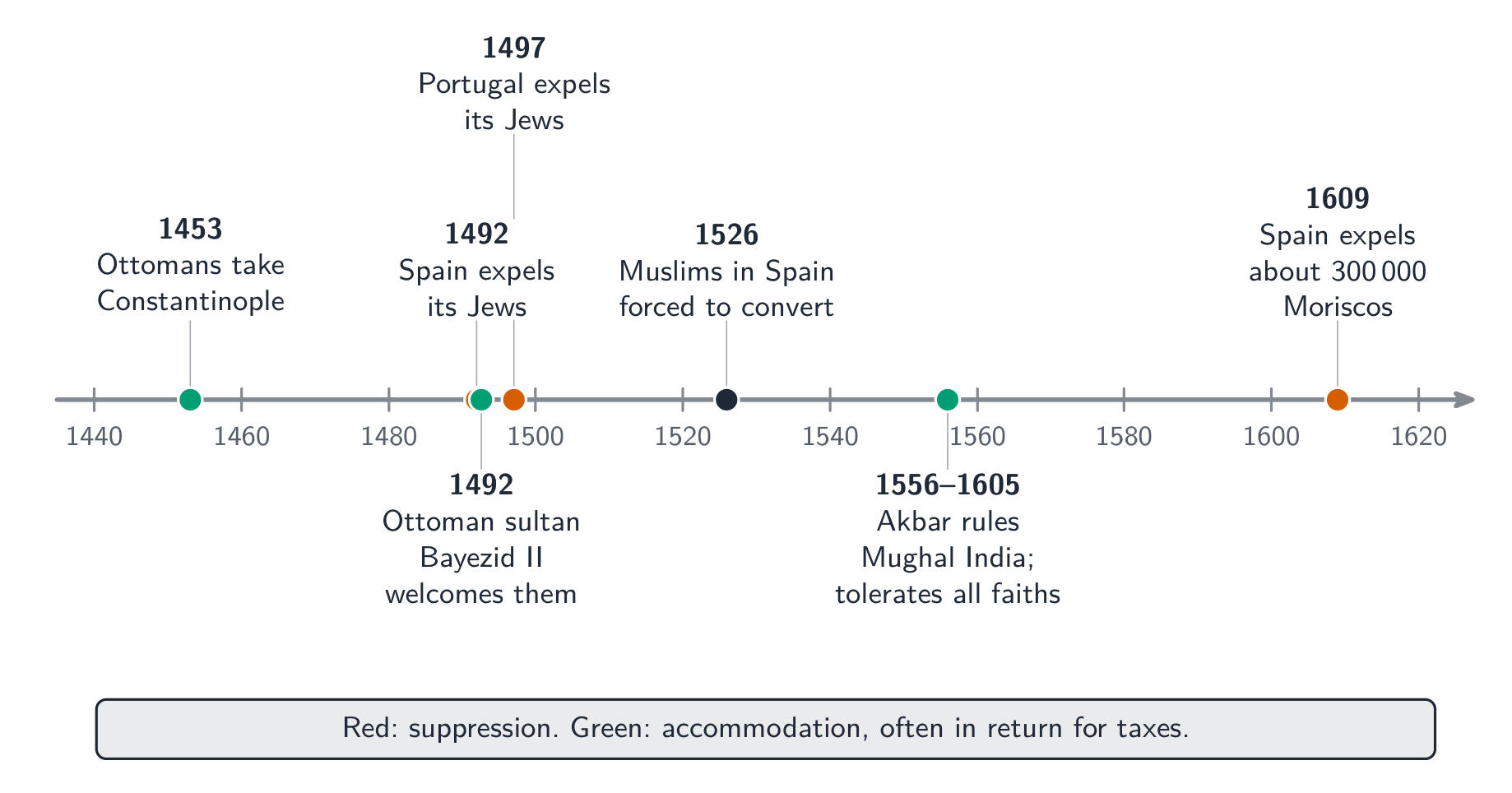
- On 31 March 1492, Ferdinand and Isabella of Spain ordered all Jews to convert to Christianity or leave by the end of July. Tens of thousands left. The Ottoman sultan Bayezid II sent ships to carry many of them to his empire; he is said to have remarked that Ferdinand had made his own country poorer and the sultan's richer. Jewish communities in Istanbul and Salonica grew and flourished.
- From 1450 to 1750, states chose either to use their people's diversity or to suppress it — and new elites rose while old ones fell.
How did the Ottoman sultan respond to Spain's expulsion of Jews in 1492?
Dificultad 1/5 · 100 monedas + un pequeño bono en el primer intento de hoy
Bayezid II welcomed them.
Accommodation or suppression
- Some states chose to accommodate 包容 diverse groups, using their skills, money and loyalty.
- Others suppressed or expelled groups to create religious or ethnic unity.
Two states, opposite decisions
- The Ottomans let Jews and Christians keep their religion and law in communities called millets, in return for taxes.
- Spain and Portugal expelled Jews (1492, 1497) and later Muslims (1609), losing many skilled people.
Accommodation, suppression, or a new elite?
Sort each policy or development.
What were Ottoman millets?
Dificultad 1/5 · 100 monedas + un pequeño bono en el primer intento de hoy
Accommodation.
Worked example: the Mughals and the Qing
- Mughals: Emperor Akbar (1556–1605), a Muslim ruler, made many Hindu Rajput nobles his generals and officials, and ended a tax on non-Muslims.
- Qing: the Manchu rulers of China kept power by separating Manchus from Han Chinese; Han men had to wear the Manchu queue hairstyle on pain of death.
- Comparison: both were ruled by a minority; Akbar accommodated the majority, while the Qing combined using Han officials with limits on them.
Akbar ruled from 1556 to 1605. How many years?
Dificultad 2/5 · 140 monedas + un pequeño bono en el primer intento de hoy
1605 − 1556.
New elites appeared
- In the Spanish Americas, the Casta system 种姓制度 ranked people by birth: Spanish-born peninsulares at the top, then American-born creoles, then mixed-race people, Native Americans and Africans.
- The Qing transition created a new Manchu elite above the old Ming officials.
Put the casta ranks in order from top to bottom.
Dificultad 3/5 · 200 monedas + un pequeño bono en el primer intento de hoy
Ranked by birth.
Old elites rose and fell
- In Russia, the old boyars lost power to nobles who served the tsar.
- In Europe, merchants gained wealth and status, while some old nobles declined.
Match each to its category.
Dificultad 2/5 · 140 monedas + un pequeño bono en el primer intento de hoy
Three categories.
Tolerance in the Ottoman Empire did not mean equality. Non-Muslims paid extra taxes and had fewer rights, but they could keep their religion and community.
Ottoman tolerance meant full equality for non-Muslims.
Dificultad 1/5 · 100 monedas + un pequeño bono en el primer intento de hoy
Extra taxes and fewer rights.
From 1450 to 1750, the Ottomans and Akbar's Mughals used diversity, while Spain expelled Jews and the Qing limited Han Chinese. New hierarchies, such as the casta system and the Manchu elite, formed as old elites rose and fell.
Compare how two states treated religious or ethnic diversity between 1450 and 1750.
Comparison.