Environmental Consequences
Introducido| English | Significado |
|---|---|
| Black Death/blæk deθ/ | The fourteenth-century plague that killed a huge share of Eurasia's population. |
| bananas | bananas |
| Champa rice/ˈtʃæmpə raɪs/ | A fast-ripening rice from Vietnam that raised harvests in Song China. |
A siege and a sickness, Caffa 1346
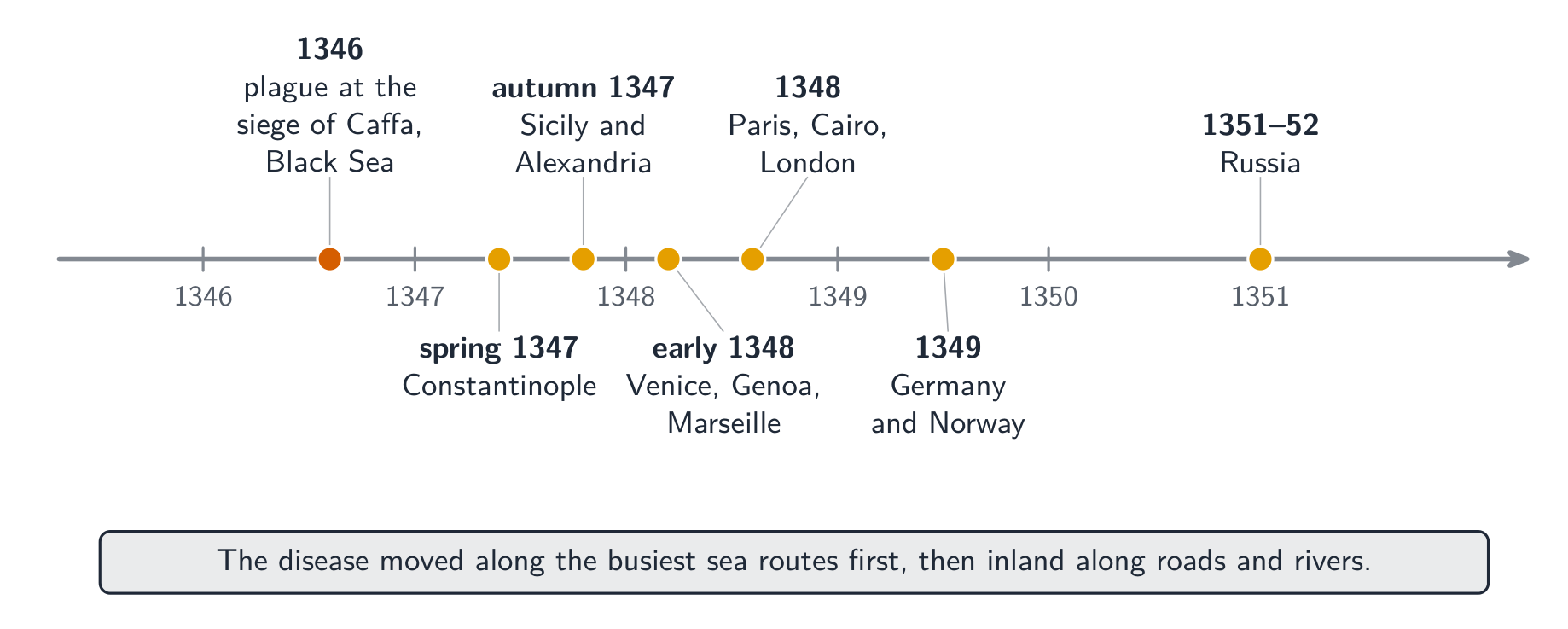
- In 1346 a Mongol army besieged Caffa, a trading port on the Black Sea run by merchants from Genoa. Plague broke out among the soldiers. Italian ships leaving Caffa carried the disease to Constantinople and then to Sicily in October 1347.
- Within five years the Black Death 黑死病 had killed perhaps a third or more of the people of Europe, the Middle East and North Africa.
How did the plague reach Sicily in 1347?
Dificultad 1/5 · 100 monedas + un pequeño bono en el primer intento de hoy
Genoese ships left Caffa carrying it.
Diseases travel with trade
- The plague bacterium lived in fleas on rats and other rodents. Caravans and ships carried the animals, the fleas and sick people along the same routes as silk and spices.
- The busier the route, the faster the disease spread. Ports and caravan cities were hit first and hardest.
The plague bacterium was carried by fleas on rats and other rodents.
Dificultad 1/5 · 100 monedas + un pequeño bono en el primer intento de hoy
Ships and caravans carried them along the trade routes.
How far it reached
- It reached Constantinople and Alexandria in 1347, then Italy, France, Cairo and England in 1348, and Scandinavia and Russia by 1351. Cairo may have lost a third of its people.
- Some places suffered less, and the disease came back many times over the next three centuries.
Put the plague's arrival in order.
Dificultad 3/5 · 200 monedas + un pequeño bono en el primer intento de hoy
1346, 1347, 1348, about 1351.
Crops travelled too
- The same networks spread useful crops. Bananas 香蕉, from Southeast Asia, became a key food in East and Central Africa. Fast-ripening Champa rice 占城稻 from Vietnam let farmers in China grow two crops a year.
- Muslim farmers and traders carried citrus fruits, sugar cane and cotton westward to the Mediterranean.
Fast-ripening ____ rice let Chinese farmers grow two crops a year.
Dificultad 1/5 · 100 monedas + un pequeño bono en el primer intento de hoy
It came from Vietnam.
Worked example: one cause, opposite effects. Busy trade routes connected Afro-Eurasia (cause). They carried Champa rice, which helped China's population grow (positive effect). They also carried the plague, which made Europe's population fall by about a third (negative effect). A strong answer shows that the same connection produced both effects.
What did the spread of Champa rice and of the plague have in common?
Dificultad 1/5 · 100 monedas + un pequeño bono en el primer intento de hoy
One connection, opposite effects.
After the plague
- With so many workers dead, survivors in western Europe could demand higher wages, and serfdom weakened there. Rulers tried to fix wages by law, and peasants rebelled in France (1358) and England (1381).
- Some people blamed outsiders: Jewish communities in many European towns were attacked and murdered.
Benefit or harm?
Sort what the trade routes spread.
What happened in western Europe after the plague?
Dificultad 2/5 · 140 monedas + un pequeño bono en el primer intento de hoy
Population took over a century to recover.
Do not treat the plague and the trade boom as separate stories. The plague spread so fast because trade networks were so busy. Name the route or city in your answer, and link the disease to the connection that carried it.
The plague spread fast because trade networks were busy.
Dificultad 1/5 · 100 monedas + un pequeño bono en el primer intento de hoy
The disease used the same routes as the goods.
Trade routes spread crops and diseases as well as goods. Bananas, Champa rice and citrus spread to new regions and fed more people. The same routes carried the Black Death from the Black Sea in 1346 across Afro-Eurasia, killing perhaps a third of Europe's people, raising wages and weakening serfdom in the west.
Explain the environmental effects of trade networks in Afro-Eurasia, 1200-1450.
Show that the same networks did both.