Comparing the Networks
Introducido| English | Significado |
|---|---|
| Silk Roads/sɪlk rəʊdz/ | The overland routes that carried goods and ideas between East Asia and the Mediterranean. |
| monsoon | monsoon |
Chinese porcelain at Great Zimbabwe
- Great Zimbabwe, in southern Africa, was a stone city of perhaps 10 000 people at its height in the 1300s. Its rulers grew rich by sending gold to the coast. In its ruins, archaeologists found pottery from China and Persia and glass beads from India.
- Goods from three continents reached an inland African city because the world's trade networks were connected.
What did archaeologists find at Great Zimbabwe?
Dificultad 1/5 · 100 monedas + un pequeño bono en el primer intento de hoy
Evidence of connected trade networks.
Three networks
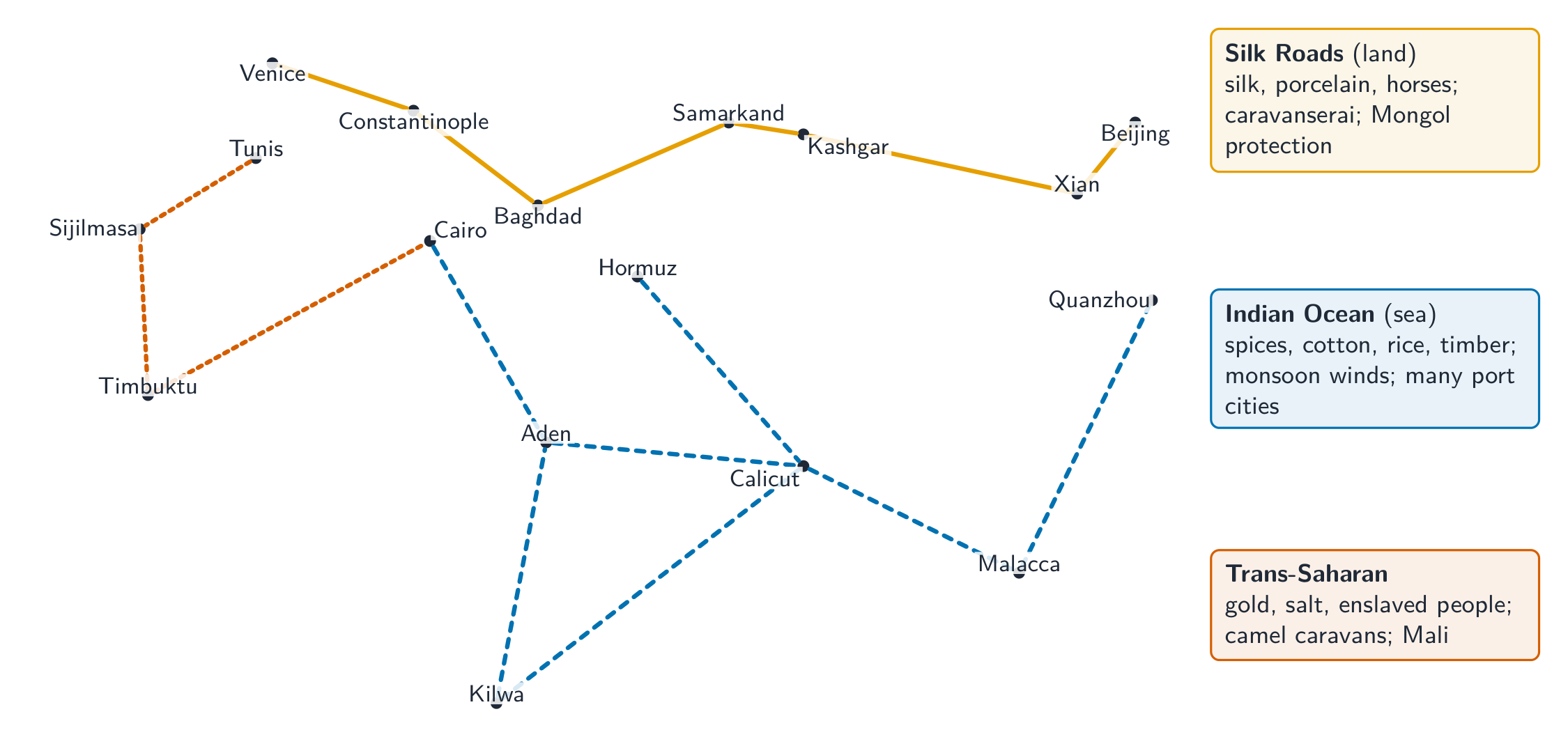
- The Silk Roads 丝绸之路: land routes across Central Asia between China, Persia and the Mediterranean.
- The Indian Ocean network: sea routes linking East Africa, Arabia, India, Southeast Asia and China. The trans-Saharan routes: camel caravans between North and West Africa.
Match each network to where it ran.
Dificultad 2/5 · 140 monedas + un pequeño bono en el primer intento de hoy
Three routes, all connected.
What they shared
- All three grew because of better technology and business methods: the compass and larger ships at sea, camel saddles in the desert, and caravanserai (inns for merchants), paper money and credit on land.
- All three made the cities and states on them rich, and all three carried religions, technologies, crops and diseases as well as goods.
What did all three networks share?
Dificultad 2/5 · 140 monedas + un pequeño bono en el primer intento de hoy
Only the Silk Roads had Mongol protection.
How they differed
- Environment: steppe and mountains, open sea with seasonal monsoon 季风 winds, or desert.
- Goods: the Silk Roads carried mostly light luxuries such as silk and porcelain; Indian Ocean ships could carry bulk goods such as rice, timber and cotton cloth; the Sahara carried gold and salt.
The seasonal winds of the Indian Ocean are called the ____.
Dificultad 1/5 · 100 monedas + un pequeño bono en el primer intento de hoy
They blew one way in summer and the other in winter.
Worked example: comparing on one question. Ask the same question of two networks: who protected the trade? On the Silk Roads, the Mongol Empire (1200s–1300s) kept one set of rules from China to Persia, so trade grew safer. In the Indian Ocean, no single empire ruled the sea, and many port cities competed for merchants. Same question, different answers: that is a comparison.
One empire controlled the whole Indian Ocean.
Dificultad 1/5 · 100 monedas + un pequeño bono en el primer intento de hoy
Many port cities competed instead.
Sea trade could carry more
- A large Chinese junk could carry hundreds of tonnes, far more than a caravan of camels. That is why the Indian Ocean carried everyday goods for whole populations, not only luxuries for the rich.
- The monsoon winds blew one way in summer and the other in winter, so merchants waited in port cities and built communities there, as Arab and Persian merchants did in East Africa and India.
Which network?
Sort each feature by the network it describes.
Why could the Indian Ocean carry everyday goods such as rice?
Dificultad 1/5 · 100 monedas + un pequeño bono en el primer intento de hoy
A large junk carried hundreds of tonnes.
A comparison needs both similarities and differences, linked by the same question. Describing one network and then another is not a comparison. Use words such as "both", "whereas" and "unlike".
Describing one network and then another is enough for a comparison.
Dificultad 1/5 · 100 monedas + un pequeño bono en el primer intento de hoy
Ask the same question of both and link them.
From about 1200 to 1450, the Silk Roads, the Indian Ocean and the trans-Saharan routes all grew through better technology, enriched the states on them and spread religions, crops and diseases. They differed in environment, in goods and in who protected them: the Mongols on the Silk Roads, competing port cities in the Indian Ocean, and Mali in the Sahara.
Compare the Silk Roads and the Indian Ocean network, 1200-1450.
Ask the same question of both.