Dar al-Islam After the Abbasids
Introducido| English | Significado |
|---|---|
| Abbasid Caliphate/ˈæbeɪsɪd ˈkælɪfeɪt/ | The Islamic empire, centred on Baghdad, that flourished as a centre of learning. |
| Turkic/ˈtɜːkɪk/ | Turkic |
| Seljuks | Seljuks |
| Mamluks | Mamluks |
| Sufis/ˈsjuːfiz/ | suñíes |
An observatory after a disaster, 1259
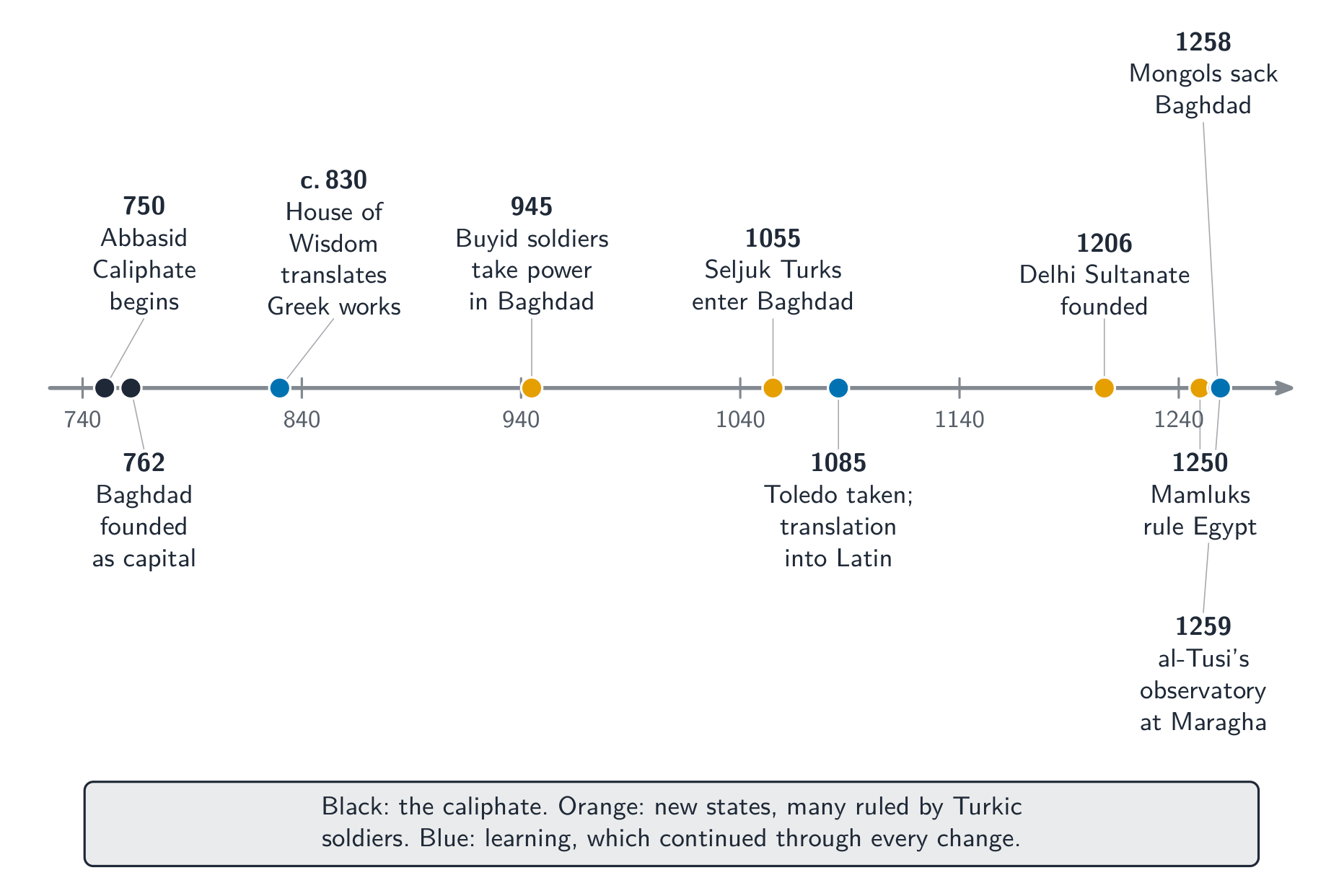
- In 1258 a Mongol army sacked Baghdad, the capital of the Abbasid caliphs for five hundred years. The last caliph was killed, and the city's libraries were destroyed.
- A year later, the Mongol ruler Hülegü paid the Persian scholar Nasir al-Din al-Tusi to build a great observatory at Maragha. Islamic learning survived the fall of the caliphate that had sponsored it.
Who paid for al-Tusi's observatory at Maragha?
Dificultad 1/5 · 100 monedas + un pequeño bono en el primer intento de hoy
A year after the Mongols sacked Baghdad.
One caliphate becomes many states
- The Abbasid Caliphate 阿拔斯哈里发国 (750–1258) ruled from Baghdad, but from the 900s local governors and soldiers took real power, and the caliph kept mostly religious authority.
- New states arose, many ruled by Turkic 突厥 peoples who had come as soldiers: the Seljuks 塞尔柱人 took Baghdad in 1055, the Mamluks 马穆鲁克 ruled Egypt from 1250, and the Delhi Sultanate ruled northern India from 1206.
Match each state to where it ruled.
Dificultad 2/5 · 140 monedas + un pequeño bono en el primer intento de hoy
Many of their rulers were Turkic.
Rule spread by conquest
- Muslim states expanded by war: the Seljuks defeated the Byzantines at Manzikert (1071), and the Delhi sultans conquered most of northern India.
- Conquest did not mean everyone converted. Most people in northern India stayed Hindu, and non-Muslims paid a special tax.
When Muslim states conquered northern India, most people there became Muslim.
Dificultad 1/5 · 100 monedas + un pequeño bono en el primer intento de hoy
Most stayed Hindu and paid a special tax.
Faith spread by contact
- Islam spread more slowly and more widely through merchants, missionaries and Sufis 苏非派 — Muslim mystics who taught through poetry, music and the shrines of saints.
- Merchants carried Islam along the Indian Ocean to East Africa and Southeast Asia, and across the Sahara to West Africa, places no Muslim army conquered.
Muslim mystics who taught through poetry, music and saints' shrines are called ____.
Dificultad 1/5 · 100 monedas + un pequeño bono en el primer intento de hoy
They spread Islam where no army went.
Worked example: innovation or transfer? In Abbasid Baghdad, the House of Wisdom translated Greek works by Aristotle and Euclid into Arabic: that is a transfer of knowledge. In Maragha, al-Tusi improved the mathematical model of the planets: that is an innovation, new knowledge. A good answer separates the two and gives an example of each.
Translating Euclid into Arabic at the House of Wisdom is an example of...
Dificultad 1/5 · 100 monedas + un pequeño bono en el primer intento de hoy
Knowledge moved, not made.
Learning moved west
- In Muslim Spain, cities such as Córdoba and Toledo had large libraries. After Christians took Toledo in 1085, scholars there translated Arabic works into Latin.
- European universities later studied Ibn Sina's Canon of Medicine and Ibn Rushd's commentaries on Aristotle.
Conquest or contact?
Sort how Muslim rule or Islam reached each place.
Scholars in Toledo translated Arabic works into Latin.
Dificultad 1/5 · 100 monedas + un pequeño bono en el primer intento de hoy
After Christians took the city in 1085.
Political breakup did not mean cultural decline. The caliphate lost power from the 900s, but trade, cities and scholarship kept growing under the new states. Do not confuse the end of one political authority with the end of a civilisation.
What happened to trade and learning as the caliphate broke up?
Dificultad 1/5 · 100 monedas + un pequeño bono en el primer intento de hoy
Political breakup is not cultural decline.
From the 900s the Abbasid Caliphate broke into many states, often ruled by Turkic peoples such as the Seljuks and Mamluks, until the Mongols sacked Baghdad in 1258. Muslim rule spread by conquest, but Islam itself spread mostly through merchants, missionaries and Sufis. Muslim states supported both the transfer of Greek learning and new discoveries, which later reached Europe.
Explain how Islam and Muslim states changed between 1200 and 1450.
Change in politics, continuity in culture.