South and Southeast Asia
Introducido| English | Significado |
|---|---|
| Buddhist monasticism/ˈbʊdɪst məˈnæstɪsɪzəm/ | Communities of monks — spread learning across the region. |
| Bhakti movement/ˈbʌkti ˈmuːvmənt/ | A Hindu movement that taught personal, loving devotion to a god, open to people of every caste and to women. |
| Sufism/ˈsjuːfɪzəm/ | suñismo |
A navy strikes across the sea, 1025
- In 1025, King Rajendra I of the Chola dynasty in southern India sent a fleet across the Bay of Bengal against Srivijaya, the trading kingdom that controlled the Strait of Malacca. Chola inscriptions list about 14 ports his forces attacked, including Srivijaya's capital. Srivijaya grew rich by taxing ships that passed through the strait; the Chola wanted that trade for their own merchants.
- From 1200 to 1450, Hinduism, Buddhism and Islam shaped states in South and Southeast Asia, which drew power from either the sea or the land.
Why did the Chola attack Srivijaya in 1025?
Dificultad 1/5 · 100 monedas + un pequeño bono en el primer intento de hoy
Control of a sea route.
Three faiths in one region
- Hinduism and Buddhism spread from India to Southeast Asia, and Islam arrived with merchants and the Delhi Sultanate (from 1206).
- Buddhist monasticism 佛教僧侣制度 — communities of monks — spread learning across the region.
The Delhi Sultanate began in 1206 and the Chola raid was in 1025. How many years apart?
Dificultad 2/5 · 140 monedas + un pequeño bono en el primer intento de hoy
1206 − 1025.
Devotion beyond hierarchy
- The Bhakti movement 虔信运动 taught personal devotion to a Hindu god, open to all castes and to women.
- Sufism 苏非主义, a mystical form of Islam, spread through poetry, music and saints' shrines, and won many converts.
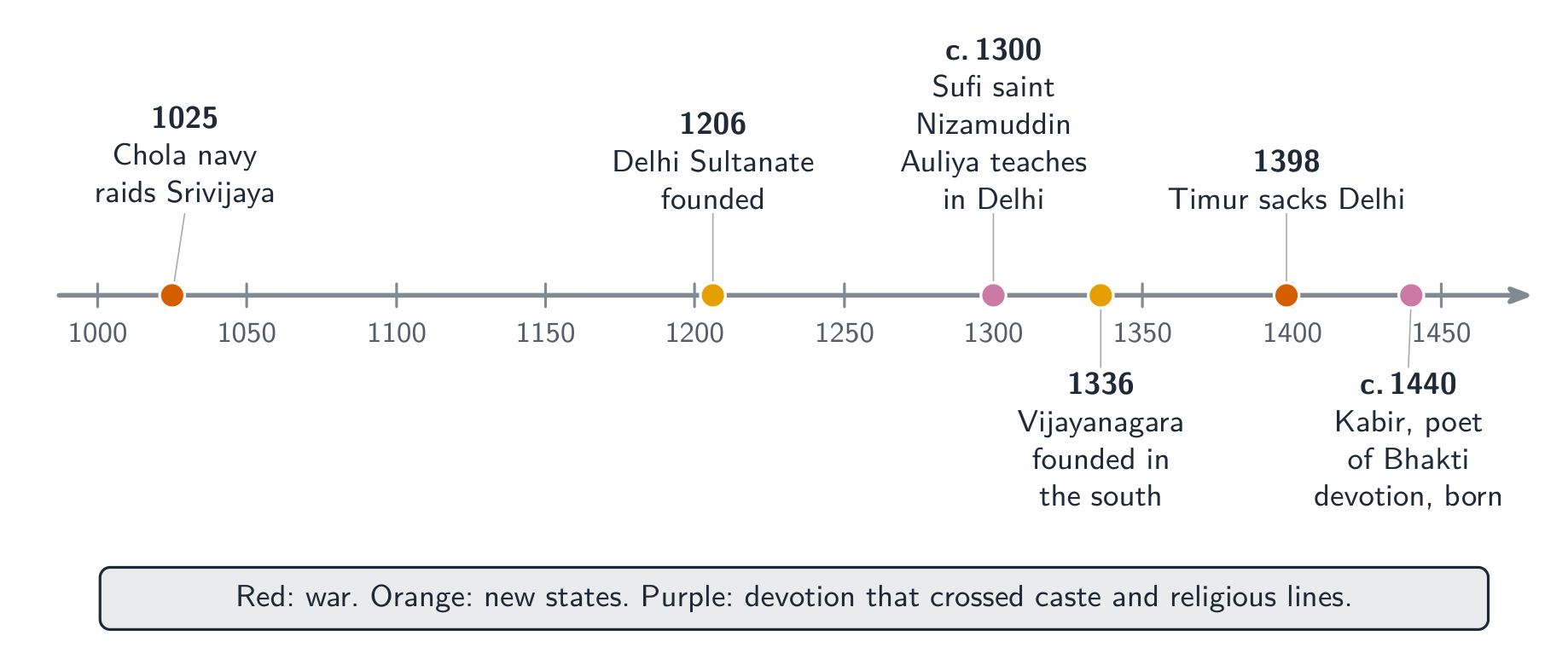
Follow a belief system along a trade route
Conversion that follows a merchant leaves different evidence from conversion that follows an army.
Match each movement to its religion.
Dificultad 2/5 · 140 monedas + un pequeño bono en el primer intento de hoy
Three faiths.
Why was the Bhakti movement important?
Dificultad 1/5 · 100 monedas + un pequeño bono en el primer intento de hoy
Devotion beyond hierarchy.
Worked example: Srivijaya taxing sea trade
- Place: Srivijaya, on Sumatra, controlled the Strait of Malacca between the Indian Ocean and the South China Sea.
- Method: it made ships stop at its ports and pay fees; it used its navy against pirates and rivals.
- Result: trade, not farmland, was its main source of wealth — a sea state — and it supported Buddhist learning; the Chinese monk Yijing studied there in the 7th century.
Land states
- The Khmer Empire built Angkor Wat (12th century) and drew wealth from rice farming, using huge reservoirs.
- The Majapahit kingdom on Java (from 1293) combined rice farming with trade.
Match each state to its main source of power.
Dificultad 2/5 · 140 monedas + un pequeño bono en el primer intento de hoy
Sea states and land states.
Using this in an answer
- Ask where a state's power came from: control of a sea route or control of farmland.
- Then link religion to the state: Angkor Wat was first a Hindu temple, later Buddhist.
Religions did not replace each other cleanly. Hindu, Buddhist and Muslim traditions often lived side by side and mixed in the same kingdoms.
In Southeast Asia, each religion fully replaced the one before.
Dificultad 1/5 · 100 monedas + un pequeño bono en el primer intento de hoy
They often lived side by side.
From 1200 to 1450, Hinduism, Buddhism and Islam — through Bhakti, Sufism and monasteries — shaped South and Southeast Asia. Sea states like Srivijaya taxed trade through the Strait of Malacca, while land states like the Khmer drew wealth from rice.
Compare the sources of power of Srivijaya and the Khmer Empire.
Comparison.